
You already know hustle culture is exhausting. What you may not know is that the moment you start earning from a hobby you love, a documented psychological law — the Overjustification Effect — begins cannibalising your enjoyment of it. The pie tastes less sweet when its flavour is tied to your ability to pay rent. And the most radical thing you can do in 2026 is simply refuse to sell a ticket to the show.
 Brajesh Mishra
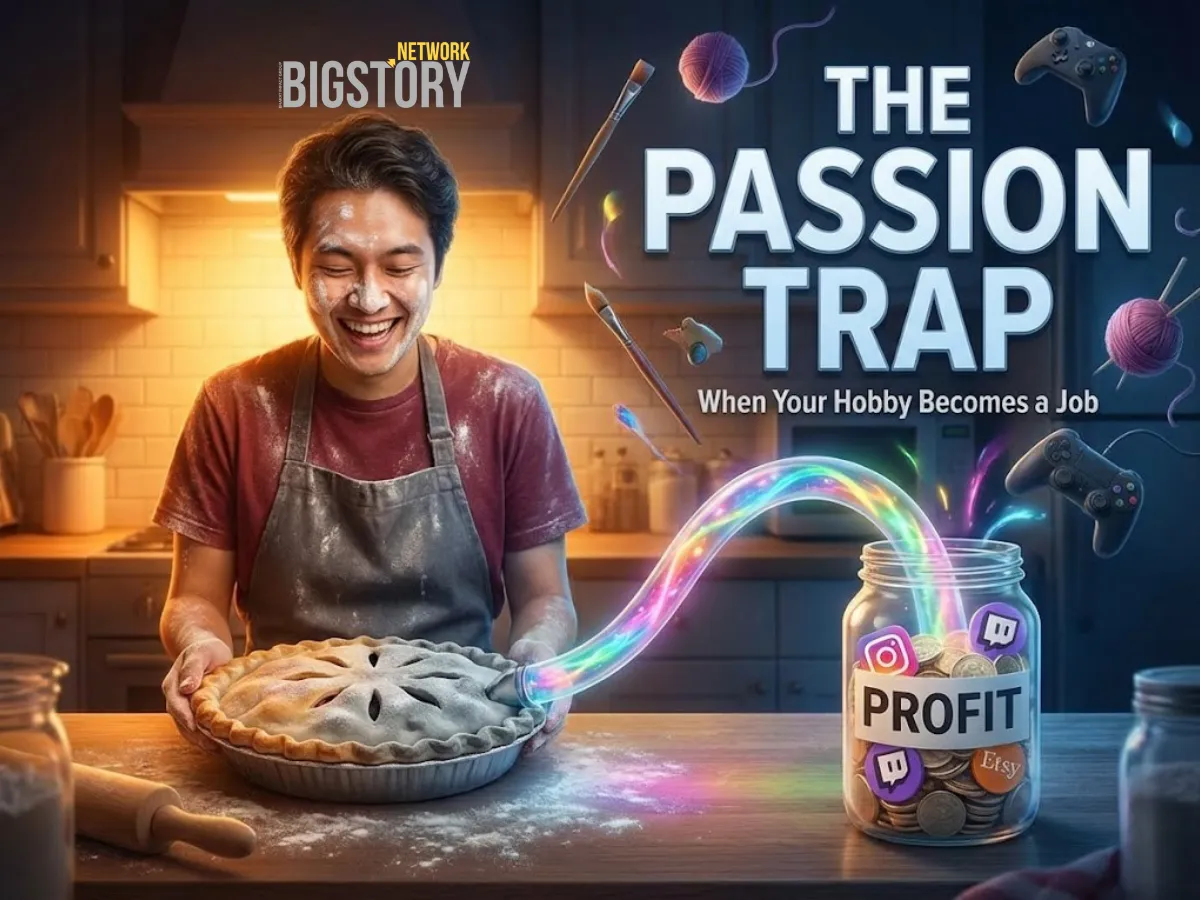
Imagine yourself vibing in your kitchen on a wonderful Sunday afternoon. You have spent three hours baking a salted caramel apple pie from scratch. It is messy, imperfect, and delicious. You put it on the table, and your friend takes a bite. Their eyes light up.
Then, they say: “Omg, this is amazing. You should sell these!”
A sentence that would generally mean as a compliment, but in 2026, it is an insult.
It implies that the act of baking, of creating something solely for the pleasure of it, is a waste of an asset. Why just eat the pie when you could monetize the pie?
This is the “Etsy Reflex.” Somewhere in today’s time, we have internalized the idea that leisure is only valuable if it generates an ROI (Return on Investment).
And the data confirms this cultural sickness. According to a 2025 workforce survey, 43% of Gen Z now have a second income stream. In India, the "gig economy" workforce has tripled. Globally, millions have turned their living rooms into factory floors. We have killed the “Amateur”: the person who does something purely for the love (amator) of it and replaced them with the “Global Hustler.”
The biggest engine of this anxiety is the global "Creator Economy." We are continuosly sold a lie that “Anyone can be a Creator.” We are told that if we just post enough, grind enough, and “build a personal brand,” we can escape the 9-to-5.
But let’s look at the brutal math of the Global Platform Economy in 2025.
The 4% Rule Despite the flashy headlines of teenagers making millions on TikTok, the reality is a statistical lottery.
Remember when gaming was just a sweet escape? You'd clock out of work, grab a controller, and just blast some aliens to chill out. Well, for millions of guys worldwide—from Seoul to San Francisco, that's totally different now. Gaming is the job. The big pressure these days is that if you're playing but not streaming it, you're basically "wasting perfectly good content."
To earn that $200/month, the average “aspirational streamer” spends 10–20 hours a week performing. They have to be “high energy.” They have to talk to a chat room that might be empty. We have taken the one thing designed to lower our cortisol (play) and turned it into a source of adrenaline (work).
We aren't creating for ourselves anymore but creating for an algorithm that hates us.
It isn't just about money. Even if you never accept a cent for your hobby, you are likely still treating it like a job. This is due to the "Gamification of Existence."
Tech platforms have convinced us that an activity doesn't count unless it generates data.
We have turned leisure into a competitive sport against ourselves that creates a "Performance Loop." You aren't reading to get lost in a story; you are reading to increment a progress bar. The moment your hobby has a "streak" (like Duolingo) or a "score," it ceases to be played and rather becomes labor.
We are optimizing our downtime. But optimization is the enemy of relaxation. Relaxation is, by definition, inefficient.
While most of you would be connecting this to yourself, it is important to know about why we do this to ourselves? Why does a free Sunday afternoon feel like a threat?
The answer lies in a concept sociologists call “Internalized Capitalism.”
Most of us treat our bodies like a corporation treats a factory. If the machines (us) aren't running at full capacity, we see it as a loss. We view time as currency, so “spending” it on a nap feels like lighting a $100 bill on fire.
This leads to a modern psychological scar: “Productivity Dysmorphia.”
Much like body dysmorphia, where a person cannot see their true reflection, Productivity Dysmorphia prevents you from seeing your own success. You could finish 10 tasks in a day, but your brain will fixate on the one you didn't do. You never feel “done.” You never feel “off the clock.”
Ever got an urgent feeling of not doing something productive even on the first day of your vacation? It is called “Leisure Sickness” and this constant state of “alertness” leads to a physical rejection of rest.
Your body has become so addicted to cortisol (stress hormones) that when you finally relax, you go into withdrawal (the "let-down effect"). Your nervous system literally does not know how to be safe without being busy.
This isn't just a "vibe" but a documented psychological law that the researchers discovered in the 1970s as the "Overjustification Effect."
They found that if you take a child who enjoys drawing (Intrinsic Motivation) and start giving them a gold star or money for every drawing (Extrinsic Motivation), they will eventually stop wanting to draw for fun. The external reward cannibalizes the internal joy. The brain shifts from saying, "I do this because I love it," to "I do this because I get paid."
When we monetize our passions, we trigger this effect in ourselves. We unwittingly strip-mine our own joy saying “The pie tastes less sweet when the flavor is tied to your ability to pay rent.”
Ever got an urgent feeling of not doing something productive even on the first day of your vacation? It is called “Leisure Sickness” and this constant state of “alertness” leads to a physical rejection of rest.
Your body has become so addicted to cortisol (stress hormones) that when you finally relax, you go into withdrawal (the "let-down effect"). Your nervous system literally does not know how to be safe without being busy.
So, how do we stop the factory?
Search on the web and the internet's blunt advice is often to “lower your standards”: to join a “Shitty Craft Club” or simply embrace being mediocre and while there is freedom in being bad at things, that isn't the only answer.
The true rebellion is deeper. It is the De-Coupling of Joy and Profit.
You don't have to be bad at your hobby to keep it safe. You can be an incredible baker. You can be a virtuoso guitarist. You can be a grandmaster gamer. The rebellion is simply refusing to sell a ticket to the show.
The rebellion is already starting as we are seeing the rise of "Anti-Ambition" communities.
Take the "Shitty Craft Club." Started by comedian Sam Reece, it is a viral movement where people gather to glue googly eyes on trash or make terrible bead necklaces. The only rule? It has to be bad. By enforcing mediocrity, they short-circuit the pressure to be perfect. They are reclaiming the right to be useless.
Or look at the "Luddite Club" in New York: a group of teenagers who meet in Prospect Park every Sunday. They leave their phones at home, bring flip phones (or no phones), and spend hours sketching, reading, or staring at the clouds. They have realized that to reclaim their "Amateur" status, they must physically disconnect from the "Global Hustle."
2. The "Zero ROI" Pursuit We must embrace activities that have Zero ROI.
These activities are the antidote because they have no “output.” You cannot put a finished puzzle on your resume. That is exactly why they heal us. They force the brain to exit “Market Mode” and enter “Amateur Mode.”
The word “Amateur” has been poisoned. We use it to mean “unprofessional” or “unskilled.”
But the word comes from the Latin “Amator” which means “Lover.”
An amateur is not someone who is bad at the job. An amateur is someone who does the work for the love of the work itself, not for the paycheck that comes after.
The greatest lie of the Hustle Culture was that your passion should be your profession. The truth is often the opposite: making your passion your profession is the fastest way to kill the passion.
In 2026, the most radical thing you can do is not to start a side hustle. It is to be an Amateur in the first place.
“Because I can't afford to.”
This is a fantastic addition. Adding that "Personal Note" at the very end softens the tone—it acknowledges that some people do succeed, but warns the rest of us not to force it. It makes the writer sound like a wise friend, not just a critic.
To give you that "better closure statement" you asked for, I have polished the grammar of your personal note slightly (to make it punchier) and provided three options for the final sentence.
Here is the revised ending. You can choose the closer that fits best.
So, how do we stop the factory?
Search on the web and the internet's blunt advice is often to “lower your standards”: to join a “Shitty Craft Club” or simply embrace being mediocre. And while there is freedom in being bad at things, that isn't the only answer.
The true rebellion is deeper. It is the De-Coupling of Joy and Profit.
You don't have to be bad at your hobby to keep it safe. You can be an incredible baker. You can be a virtuoso guitarist. You can be a grandmaster gamer. The rebellion is simply refusing to sell a ticket to the show.
1. The "Shitty Craft" & "Luddite" Movements The rebellion is already starting as we are seeing the rise of "Anti-Ambition" communities.
Take the "Shitty Craft Club." Started by comedian Sam Reece, it is a viral movement where people gather to glue googly eyes on trash or make terrible bead necklaces. The only rule? It has to be bad. By enforcing mediocrity, they short-circuit the pressure to be perfect. They are reclaiming the right to be useless.
Or look at the "Luddite Club" in New York: a group of teenagers who meet in Prospect Park every Sunday. They leave their phones at home, bring flip phones (or no phones), and spend hours sketching, reading, or staring at the clouds. They have realized that to reclaim their "Amateur" status, they must physically disconnect from the "Global Hustle."
2. The "Zero ROI" Pursuit We must embrace activities that have Zero ROI.
These activities are the antidote because they have no “output.” You cannot put a finished puzzle on your resume. That is exactly why they heal us. They force the brain to exit “Market Mode” and enter “Amateur Mode.”
The word “Amateur” has been poisoned. We use it to mean “unprofessional” or “unskilled.”
But the word comes from the Latin “Amator”—which means “Lover.”
An amateur is not someone who is bad at the job. An amateur is someone who does the work for the love of the work itself, not for the paycheck that comes after.
The greatest lie of the Hustle Culture was that your passion should be your profession. The truth is often the opposite: making your passion your profession is the fastest way to kill the passion.
In 2026, the most radical thing you can do is not to start a side hustle. It is to be an Amateur in the first place.
“Because I can't afford to.”
On a personal note: Selling a personal hobby can often diminish the joy you derive from it. A hidden cost that is rarely worth the exchange.
If you have found success following your passion, hey, that is honestly the best feeling in the world but if you are stuck in the comparison game, thinking, "If others are getting fame and money from their passion, maybe I should try monetizing mine", trust me, you are in for a lot of disappointment.
Not everything needs a price tag to have value. Some things are just for you, and that is enough.
What is the "Etsy Reflex"?
The "Etsy Reflex" is the modern cultural impulse to immediately suggest monetizing a hobby. For example, telling a friend who baked a pie, "You should sell these!" It implies that leisure activities are only valuable if they generate a financial Return on Investment (ROI).
What is "Productivity Dysmorphia"?
Productivity Dysmorphia is a psychological state where a person cannot recognize their own success or productivity. Much like body dysmorphia, it creates a distorted view where one never feels "done" or "off the clock," leading to constant anxiety even after completing tasks.
What is the "Overjustification Effect"?
The Overjustification Effect is a psychological phenomenon where introducing an external reward (like money) for an activity one already enjoys (intrinsic motivation) actually decreases the person's desire to do it. Essentially, monetizing a passion can kill the joy of it.
Is the Creator Economy a reliable way to make money?
Statistically, no. According to 2025 data, only 4% of creators globally earn a living wage (over $100k/year). The median income for creators on major platforms is often around $200/month, and it takes an average of 6.5 months to earn the first dollar.
What is a "Zero ROI" hobby?
A "Zero ROI" (Return on Investment) hobby is an activity performed purely for enjoyment with no intention of financial gain or professional advancement. Examples include doing jigsaw puzzles, bird watching, or reading fiction without logging it on tracking apps.
 Exclusive Content


Sign up for the Daily newsletter to get your biggest stories, handpicked for you each day.


 Trending Now! in last 24hrs


