
You already know the word burnout. What you may not know is that what you are experiencing is no longer burnout — burnout assumes overwork and prescribes rest. What is collapsing now is not your energy. It is your feedback loop, your sense of agency, and your belief that effort still connects to outcome. And no amount of rest repairs a life that has stopped making sense.
 Brajesh Mishra
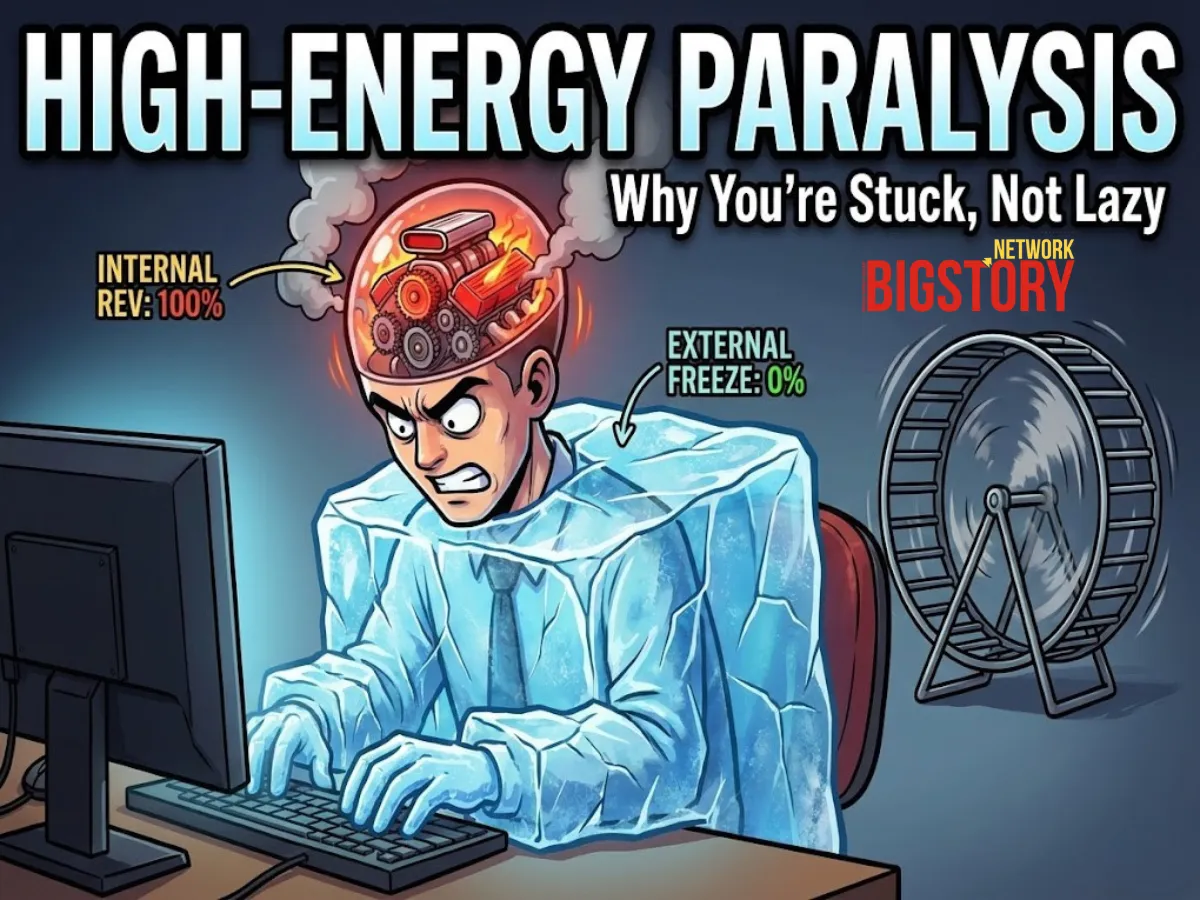
Burnout has stopped fitting. What millions are experiencing now is functional freeze — an involuntary nervous system shutdown when effort repeatedly produces no feedback, no reward, and no visible progress.
This is not a personal failing. When the brain registers that action no longer connects to outcome, it pulls the emergency brake on motivation entirely — not as a choice, but as a survival mechanism.
When work is identity and the system stops delivering, what breaks is not just motivation — it is the self. Psychologists call this moral injury. A vacation cannot fix a wounded conscience.
Rest no longer restores because the separation between work and recovery has collapsed — remote work brought the office into the bedroom, and cities replaced free third places with ₹250 coffee seats.
Quiet quitting, soft life, and dumb phones are not trends. They are a decentralised general strike of the psyche. When effort stops guaranteeing safety, stepping away is not apathy — it is discernment.
Do you remember when not being able to focus, not being able to work or care the way you used to had a name that actually made sense? For years, "burnout" has fit neatly enough. It has been the acceptable explanation for the exhaustion, the brain fog, and the sense that something internal had finally frayed. It was a container for our struggle. But lately, that word has stopped working.
This no longer feels like being tired; it feels like being stuck.
We are witnessing a strange, invisible paralysis where effort continues, but nothing moves forward. Ambition hasn’t disappeared, yet action no longer connects to outcome. You are still trying, still showing up, still obsessing over what needs to be done—and yet, nothing lands. This doesn't arrive as a dramatic breakdown or a clear moment of collapse. Instead, it manifests as friction: a quiet, internal malfunction that most people assume is a personal failing.
Because we lack a name for it, the struggle has moved underground. The questions are surfacing privately in digital confessionals: Reddit threads, "just curious" Quora posts, and therapy blogs trying to translate what patients can't quite articulate. They appear in late-night prompts typed into AI chatbots as the things we are too ashamed to ask another human:
Why can’t I do things I know how to do?
Why does everything feel harder than it should be?
Why am I exhausted even when I haven’t done anything?
Am I lazy… or is something wrong with me?
At first glance, these sound like symptoms of burnout. But burnout assumes overwork and depletion; it assumes that rest is the cure. What we are circling here is something harder to explain and harder to name.
That difficulty in finding the right word isn’t uncommon because it’s central to the problem. We live in a moment of hyper-classification where language rushes in to contain discomfort as quickly as possible. Relationships become "situationships," exhaustion is "burnout," and loneliness is rebranded as "introversion." We use labels to cage our experiences.
But some experiences resist the cage. This is one of them. Because what is collapsing here isn't just our energy or our motivation but our identity.
Because when identity collapses, the sensation that follows isn’t just exhaustion. It is something harder to name, which is a kind of frenzied helplessness.
We are still trying. We are frantically "upskilling", opening endless tabs of Coursera certificates and tutorials in a desperate attempt to stay "marketable" in a landscape that shifts every week. We optimize our portfolios and our lives, but the results don’t seem to come. It feels like sprinting on a treadmill that is slowly tilting vertical: all motion, zero traction.
This is high-energy paralysis. It is panic mixed with effort: a nervous system revving at full RPM while the wheels spin uselessly in the air. When effort repeatedly fails to produce feedback, something deeper than motivation collapses and that is when the Agency collapses.
The human brain is built on feedback loops: Action → Response → Adjustment. This loop is what makes us feel like participants in our own lives. But when you spend your days shouting into the digital void, sending applications that vanish and work that gets buried by an algorithm, the system stops trusting action itself.
This isn’t laziness. It is a Functional Freeze.
It is a physiological response to overwhelm. When the brain realizes that effort no longer leads to reward, it stops sending the signal to move. You aren't "choosing" to stay in bed; your nervous system has pulled the emergency brake.
This biological shutdown isn't happening in a vacuum. It is a rational response to a world that has stopped honoring its side of the deal.
For most of modern history, early adulthood followed a simple imperfect bargain: Work hard → get stable → build a future. That loop didn’t promise happiness, but it promised direction. It made the effort feel rational.
That loop is now broken.
We see the wreckage of this bargain everywhere. Entry-level ladders have vanished, replaced by "ghost postings" that exist only to collect data or project a false image of growth. We are fighting AI filters that reject us in milliseconds because of a missing keyword, never allowing a human eye to see our craft.
Young workers today perform more "preparatory labor" than any generation before them. It is a world of unpaid test tasks, endless culture-fit interviews, and the soul-crushing labor of tailoring every single application to a machine.
When you do this hundreds of times and hear nothing back, not even a rejection; your brain doesn't conclude that you need to "optimize" your CV.
It concludes that the environment is no longer responsive to your existence and we all know that motivation depends on reliable feedback. But in a world of digital silence, effort itself begins to feel like a waste of the very energy we no longer have.
This failure cuts deeper than a paycheck because, for an entire generation, work was never just a way to pay rent. Work was the soul.
We were raised on the idea of "Workism": the belief that we should follow our passions until our self-worth was perfectly welded to our productivity. We were told that if we loved what we did, the work would justify the sacrifice. Our "personal brands" became the armor we wore to face the world.
But when the system fails to deliver the stability or dignity it promised, the problem isn’t just economic. It is existential. If you are what you do, and you can’t "do" enough to feel secure, then who are you?
This is where burnout mutates into moral injury.
It is the hollow feeling of spending forty hours a week "optimizing" systems you don't believe in, or fighting for metrics that feel meaningless. We aren’t just tired; we are disturbed by who we have to become to survive. You feel like an "empty shell" because the centerpiece of your identity—the "productive self"—has fractured.
And a vacation cannot fix a wounded conscience.
Beneath this identity collapse, something even more is getting corrosive: temporal disintegration.(A very weird, technical and hard to understand as it spells but it is quiet simple)
Ideally, we endure hardship in the present because we are investing in a future that feels real. But today, young adults struggle to imagine a future self that feels stable or even reachable.
We look forward and see a horizon crowded with existential threats: climate anxiety, economic volatility, AI displacement, and the mathematical impossibility of homeownership. The future has become either abstract or catastrophic.
When the future feels unavailable, effort in the present starts to feel biologically pointless. This isn’t laziness. It is called “Functional Freeze.”
Why save? Why grind? Why delay joy for a version of life that may never arrive?
You cannot restore energy without restoring belief in a future worth investing in. And no amount of productivity advice can repair a timeline that feels like it’s already broken.
Traditionally, recovery depended on separation. I work here. I live there. I put effort here. Restoration elsewhere.
That separation has collapsed.
Remote work didn't just liberate us; it dragged the office into our sanctuaries. It is the Slack notification lighting up the dinner table. It is the laptop that never leaves the bedroom nightstand, staring at you while you try to sleep.
At the same time, our cities commodified the places where we used to breathe. The "third places": libraries, community centers, public benches—have either disappeared or become pay-to-stay zones. You can’t sit in a café anymore without buying a INR 250 / $7 Coffeejust to rent the chair.
What vanished wasn’t just leisure. It was co-regulation.
Human nervous systems evolved to down-regulate in the presence of other humans, through ambient conversation and shared silence. Without those free, open environments, the body never fully powers down.
This is why we aren’t just resting anymore. We are withdrawing.
"Bed rotting" isn’t indulgence. It is a freeze response. When home becomes work, work becomes surveillance, and public space becomes unaffordable, the bed becomes the last remaining safe zone. It is the only place left where no one is asking for a deliverable.
This is where the headlines get it wrong. They look at our survival strategies and frame them as cute, fleeting trends: Soft Life. Quiet Quitting. Dumb Phones.
They are not trends. They are a decentralized, leaderless general strike of the psyche.
When effort no longer guarantees safety, the rational move isn’t to try harder. It is to reduce exposure. What looks like disengagement is actually discernment.
We aren’t asking for a hustle revival. We are asking something far more unsettling:
What kind of world makes stepping away the healthiest option?
Burnout was the symptom. This is the diagnosis. And until we rebuild the systems that broke our connection to the future, rest will never be enough—because rest cannot repair a life that no longer makes sense.
Q: Is the "Functional Freeze" the same as laziness? A: No. Laziness is a choice to avoid effort.
Functional Freeze is an involuntary survival mechanism. When your nervous system perceives a high-stress environment with no reachable rewards, it pulls the "emergency brake" to conserve energy. You aren't avoiding work; your body is protecting you from what it perceives as a futile threat.
Q: Can a vacation fix this feeling? A: Burnout caused by simple overwork can be helped by rest. However, if your struggle is rooted in Moral Injury or Identity Collapse, a vacation is only a temporary bandage. Recovery requires rebuilding your agency and finding environments where your effort actually connects to meaningful outcomes.
Q: How do I explain this to an employer or older family member? A: Use the term "Feedback Loop Failure." Explain that modern work structures—AI filters, ghost jobs, and digital isolation—have removed the traditional markers of progress. It is harder to stay motivated when the "Work Hard → Get Stable" bargain has been mathematically broken by the current economy.
Q: Are "Dumb Phones" and "Soft Life" just for Gen Z? A: Not at all. These are tools for Cognitive Self-Defense. Anyone, regardless of age, can benefit from reducing their exposure to attention-stripping algorithms and prioritizing nervous-system repair over the "hustle" grind.
To provide depth to the concepts discussed in this article, we have relied on a combination of clinical psychology, economic reports, and sociological studies:
1. The Psychology of Burnout & Freeze Responses
2. The Broken Economic Bargain
3. Modern Culture & Survival Strategies
am I lazy or am i broken, functional freeze response, high energy paralysis, burnout vs depression, identity collapse, why can’t I focus anymore, workism, economic nihilism, bed rotting meaning, agency collapse, ghost jobs, silent strike, quiet quitting, soft life trend, career burnout 2026, cognitive self defense, mental health for gen z, why am i exhausted, productivity guilt
Feeling stuck, paralyzed, or "lazy" despite trying your best? It isn't burnout—it’s an identity crisis. Discover why rest isn't enough and how to repair your agency.
 Exclusive Content


Sign up for the Daily newsletter to get your biggest stories, handpicked for you each day.


 Trending Now! in last 24hrs


