
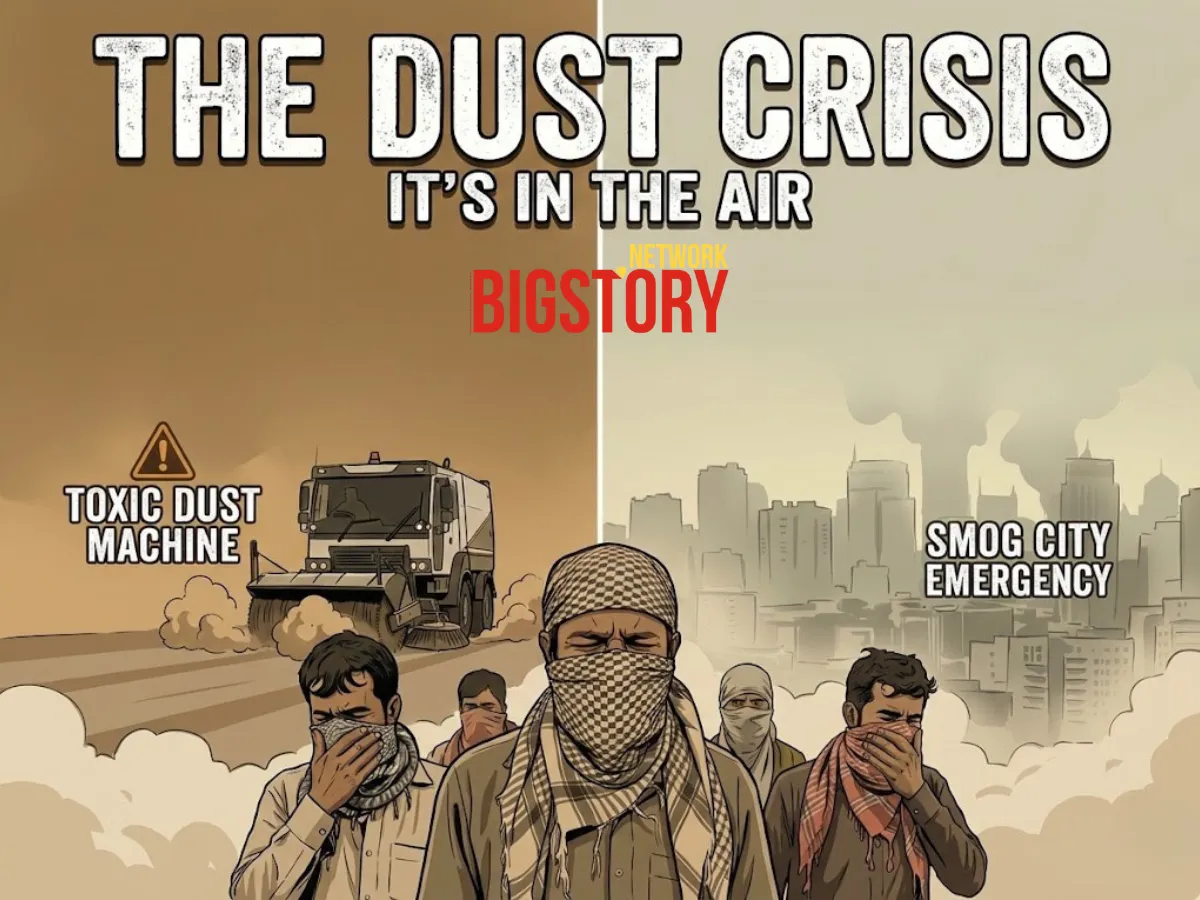
You already know Indian cities are dusty. What you may not know is that the grey filter over your skyline is not pollution in the way we have been taught to think about it — it is not smoke, not smog, not a chemistry problem. It is a geology problem. India has not just polluted the air. It has resuspended the earth. And it is doing it 365 days a year, while the government fights a seasonal villain 99 that only shows up in winter.
 Brajesh Mishra
It feels like a ritual that every Indian knows, though we rarely speak of it.
In the morning, as you step onto your balcony or approach your window, carrying a cup of tea. Instinctively, your hand rests on the railing and as you pull it back, you rub your thumb against your fingertips, you feel a fine, gritty, grey powder.
Although it was cleaned yesterday, it's still dusty and for the weird part: It will be there again tomorrow.
We have normalized this. We call it "dusty," as if it’s a weather condition. We wipe our car windshields with a cloth every morning, watching the grey cloud puff into the air, accepting it as a normal thing living in India. We apply filters to our photos to cut through the yellow-grey haze that hangs over our skylines, subconsciously trying to color-correct reality but this isn't "weather" and this isn't "just dust."
If you look at a satellite map or a raw photograph of an Indian city compared to Tokyo, London, or even Bangkok, there is a distinct visual difference. They are high-contrast; shadows are black, skies are blue. India is low-contrast; everything is washed in a sepia mid-tone.
We are living in the "Sepia Nation" and this filter is made of millions of tons of pulverized earth, concrete, and silica that we have forgotten how to keep on the ground.
For the last decade, our national conversation on pollution has been myopic. We are obsessed with Smoke.
We focus on the chemistry of the air (PM2.5)—the invisible toxins from combustion. And while those are deadly, they are seasonal villains.
But there is a second villain, a "Silent Killer" that stays with us 365 days a year. It is PM10: the coarse particles. This isn't smoke from a fire; it is the physical disintegration of the city itself.
While we wear masks to filter out the smoke, we are physically drowning in matter. We treat the air like a chemistry experiment gone wrong, when in reality, it is a geology experiment gone wrong. We haven't just polluted the air; we have resuspended the earth.
The earth is not a passive element; it is abrasive. We often see dust as a mere nuisance, something to be cleared away, but on a microscopic scale, this pervasive 'sepia filter' is actually a weapon. Unlike soft, organic smoke, these airborne particles are sharp shards of silica, pulverized concrete, and heavy metals. They abrade the delicate lining of our lungs like sandpaper. Furthermore, unlike winter smog that eventually dissipates, this grit is permanent. It lingers through May, swirls throughout June, and ultimately settles forever within our alveoli. We are doing more than just inhaling polluted air; we are slowly fossilizing our lungs with the very debris generated by our own development.
To understand why the sky is grey, we must first understand the difference between Poison and Matter.
When we talk about "pollution," we treat it like a single, toxic soup. But forensic science divides it into two distinct enemies.
The biggest lie we tell ourselves is that traffic pollution comes only from the exhaust pipe.
Imagine a brand new, electric bus driving down a typical road in Delhi or Bangalore, it is green, it has zero tailpipe emissions, the government loves it, but look at its wheels.
As that heavy electric bus moves, its tires grind against the asphalt. The massive aerodynamic drag creates a turbulent wake behind it. If the road is covered in a layer of loose silt, which typically every Indian road has, that "clean" bus acts like a massive Leaf Blower.
Yes, the dust a vehicle throws at you while you tail them on the road... It sucks the dust off the ground and blasts it onto your face.
This is the physics of Road Dust Resuspension. In a city like Tokyo, the dust stays on the ground because the roads are washed and the shoulders are paved. In India, because we leave the "shoulders" of our roads as raw earth, every car that passes drags a fresh supply of dirt onto the tarmac, grinds it into powder, and launches it into the air.
A clean car on a dirty road causes more PM10 pollution than a dirty car on a clean road.
We have been conditioned to believe that pollution is a "Winter Problem." We wait for the October smog alerts. We buy air purifiers in November. We pack them away in March.
But the data proves this is a dangerous delusion.
Think back to May 2025. There were no farm fires in Punjab. There was no winter fog to trap the smoke. The sun was blazing at 45°C. The air should have been clean.
But it wasn't. Delhi’s PM10 levels in May averaged 223 µg/m³—nearly four times the safe limit.
Why? Because the heat worked against us. It baked the soil bone-dry, turning the city into a cauldron of loose silica. We didn't see it as "smog" because it wasn't white; it was that familiar, low-contrast "haze" we mistake for heat.
The truth is, we don't have a pollution season. We have a Smoke Season (Winter) and a Dust Season (Year-Round). And while the government fights the smoke, the dust is going unattended.
Why does this distinction between "Smoke" and "Dust" matter to your body?
We are often told that PM2.5 is the only killer because it enters the bloodstream. This makes us underestimate PM10. We think of dust as "natural"—just a bit of soil that makes us cough.
The Sandpaper Effect: But the dust in an Indian city is not "soil." As we established, it is a mixture of pulverized concrete, tire rubber, and asphalt. It is high in Silica and Heavy Metals. When you breathe construction dust, you aren't just breathing dirt; you are breathing microscopic shards of glass and stone.
Unlike soft organic smoke, these particles are physically abrasive. When they lodge in your upper respiratory tract and bronchial tubes, they act like sandpaper.
The "3-Foot" Death Zone: This dust crisis is particularly cruel to children. Remember the physics of Resuspension? Heavy dust (PM10) hovers lower to the ground than light smoke. The highest concentration of resuspended road dust floats in the 0 to 1-meter zone above the asphalt.
If you want to see where this dust comes from, you don't need a satellite, you just need to look at your shoes. Let me show you some examples:
We often blame the farmers for Delhi's air. But if you stand under a Metro pillar in May, miles away from any farm fire, you can literally taste the grit in your teeth and that "crunch" is local.
According to IIT Kanpur, up to 56% of Delhi’s PM10 pollution originates from Road Dust. Think about the last time you drove past a road repair crew. There is no vacuum sealing, no water sprinkling. Just a cloud of grey powder drifting into traffic. Or look at the leaves of a tree on the Ring Road. They aren't green; they are coated in a thick, cement-like paste. That paste is "Resuspended Dust."
Mumbaikars used to have a superpower: The Sea Breeze. Every evening, the wind would blow in from the Arabian Sea and scrub the city clean. But recently, if you look out of a high-rise window in Lower Parel towards the sea, you don’t see a blue horizon. You see a grey wall. This isn't mist. It is the exhaust of a city under reconstruction. With the Coastal Road, the Metro, and thousands of redevelopment projects happening simultaneously, Mumbai has turned into an open-air quarry. Reports from NEERI suggest that when you combine direct construction dust with the mud tracked onto roads by dump trucks, the construction sector accounts for nearly 70% of the dust load. The sea breeze can’t help anymore. We have built so many skyscrapers that we’ve created "Concrete Canyons" that trap the dust at street level.
In Bengaluru, this dust has a specific color: Reddish-brown. It comes from the city’s unique failure: The Unpaved Shoulder. Next time you are stuck in traffic on the Outer Ring Road, look at the space between the tarmac and the footpath. It’s raw, red earth. Every time a bike tries to shortcut through that gap, or a bus pulls over to a stop, it drags that red soil onto the road. According to CSTEP, a significant portion of Bengaluru’s pollution is "Soil Dust." It’s not factories. It’s not crop burning. It’s simply the fact that we refused to pave the last two feet of the road. We are choking on the "Last Mile" connectivity gap, quite literally.
Imagine you have a leaking roof, water is pouring into your living room and instead of fixing the hole in the roof, you spend your entire life savings buying expensive mops to clean the floor every hour. This is exactly how we are fighting dust.
The 6,500 Crore Rupee Broom: If you have ever been stuck behind one of those massive "Mechanical Road Sweepers" on a highway, you know the truth. It moves slowly, spinning its brushes, and often, instead of cleaning, it kicks up a massive cloud of dust that engulfs the cars behind it.
Yet, this machine is the government's favorite toy.
According to a forensic audit of the National Clean Air Programme (NCAP) funds, a staggering amount of the budget has been spent on "Road Dust Management"—buying these sweepers and water sprinklers.
We are spending billions to move dust from the center of the road to the side of the road and 20 minutes later, the sun dries it out, a truck drives by, and the dust is back in the air. We are treating a hemorrhage with a band-aid. We are funding the "mops" instead of paving the "roof" (the unpaved shoulders) that is generating the dust in the first place.
The "VIP" Loophole: There is another reality every Indian has noticed. When the pollution gets "Severe," the government bans construction.
If you are a middle-class family trying to build a small home, your work stops. You get fined. But look across the street. The massive Metro construction? The National Highway expansion? The Flyover project? They are still running full throttle.
This is the "Linear Project" Loophole. Under the emergency rules (GRAP), "Linear Public Projects" (Highways, Metros, Pipelines) are often exempt from bans. The irony is cruel. These massive earth-moving projects are the biggest creators of dust. By exempting them, the government is essentially saying: "Pollution is illegal, unless the State is doing it."
The Vertical Garden Hoax: And then, there is the most visible scam of them all: The Metro Pillar Garden.
You’ve seen them—those thousands of small plastic pots zip-tied to concrete pillars in Noida, Delhi, and Bangalore. For the first month, they look green and lush—a perfect photo-op for a politician.
But look at them now. Drive past the Blue Line in Delhi or the pillars in Noida. They are brown, withered, and in most scenarios, dead.
It is a failure of basic thermodynamics. A concrete pillar in May hits 50°C. A tiny plastic pot has no insulation. We are literally boiling the roots of these plants. Instead of cleaning the air, these dead gardens have become a new pollution source: thousands of crumbling plastic pots turning into microplastics, slowly disintegrating into the wind. It wasn't environmentalism; it was decoration and we paid for it.
Let’s be realistic. The dust isn't going anywhere tomorrow.
We are a developing nation. We are building metros, highways, and homes because we need them. As long as we are pouring concrete and digging earth, there will be dust. We cannot pause India’s growth, and we cannot vacuum the entire subcontinent overnight.
We also know that not everyone is going to help. Budgets are tight, attention spans are short, and not every Resident Welfare Association (RWA) has the funds to pave their road shoulders. Not every builder is going to wash the tires of every truck. Inertia is a powerful force.
But there are people, communities, and civic officials who are trying. You see them planting saplings on weekends, adopting road verges, or fighting for better parks. To them, we say: We wholeheartedly appreciate your work.
If we are going to fight the Sepia Nation, we need to stop wasting effort on solutions that don't work (like plastic pots and smooth leaves) and start backing the solutions that do.
The Botanical Shield: So, when you decide to plant a tree near you, don't just plant it for "greenery." Plant it for impact.
Not all leaves are created equal. To trap the heavy, abrasive silica dust of an Indian city, we need a specific kind of leaf. We need Friction.
The Climber Alternative: For our civic officials trying to beautify metro pillars: We appreciate the intent, but the plastic pots are failing you.
The smarter, cheaper alternative is Roots in the Ground. Instead of hanging expensive pots, plant robust native creepers like Vernonia (Curtain Creeper) or Bougainvillea at the base of the pillar. Their roots stay cool in the earth. They require minimal water. And within two years, they form a dense, living curtain that actually traps dust and noise—without a single piece of plastic waste.
It is time to appreciate the builders, the planters, and the sweepers who are trying to keep the dust down, but let's also arm them with better science.
The "Sepia Nation" is not an inevitability. It is a choice. We can choose to pave the shoulders. We can choose to ban plastic pots. And we can choose to plant trees that work as hard as we do.
We don’t just need a greener city. We need a cleaner one. And it starts by keeping the earth on the ground.
What is the "Sepia Nation"?
"Sepia Nation" is a term describing the visual quality of Indian cities, where high levels of suspended dust (PM10) create a permanent low-contrast, yellowish-grey filter over the skyline, unlike the high-contrast blue skies seen in cities with better dust management.
What is the difference between PM2.5 and PM10?
PM2.5 refers to fine particles (smoke/chemicals) that enter the bloodstream. PM10 refers to coarser particles (dust, silica, pulverized concrete) that are physically abrasive, lodging in the lungs and causing mechanical irritation and fibrosis.
Why do Electric Vehicles (EVs) still cause pollution in India?
This is the "Tesla Paradox." While EVs have zero tailpipe emissions, their tires still grind against unpaved road shoulders. This "Road Dust Resuspension" means a heavy EV can kick up just as much PM10 dust as a diesel truck if the roads are dirty.
Which trees are best for reducing dust pollution?
Trees with rough, hairy, or corrugated leaves are best for trapping dust. The Arjun tree (Terminalia arjuna) and the Banyan tree are superior choices compared to smooth-leaved trees like Neem, as their textured surfaces physically capture airborne particulates.
Why is dust pollution high in summer (May) in India?
Contrary to the belief that pollution is a winter-only issue, heat dries out the soil, making it loose and powdery. Without winter moisture to hold it down, traffic and wind easily resuspend this silica dust, causing high PM10 levels even when there is no crop burning or fog.
This video effectively visualizes the "Sepia Nation" concept, showing how dust is not just a nuisance but a pervasive, gritty layer that coats our cities and lungs.
 Exclusive Content


Sign up for the Daily newsletter to get your biggest stories, handpicked for you each day.

 Trending Now! in last 24hrs


