BIGSTORY Network


BIG SHOT Dec. 31, 2025, 3:57 p.m.

Adani’s Aerotropolis: A ₹20,000 Crore City with a Runway

Adani’s Navi Mumbai Airport is a ₹20,000 Crore real estate pivot targeting 70% non-aviation revenue, functioning as a luxury "Aerotropolis" rather than just a transit hub.

by Author Minaketan Mishra
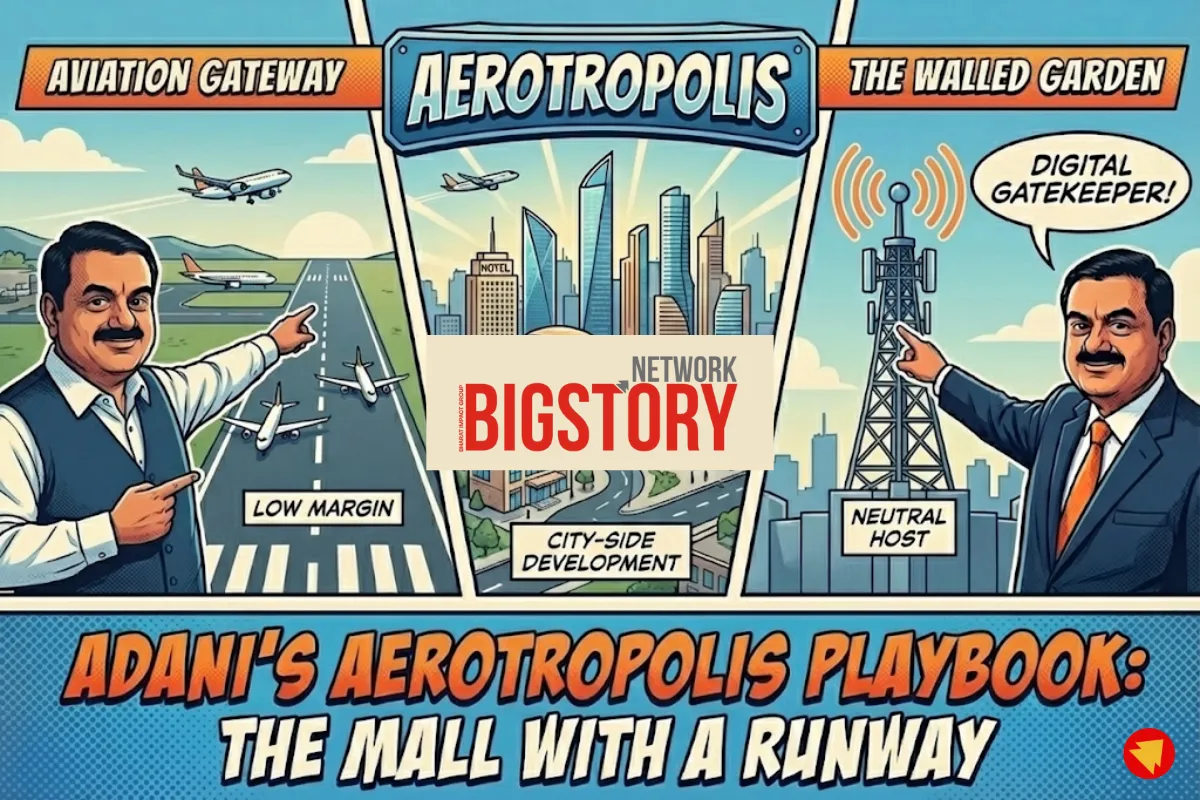
Hero Image

Introduction: The "Mall with a Runway"

If you drive down to the new Navi Mumbai International Airport (NMIA), you might think you are looking at a transit hub. You would be wrong.

For decades, the business of running an airport was simple but tough: you built a runway, airlines paid you landing fees, and you made a small margin. It was a "low margin, high liability" game. But the Adani Group doesn't play low-margin games.

The most revealing data point in their strategy isn't about planes—it's about the 70/30 Split.

Globally, the world's best airports (like Changi in Singapore or Dubai International) generate about 40-50% of their revenue from non-aeronautical sources (shopping, hotels, duty-free). The Adani Group has publicly set a target to derive 70% of their revenue from non-aeronautical sources by 2030.

This is a structural pivot. It means the aircraft are merely the funnel to bring high-net-worth individuals into a controlled ecosystem. The real product isn't the flight; it's the "City-Side Development"—a massive commercial engine where the airport becomes the destination itself.

1. The Real Estate Arbitrage: A ₹20,000 Crore Bet

Why this obsession with non-aeronautical revenue? Because of Regulatory Arbitrage.

In India, the Airports Economic Regulatory Authority (AERA) strictly caps how much profit an operator can make from "aeronautical services" (landing fees, parking, etc.). It’s a cost-plus model with limited upside.

However, there is no government cap on:

  • The rent for a luxury office tower next to the terminal.
  • The room rate for a 5-star hotel in the airport precinct.
  • The lease for a high-end retail outlet.

Adani has committed a staggering ₹20,000 Crore to what they call "City-Side Development" across their portfolio, with the lion's share going to Mumbai. The master plan for Navi Mumbai involves a 240-acre "Walkable Business District" featuring five luxury hotels (1,000 keys), three Grade-A office towers, and a massive retail precinct.

The "Time Arbitrage"

The strategy attacks Mumbai's biggest weakness: Friction. Currently, a global CEO landing in Mumbai faces a grueling 90-minute commute to Nariman Point or an unpredictable slog to BKC. In the Adani Aerotropolis, that friction is zero. You land, walk to your office, hold your board meeting, sleep in the hotel, and fly out.

This isn't just a convenience; it's an existential threat to the property valuations of South Mumbai.

2. The Silent Cost: The "Neutral Host" War (Why Your Phone Died)

If you have visited the new airport recently, you might have noticed a major problem: "Dead Zones." Your Jio or Airtel signal likely vanished the moment you entered the precinct.

This is not a technical glitch. It is a corporate battle for the "Nervous System" of this new private city.

To control the digital experience, Adani NMIAL has deployed a "Neutral Host" model. Instead of allowing telecom operators (Jio, Airtel, Vi) to install their own towers and antennas (known as "Right of Way" or RoW), Adani has built its own network and wants the telcos to rent it.

The Numbers Behind the Dispute

  • The Telco Claim: The Cellular Operators Association of India (COAI) alleges that Adani is demanding ₹92 Lakh per month per operator. They call this "exorbitant" and "commercially untenable."
  • The Adani Defense: They argue this model prevents clutter, ensures security in sensitive zones (like ATC towers), and is a global standard for "Smart Airports."

The Result? A standoff. The telcos have refused to pay, and the passengers are left with zero signal, forced to log in to the airport's public Wi-Fi. This turns the airport into a "Walled Garden" where the operator controls the digital pipe, effectively becoming a "Digital Gatekeeper."

3. The Premium Trap: The Price of a "Private City"

This luxury ecosystem comes with a price tag, and the consumer is footing the bill. The clearest indicator of this "Premiumization" strategy is the User Development Fee (UDF)—the tax you pay just to enter the airport.
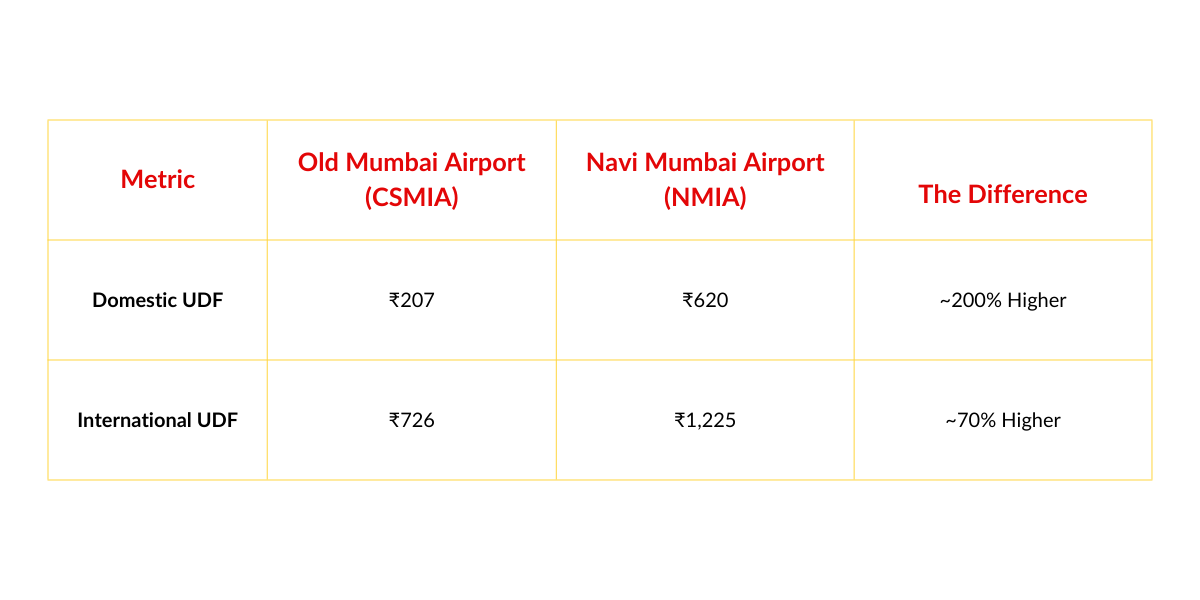
The Insight: The ₹620 fee signals that NMIA is not trying to be a low-cost alternative for the masses. It is positioning itself as a premium product for the top 10% of income earners—the same people who will shop at the luxury malls and stay at the hotels.

4. The Verdict: The Rise of the "Private City"

The Navi Mumbai International Airport is a masterclass in modern business strategy. The Adani Group has effectively taken a public utility license and used it to build a private commercial fiefdom.

  • For Investors: This is a strong buy signal. The shift to unregulated real estate revenue (the 70% target) de-risks the business from aviation volatility.
  • For the City: It marks the "Death of the Center." The center of gravity in Mumbai is shifting East, away from the colonial legacy of Nariman Point.
  • For the Consumer: Get ready to pay. The efficiency of the "Aerotropolis" is undeniable, but the costs—both financial (UDF) and digital (Neutral Host)—are the entry tickets to this new private world.

5. The Adani Playbook: 4 Lessons for Students of Business

We often look at billionaires and ask "How?" The answer usually isn't luck; it’s structural engineering. Here is the playbook from the Navi Mumbai project:

Lesson 1: The "Loss Leader" on a Macro Scale

In retail, a "loss leader" is cheap milk sold to get you into the store so you buy the expensive wine. Adani has applied this to infrastructure.

  • The Concept: The airport operations (planes) are the "milk"—low margin and high regulation. The "City-Side Development" (hotels, malls) is the wine.
  • The Takeaway: Don't just look at the core product. Ask yourself: "What else can I sell to the customer once they are inside my door?"

Lesson 2: Sell "Time," Not Just Service

Why will a CEO pay a premium to stay at the Aerotropolis? Because the alternative is a 90-minute traffic jam.

  • The Concept: Adani bet on "Time Arbitrage." They identified the city's biggest pain point (friction) and built a solution that eliminates it.
  • The Takeaway: If you can save a high-net-worth individual 2 hours, your pricing power is unlimited.

Lesson 3: Vertical Integration (The "Walled Garden")

Most developers let Jio or Airtel handle the connection. Adani said "No."

  • The Concept: By using the "Neutral Host" model, they are attempting to own the "nervous system" of the building, not just the concrete.
  • The Takeaway: True dominance comes from controlling the entire value chain. If you own the land, the building, and the digital pipe, you turn a one-time customer into a recurring subscriber.

Lesson 4: Regulatory Arbitrage

This is the most advanced move. Adani is using the definition of an "Airport" to build a "City."

  • The Concept: They leverage the "Airport License" to get land and security clearance, but leverage the "VNO License" (telecom) to act like a private operator.
  • The Takeaway: Business isn't just about product; it's about understanding the rules better than your competition. They found the gray area between "Public Utility" and "Private Luxury" and built a castle on it.

Frequently Asked Questions (FAQ)

Q: Why is there no mobile signal at Navi Mumbai Airport? A: It is due to a commercial dispute. Adani NMIAL wants telecom operators (Jio, Airtel) to use their "Neutral Host" infrastructure for a fee, while operators want to install their own equipment to avoid high costs.

Q: What is the Adani 70/30 Revenue Split? A: It is the Adani Group's strategic target to earn 70% of their revenue from non-aviation sources (retail, real estate) and only 30% from actual flight operations by 2030.

Q: Why are the charges (UDF) higher at Navi Mumbai Airport? A: The Domestic UDF is ₹620 compared to ₹207 at the old airport. This higher fee supports the massive "City-Side" infrastructure and positions the airport as a premium destination.

Disclaimer: This article is an analysis of public strategy documents and market data. It is for educational and informational purposes only.


Sources & References

  1. Adani Airports To Develop Rs 20,000 Crore Realty Projects Around Major Airports
  2. With ₹20000 cr plan, Adani eyes global-style airport business hubs
  3. Adani Airports Unveils Rs 20,000-Crore City-Side Expansion Plan
  4. Adani Group Plans to Diversify its Airports Business
  5. Adani Airports Rolls Out City-Side Development Plan Worth Rs 20,000 Cr
  6. Adani plans ₹20000 crore city-side push to diversify airports business
  7. Navi Mumbai Property Market Soars After Airport Launch
  8. Adani Airport Holdings Limited Investor Presentation (June 2025)
  9. Airlines duopoly not a concern... Jeet Adani
  10. Airport Non Aeronautical Revenue Market Size, Growth, Trends and Forecast
  11. Telcos' body clashes with Adani Group-owned Navi Mumbai airport over RoW denial
  12. COAI seeks DoT intervention over denial of Right of Way
  13. COAI flags RoW denial, slams Navi Mumbai Airport's exclusive telecom mandate
  14. COAI seeks Centre's intervention over telecom facilities at Navi Mumbai airport
  15. Adani Airport vs. Telecom Giants: Massive RoW Clash Erupts Over Sky-High Charges
  16. Right of Way not denied for telcos; will not give in to cartelisation
  17. Telcos' body COAI, Adani Group-owned Navi Mumbai airport clash over RoW denial
  18. Telecom operators, Adani spar over network rollout at Navi Mumbai airport
  19. Telcos accuse Adani-run Navi Mumbai airport of blocking mobile infra
  20. Airtel, Jio Accuse Adani Group Of Imposing Monopoly At Navi Mumbai Airport
  21. Why are mobile services unavailable at Navi Mumbai International Airport?
  22. Telcos seek govt action against Navi Mumbai Airport (Reddit)
  23. Navi Mumbai Airport Sets New Standards With Tariff Approval
  24. Telecommunications Act 2023 - Drishti IAS
  25. Partial Notification of the Telecommunications Act, 2023
  26. THE TELECOMMUNICATIONS ACT, 2023 (Official Gazette)
  27. Adani Airport vs. Telecom Giants (Whalesbook Report)
  28. Airports with 5G Buffer - FAA
  29. Los Angeles World Airports Report
  30. Adani Group Refutes Telecom Cartel Allegations
  31. All You Need to Know About Navi Mumbai International Airport


Minaketan Mishra
Minaketan Mishra Tech Specialist

Minaketan Mishra serves as Junior Editor and Tech Specialist at BIGSTORY NETWORK. He is crucial in shaping digital content, blending editorial precision with technological expertise. Mishra ensures engaging narratives are delivered seamlessly, focusing on accurate reporting and optimizing online presence through his specialized tech skills. His role supports Big Story Network's commitment to cutting-edge journalism.

BIGSTORY Trending News! Trending Now! in last 24hrs

Zepto’s Time Engine: The Tech Behind Vohra’s ₹11,000 Cr Run
BIG SHOT
Zepto’s Time Engine: The Tech Behind Vohra’s ₹11,000 Cr Run
The Invisible War: Why Your Phone is Dead at Navi Mumbai Airport & The ₹92 Lakh Fight for the "Last Meter"
BIG SHOT
The Invisible War: Why Your Phone is Dead at Navi Mumbai Airport & The ₹92 Lakh Fight for the "Last Meter"
Adani’s Aerotropolis: A ₹20,000 Crore City with a Runway
BIG SHOT
Adani’s Aerotropolis: A ₹20,000 Crore City with a Runway
The Systemic Flaw: Why Retail Investors Lose in New-Age Tech IPOs
BIG SHOT
The Systemic Flaw: Why Retail Investors Lose in New-Age Tech IPOs