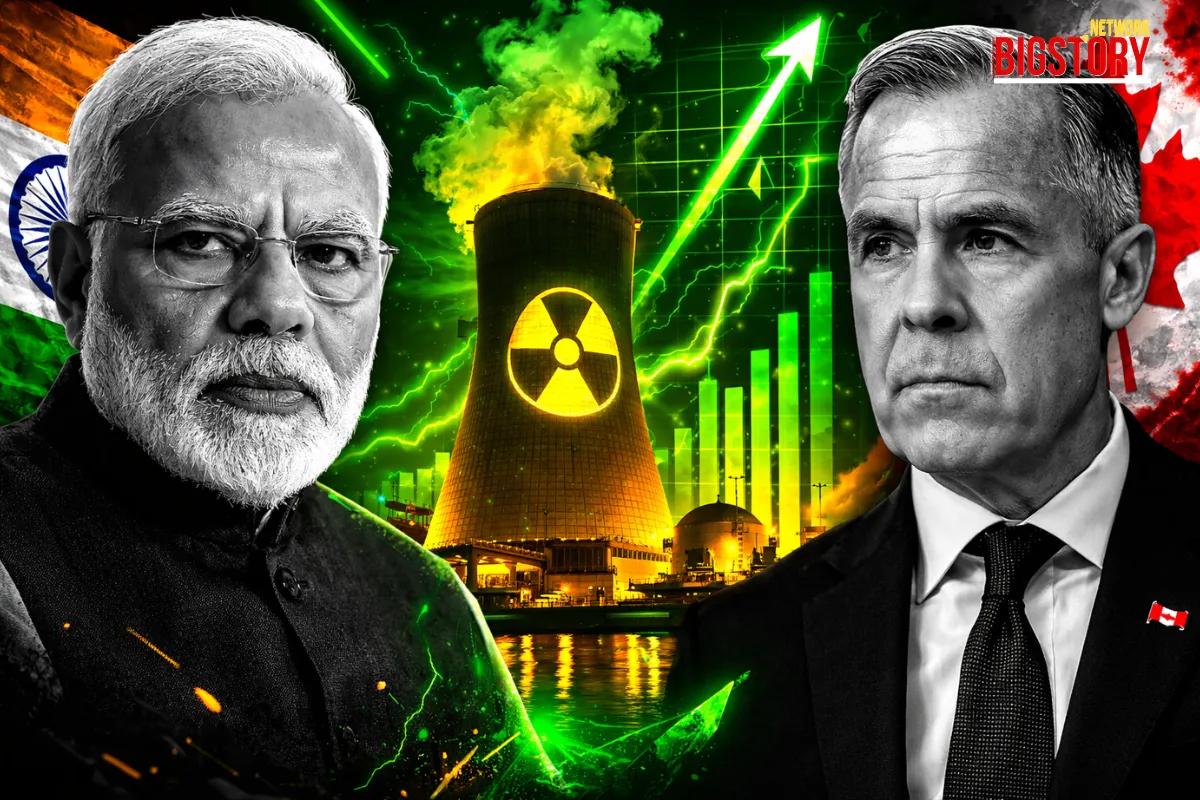
The diplomatic deep freeze is officially over, thawed by the immense heat of nuclear ambition. On March 2, 2026, Indian Prime Minister Narendra Modi welcomed Canadian Prime Minister Mark Carney to Hyderabad House in New Delhi, capping off a remarkable geopolitical turnaround. The centerpiece of the visit was the signing of a massive $2.6 billion CAD agreement with Cameco Corporation, securing 22 million pounds of Canadian uranium to fuel India's civilian reactors for the next decade.
This matters because it represents one of the most rapid and lucrative diplomatic resets in modern history. Just three years ago, in September 2023, bilateral relations hit a historic low following explosive allegations regarding the killing of a separatist leader, leading to suspended trade talks and frozen visa services. Today, that animosity has been entirely superseded by the stark realities of global energy security. India desperately needs high-grade fuel to power its economic rise, and Canada—under a new Prime Minister seeking an "economic reset"—needs a reliable, massive buyer to secure its mining sector.
The "BigStory" Angle (The "Sovereign Locking" Trend & AI Mining)
Mainstream media is focusing on the "Energy for Diplomacy" swap. They are missing the critical macroeconomic shift toward "Sovereign Locking".
India is fundamentally altering how it buys energy. After watching the spot-market price of uranium experience terrifying volatility (hitting $89/lb in 2024), New Delhi is abandoning the open market in favor of long-term, bilateral "locked" volumes. By signing a 9-year supply pact with a single, stable nation, India is directly mirroring China's strategy for absolute resource security, insulating its nuclear grid from future geopolitical shocks.
Furthermore, watch the AI in Mining Logistics angle. Alongside the uranium deal, the Saskatchewan Research Council and Indian firms signed a Memorandum of Understanding (MoU) to deploy AI-driven downstream processing. This technology will be used to optimize the nuclear fuel cycle, allowing both nations to capture higher-value segments of the supply chain rather than just trading raw ore.
The Context (Rapid Fire)
- The Trigger: PM Mark Carney’s pivot toward "economic pragmatism" culminated in this New Delhi visit, focusing heavily on energy security and critical minerals to bypass lingering political grievances.
- The Backstory: India currently relies on imports for roughly 70% of its uranium needs. This is a geological necessity; domestic Indian uranium ore has a notoriously low concentration of about 0.02%, compared to the massive 15% concentration found in Canada’s Saskatchewan mines.
- The Escalation: India has set an incredibly aggressive nuclear power capacity target. New Delhi plans to scale its nuclear grid from the current ~9 GW to a staggering 100 GW by 2047, a goal that is mathematically impossible without massive, continuous foreign fuel injections.
Key Players (The Chessboard)
- Narendra Modi (The Architect): The Indian Prime Minister leveraging the deal to fuel India’s 100 GW nuclear goal, declaring the relationship "infused with new energy and positivity."
- Mark Carney (The Dealmaker): Canada's Prime Minister, who successfully orchestrated the "economic reset" with India, expanding the partnership with "new ambition, focus and foresight.
- Tim Gitzel (The Supplier): CEO of Cameco Corp, the world’s largest high-grade uranium producer, who noted that India's ambitious nuclear expansion "isn't possible without a stable supply of uranium fuel."
The Implications (Your Wallet & World)
- Short Term (Market Movers): If you are an energy or commodities investor, immediately monitor the stock performance of Cameco (TSX: CCO) and Uranium Corp of India (UCIL). This single deal represents roughly 13% of recent global commercial long-term uranium contracts, effectively setting a new baseline for global pricing.
- Long Term (The $50 Billion Target): The uranium pact is just the beginning. Both nations have agreed to fast-track the Comprehensive Economic Partnership Agreement (CEPA) by the end of 2026, setting a massive new bilateral trade target of $50 billion by 2030, which will dramatically impact the IT, agricultural, and student visa sectors.
The Closing Question
India and Canada proved that multi-billion dollar energy demands can completely erase years of bitter diplomatic hostility. Is "Sovereign Locking" of critical resources the only way nations can guarantee their energy security in the 2020s, or does relying on a single supplier create new vulnerabilities? Tell us in the comments.

FAQs
- Q: What is the value of the 2026 India-Canada uranium deal?
- A: The landmark long-term agreement signed in March 2026 is valued at CAD 2.6 billion (approximately $1.9 billion USD).
- Q: Which company is supplying uranium to India under the new agreement?
- A: Cameco Corporation, a Canadian company and one of the world's largest high-grade uranium producers, will supply the 22 million pounds of uranium to India.
- Q: Why does India need to import uranium from Canada?
- A: India relies on imports for 70% of its uranium needs because its domestic ore is of very low quality (0.02% concentration). Canada's Saskatchewan mines offer highly concentrated ore (up to 15%), making it far more efficient and vital for India's goal of reaching 100 GW of nuclear capacity.
- Q: Did India and Canada sign a free trade agreement in 2026?
- A: While a final Free Trade Agreement was not signed on March 2, the two nations agreed to formally fast-track the Comprehensive Economic Partnership Agreement (CEPA) with the goal of finalizing it by the end of 2026, setting a $50 billion bilateral trade target.
Sources: