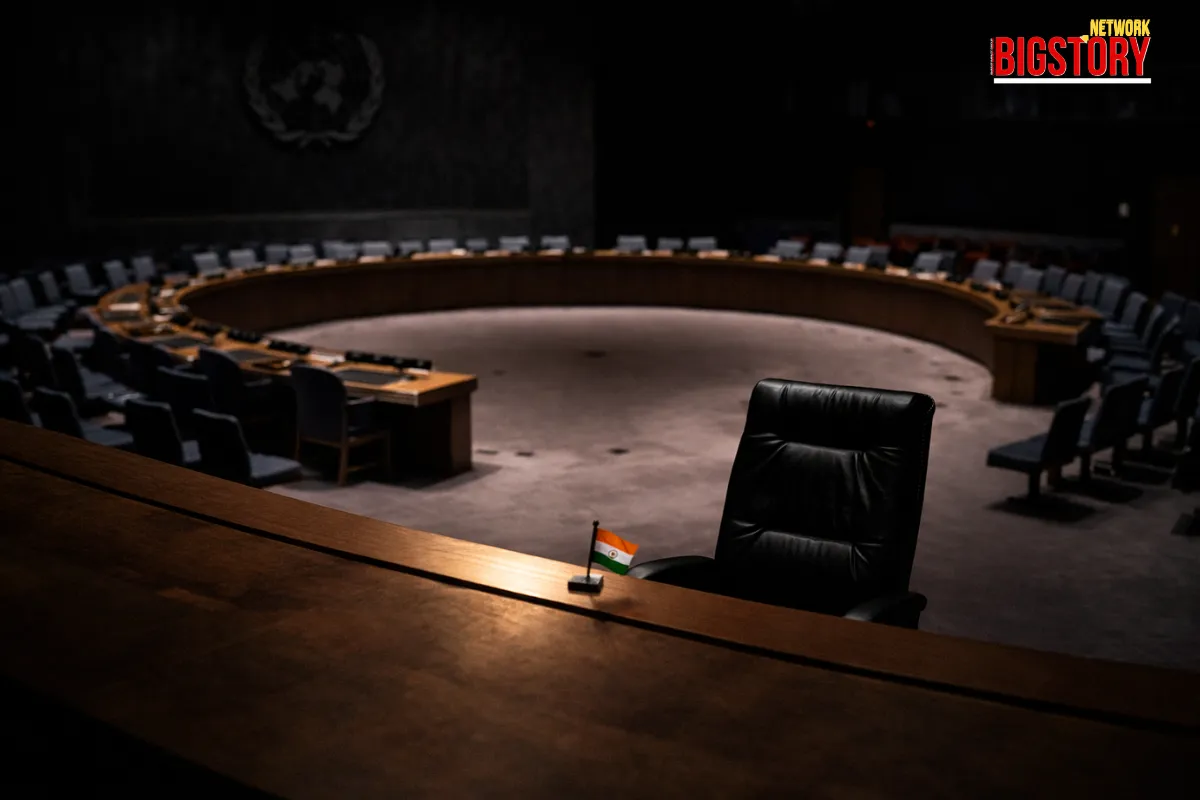
The United Nations Security Council is broken, and the world is finally demanding a repair. On Thursday, during a high-stakes state visit to New Delhi, Finnish President Alexander Stubb added a crucial European voice to a growing global consensus. Stating flatly that the UN must change to survive, Stubb announced Finland's strong support for India to secure a permanent seat on the UNSC.
This matters because the timing is not coincidental; it is a direct indictment of the current global order. The eruption of the devastating U.S.-Israel-Iran conflict in late February exposed a fatal flaw in the UN Charter: when the permanent members (the P5) are deeply invested in a war, the Council is completely paralyzed by vetoes. As Washington, Moscow, and Beijing lock horns over the Middle East, New Delhi has quietly emerged as the only major capital capable of picking up the phone to talk to both sides. India is no longer just asking for a seat based on its massive population; it is arguing that it provides a critical service the current P5 fundamentally lacks.
The "BigStory" Angle (The "Mediation Premium" & Diplomatic AI)
Mainstream geopolitical analysis usually focuses on India's economic rise and its status as the world's largest democracy as the primary justifications for its UNSC bid. They are missing the immediate value of the "Mediation Premium."
India is strategically marketing "Diplomatic Neutrality as a Service." Through its "Vishwa Mitra" (Global Friend) initiative, New Delhi is proving that in a multi-polar world torn apart by proxy wars, the Security Council desperately needs an anchor state that is not ideologically bound to the West or the East. India’s stance in the West Asia war has become the ultimate "Audition" for its UNSC seat, demonstrating that it can manage global crises rather than just participate in them.
Furthermore, watch the Diplomatic AI operation behind closed doors. To finally force a vote on UN reform, the Ministry of External Affairs (MEA) is reportedly utilizing advanced AI sentiment analysis tools. These algorithms continuously track the voting patterns, economic dependencies, and public statements of all 193 UN members. The goal is to mathematically identify the exact "swing states" within the General Assembly—particularly in Africa and Latin America—that can be systematically swayed to support a binding reform resolution, effectively digitizing India's lobbying strategy.
The Context (Rapid Fire)
- The Trigger: The complete failure of the UNSC to pass a binding ceasefire or de-escalation resolution during the initial days of the 2026 West Asia war highlighted the anachronistic nature of the 1945 power structure.
- The Backstory: India has been fighting for this seat for decades, pointing out that it represents nearly 18% of humanity (1.45 billion people) and remains the world's largest cumulative contributor to UN Peacekeeping missions (over 250,000 personnel served).
- The Escalation: The rhetoric is sharpening. External Affairs Minister S. Jaishankar has repeatedly stated that a UN that does not reflect the reality of the 21st century cannot fulfill its mandate, aligning with the viral domestic sentiment that the current UNSC is merely a "1945 hobby club."
Key Players (The Chessboard)
- Narendra Modi (The Voice of the Global South): The Prime Minister who has positioned India's UNSC bid not just as a national ambition, but as a crusade to give the entire developing world (Africa, Latin America, and Developing Asia) a permanent voice at the highest table.
- Alexander Stubb (The European Ally): The President of Finland, whose explicit endorsement adds crucial weight from a developed European nation that the UN structure is fundamentally "unrepresentative."
- China (The Lone Holdout): The only member of the P5 that refuses to formally endorse India’s bid, viewing New Delhi's rise as a direct threat to its own hegemony in Asia. Overcoming Beijing's veto power remains the ultimate hurdle.
The Implications (Your Wallet & World)
- Short Term (Managing Expectations): Disregard rumors that India will secure the seat by the end of 2026. Reforming the UN Charter is a monumental legal task requiring a two-thirds vote in the General Assembly and ratification by all P5 members (meaning China must not veto it). The process will likely take several years of grueling, structured negotiation.
- Long Term (The September Showdown): Diplomatic eyes are glued to the UN General Assembly high-level week scheduled for September 2026. India, alongside the G4 nations (Brazil, Germany, Japan), is expected to table a draft resolution demanding the start of "Text-Based Negotiations," forcing member states to finally put their positions on UN reform into legally binding writing.
The Closing Question
Four out of the five permanent members of the UN Security Council agree that India deserves a seat at the table. If a single nation (China) can indefinitely block the representation of 1.45 billion people, does the United Nations still possess any moral legitimacy? Tell us in the comments.
FAQs
- Q: Which countries support India's permanent seat in the UNSC in 2026?
- A: A vast majority of the UN General Assembly, including four of the five permanent members (the US, UK, France, and Russia), explicitly support India's bid. Recently, Finland, representing European nations pushing for reform, also announced its strong support.
- Q: Why does India deserve a permanent seat in the UN Security Council?
- A: India argues its inclusion is necessary because it is the world's most populous democracy (1.45 billion people), the fifth-largest economy, the largest historical contributor to UN Peacekeeping, and a proven neutral mediator in global conflicts, making the current 1945 structure unrepresentative of the 21st century.
- Q: Does China support India’s UNSC bid?
- A: No. China remains the only permanent member (P5) of the Security Council that has not formally endorsed India’s bid for permanent membership, presenting the most significant diplomatic hurdle due to its veto power.
- Q: What is the G4 nation group in the UN?
- A: The G4 is an alliance comprising India, Brazil, Germany, and Japan. These four nations mutually support each other's bids for permanent seats on the United Nations Security Council and actively campaign together for comprehensive UN reform.
Sources:

 Sseema Giill
 Exclusive Content