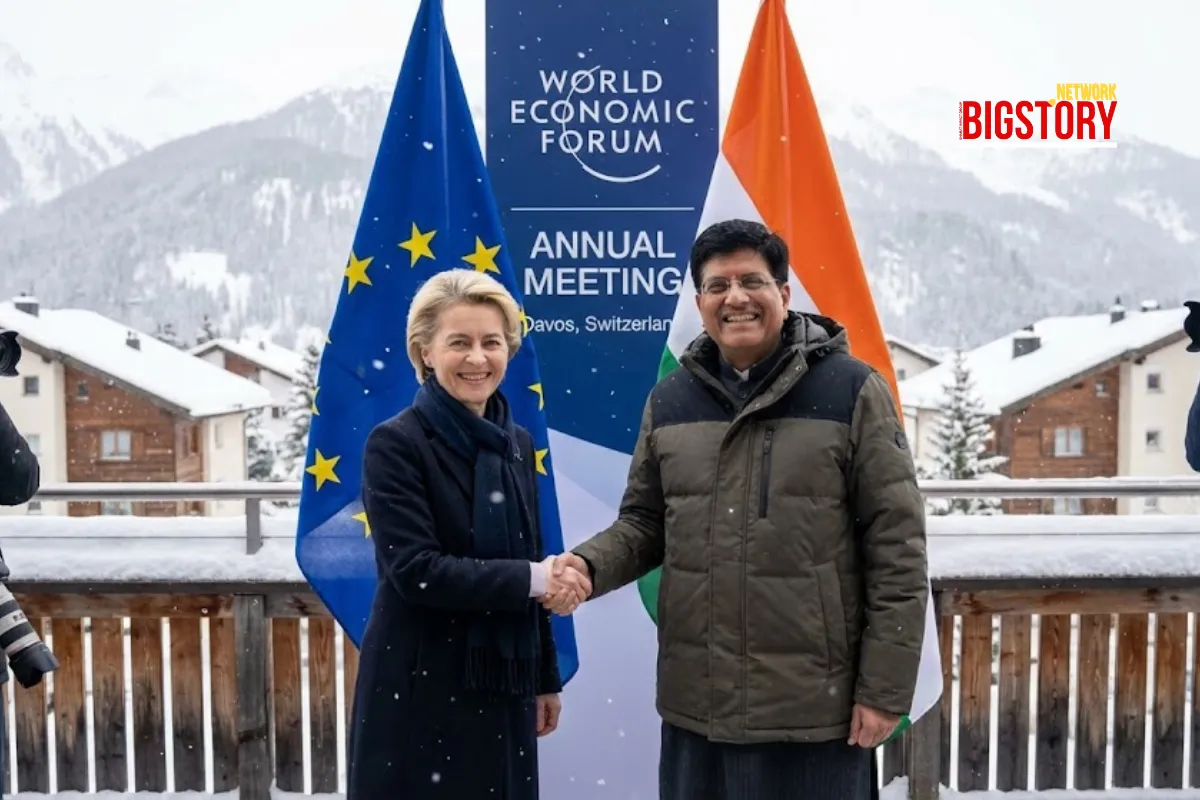
In a landmark development reported today, January 21, 2026, European Commission President Ursula von der Leyen declared that India and the European Union are on the "cusp of a historic trade agreement." Speaking from the World Economic Forum, she—alongside Indian Commerce Minister Piyush Goyal—dubbed the imminent pact the "Mother of All Deals."
The agreement is expected to be formalized during the India-EU Summit on January 27, coinciding with Republic Day celebrations where EU leaders will be chief guests. The deal aims to slash tariffs on over 90% of traded goods, creating a seamless market of 2 billion people and exponentially expanding the current $135 billion bilateral trade volume.
The Context (How We Got Here)
- The Trigger: The catalyst for this sudden breakthrough is the recent "Tariff Shock" from the US. With Washington imposing fresh levies of 10-25% on both Indian and European goods, both blocs were forced to accelerate negotiations to find alternative markets.
- The Background: Talks were initially launched in 2007 but stalled in 2013 over rigid differences regarding automobile tariffs and data security. They remained frozen until a post-pandemic relaunch in 2022.
- The Escalation: At Davos this week, Von der Leyen explicitly framed the deal as a strategic counter-balance to rising global protectionism, confirming that the 18-year deadlock has finally been broken.
The Key Players (Who & So What)
- Ursula von der Leyen (EU Commission President): The deal-closer. She is pushing to secure a "first-mover advantage" in the Indian market before other competitors lock in, aiming to diversify European supply chains away from China.
- Piyush Goyal (Commerce Minister): The negotiator. He successfully kept India's sensitive agriculture and dairy sectors out of the pact—protecting domestic farmers—while aggressively pushing for duty-free access for Indian textiles and leather.
- Ajay Srivastava (GTRI Founder): The analyst. He frames the deal not just as an economic opportunity but as a "survival mechanism" for Indian firms to absorb the shock of higher US tariffs by pivoting to Europe.
The BIGSTORY Reframe (The "Lifeboat Strategy")
While the media celebrates the sheer scale of the "2 billion" consumer base, the real story is that this is a Mutual Defence Pact.
The "Mother of All Deals" is essentially a lifeboat.
- The Real Catalyst: This 18-year-old stalemate didn't end because of sudden goodwill; it ended because of Donald Trump. His aggressive protectionist policies forced New Delhi and Brussels to find a "safe harbor" in each other.
- The Swap: The deal is a strategic barter: India opens its doors to European luxury goods (wines, spirits, cars) in exchange for Europe opening its doors to Indian labor-intensive goods (textiles, footwear). It is a classic "Guns for Butter" trade, reconfigured for the 2026 geopolitical climate.
The Implications (Why This Matters)
The deal reshapes the winners and losers of the Indian economy.
- The Tiruppur Boom: Indian textiles, which currently face high duties in the EU compared to Bangladesh or Vietnam, will gain duty-free access. This levels the playing field and could spark a massive jobs boom in Tamil Nadu and Gujarat.
- The Auto Anxiety: While consumers may cheer cheaper German cars, domestic manufacturers in Pune and Chennai face a new wave of competition. The "Zero Tariff" regime on automobiles will test the resilience of Indian manufacturing.
- The Carbon Trap: A hidden hurdle remains the Carbon Border Adjustment Mechanism (CBAM). While tariffs drop, this "Carbon Tax" kicks in. If Indian steel and aluminum exporters cannot prove they are "green," the duty-free benefits might be nullified by compliance costs.
The Closing Question (Now, Think About This)
If the world's largest democracies must band together to survive the trade policies of their oldest ally, has "Free Trade" become a survival tactic rather than an economic ideal?
FAQs
- What is the 'Mother of All Deals' mentioned by Piyush Goyal? It refers to the imminent India-EU Free Trade Agreement (FTA), expected to be signed in January 2026. Officials have used the term to describe the massive scale of the pact, which connects two markets comprising 2 billion people.
- Will European cars become cheaper in India after the 2026 FTA? Likely yes. The EU has aggressively pushed for significant tariff reductions on automobiles, wines, and spirits. If ratified, import duties on these luxury goods are expected to drop, increasing competition for domestic brands.
- How will the India-EU FTA benefit the textile industry? Indian textiles, leather, and footwear will gain duty-free access to the European market. This is crucial for hubs like Tiruppur and Surat, allowing them to compete on equal footing with Bangladesh and Vietnam, which already enjoy zero-duty benefits.
- Did India agree to the EU Carbon Tax (CBAM) in the FTA? The negotiations reportedly adopted a "middle-path." While the Carbon Border Adjustment Mechanism (CBAM) remains a non-tariff barrier, the deal likely includes mechanisms to offset liabilities using India's own carbon reduction certificates, though compliance remains a risk for heavy industries.
- When will the India-EU Trade Deal be signed? The agreement is expected to be formalized during the India-EU Summit on January 27, 2026, in New Delhi, coinciding with the Republic Day celebrations where EU leaders are present.
Mother of all deals India EU, Ursula von der Leyen Davos 2026, Piyush Goyal trade deal announcement, India EU Summit Jan 27.
Sources
News Coverage
Context & Analysis

 Sseema Giill
 Exclusive Content