BIGSTORY Network


India Jan. 27, 2026, 6:50 p.m.

UGC Equity Regulations 2026: Protests Erupt, Bareilly Magistrate Resigns Over "Black Law"

Protests hit UGC HQ over new Equity Regulations 2026. Students and UP leaders oppose mandatory "Equity Squads" and removal of false complaint penalties.
by Author Brajesh Mishra
Hero Image

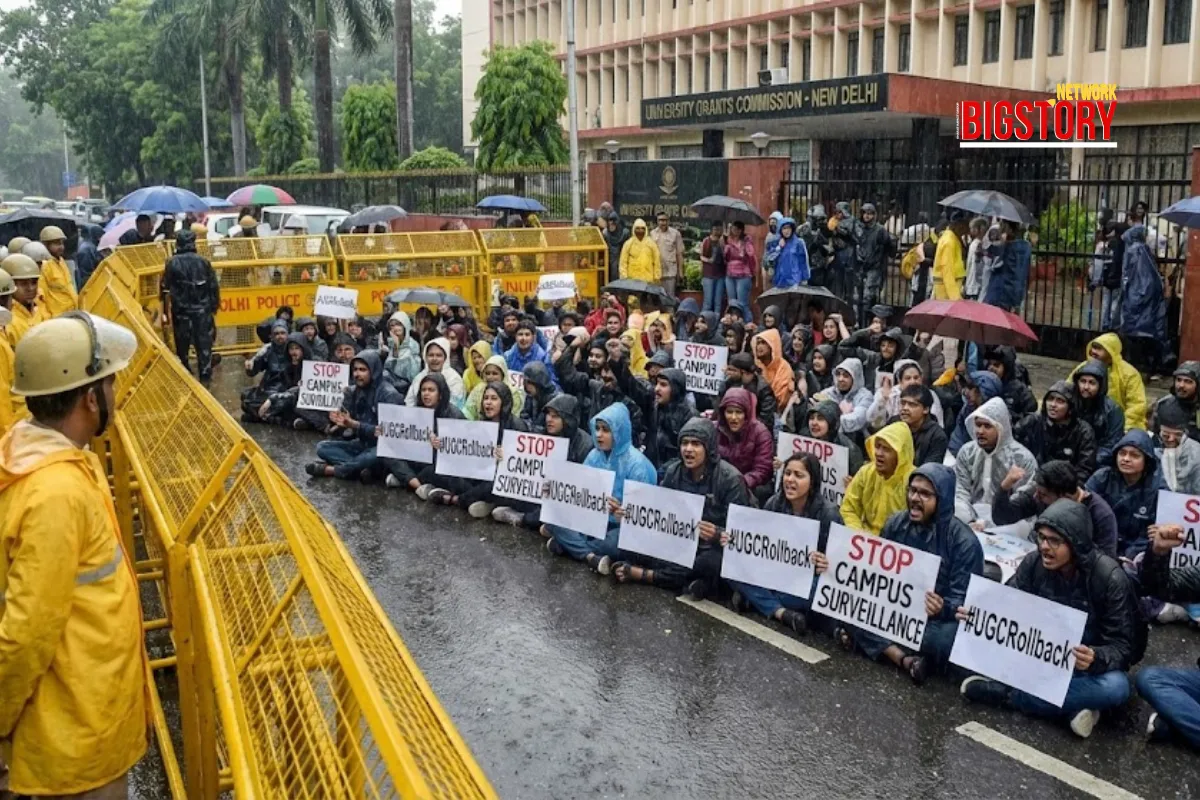
Today, January 27, 2026, the University Grants Commission (UGC) headquarters in New Delhi became the epicenter of a fierce political and academic storm as hundreds of students staged a sit-in protest against the newly notified "Promotion of Equity in Higher Education Institutions Regulations, 2026." The unrest has spilled over into Uttar Pradesh, creating a political crisis for the ruling BJP, with several local leaders and a City Magistrate resigning in protest against what they term a "Black Law" that institutionalizes reverse discrimination.

The agitation forced UGC officials to meet a student delegation led by PhD scholar Alokit Tripathi, concluding with a promise to issue a formal clarification within 15 days (by February 12). The core contention is not just the inclusion of OBCs in the protected list, but the creation of "Equity Squads"—mobile vigilance teams that students fear will turn campuses into "surveillance states"—and the controversial removal of penalties for filing false complaints.

The Context (How We Got Here)

  • The Notification (Jan 13): The UGC replaced its 2012 advisory guidelines with mandatory regulations. Key changes included adding Other Backward Classes (OBCs) to the protected category and mandating "Equity Squads" to patrol hostels and canteens.
  • The "False Complaint" Trigger: In a move that sparked the "reverse discrimination" narrative, the final 2026 draft removed a clause present in earlier versions that penalized students for filing false or malicious discrimination complaints. Protesters argue this weaponizes the law against General Category students.
  • The Political Fallout (Jan 26): On Republic Day, Alankar Agnihotri, the City Magistrate of Bareilly (UP), resigned from service, calling the regulations "divisive" and "anti-Brahmin." This was followed by the resignation of Raju Pandit, Vice President of the BJP Yuva Morcha in Noida, signaling deep internal fissures within the ruling party's support base.

The Key Players (Who & So What)

  • Alokit Tripathi (Student Leader): The voice of the protest. Leading the delegation that met the UGC today, he framed the "Equity Squads" as a tool for moral policing. His argument—"The definition of the victim is predetermined"—resonates with students who feel the law presumes guilt based on caste.
  • Alankar Agnihotri (Ex-City Magistrate, Bareilly): The symbol of dissent. A serving bureaucrat resigning over a policy issue is rare. His exit has galvanized "upper caste" groups in UP, turning a student issue into a wider electoral liability for the state government.
  • Dharmendra Pradhan (Union Education Minister): The pacifier. Attempting to de-escalate, he issued a statement today assuring that "no one will have the right to misuse the law," and that checks and balances will be maintained, though he stopped short of promising a rollback.

The BIGSTORY Reframe (The "Campus Police" State)

While the media frames this as "Upper Caste vs. Social Justice," the deeper structural shift is the Criminalization of Campus Life.

  • From Grievance to Surveillance: The introduction of "Equity Squads" fundamentally changes the university atmosphere. These are not passive committees waiting for complaints; they are active patrols. This introduces a "pre-crime" approach to social interactions, where a heated debate in a canteen can be flagged by a squad as "discriminatory behavior" without a formal victim report.
  • The "Zero Risk" Clause: By removing the penalty for false complaints, the UGC has created a "Zero Risk" environment for accusers. In highly politicized campuses (like JNU or HCU), this asymmetry is what terrifies students—the fear that political rivalries will be settled using "Equity" laws that carry the threat of expulsion.

The Implications (Why This Matters)

  • The 15-Day Ultimatum: The UGC has bought time until February 12. If the promised "clarification" does not explicitly re-introduce safeguards against false complaints, the protests are likely to intensify during the mid-semester exam period.
  • BJP’s "Social Engineering" Stress Test: The BJP has spent years consolidating the OBC vote. These regulations were meant to cement that alliance. However, the backlash from its core "General Category" base in UP puts the party in a "lose-lose" dilemma—rollback angers OBCs; implementation alienates Upper Castes.
  • Administrative Paralysis: With the "Equity Committee" now mandatory, college principals are personally liable. Fear of litigation may lead administrations to suspend accused students immediately upon complaint, bypassing due process to save their own jobs.

The Closing Question (Now, Think About This)

If a law designed to create equality requires "squads" to enforce it and prompts magistrates to resign in protest, is it healing the divide, or deepening the trench?

FAQs: Decoding the Protest

1. Why are students protesting against the UGC Equity Regulations 2026? The primary grievance is the perceived lack of protection for General Category students. Protesters cite the removal of penalties for false complaints and the creation of "Equity Squads" (surveillance teams) as mechanisms that could be weaponized to settle personal or political scores without due process.

2. What is an "Equity Squad"? Under the new rules, "Equity Squads" are mobile vigilance teams mandated to patrol "vulnerable" areas of the campus (like hostels, canteens, and common rooms) to monitor interactions and prevent discrimination. Critics argue this amounts to moral policing and constant surveillance.

3. Did the UGC remove the penalty for false discrimination complaints? Yes. Previous drafts of the regulation included a clause to punish students filing malicious or false complaints. The final notified version removed this clause to encourage victims to come forward without fear, but critics argue this removes the only deterrent against misuse.

4. Who is Alankar Agnihotri and why is he trending? Alankar Agnihotri was the City Magistrate of Bareilly, Uttar Pradesh. He resigned on January 26, 2026, explicitly citing the new UGC regulations as a "Black Law" that divides society. His resignation has become a rallying point for the protests in UP.

5. What is the "15-Day Deadline" mentioned in the news? Following the protests on Jan 27, UGC officials met with student representatives and promised to issue a formal clarification or solution regarding their demands (specifically on the misuse of the law) within 15 days, i.e., by February 12, 2026.

Sources

News Coverage

Context & Analysis


Brajesh Mishra
Brajesh Mishra Associate Editor

Brajesh Mishra is an Associate Editor at BIGSTORY NETWORK, specializing in daily news from India with a keen focus on AI, technology, and the automobile sector. He brings sharp editorial judgment and a passion for delivering accurate, engaging, and timely stories to a diverse audience.

BIGSTORY Trending News! Trending Now! in last 24hrs

Breakups Need a Certificate? Uttarakhand Tweak UCC Rules
India
Breakups Need a Certificate? Uttarakhand Tweak UCC Rules
UGC Equity Regulations 2026: Protests Erupt, Bareilly Magistrate Resigns Over "Black Law"
India
UGC Equity Regulations 2026: Protests Erupt, Bareilly Magistrate Resigns Over "Black Law"
Bovino Out, Homan In: Trump Replaces Border Chief After Nurse's Death
India
Bovino Out, Homan In: Trump Replaces Border Chief After Nurse's Death
SC Refuses to Ban "VIP Darshan" at Ujjain Mahakal
India
SC Refuses to Ban "VIP Darshan" at Ujjain Mahakal