
India bets big on chips: ₹10,000 cr Mohali modernization and ₹1.15 lakh cr ECMS bids move beyond assembly; MSMEs surge, 7nm design signals tech sovereignty.
 Brajesh Mishra
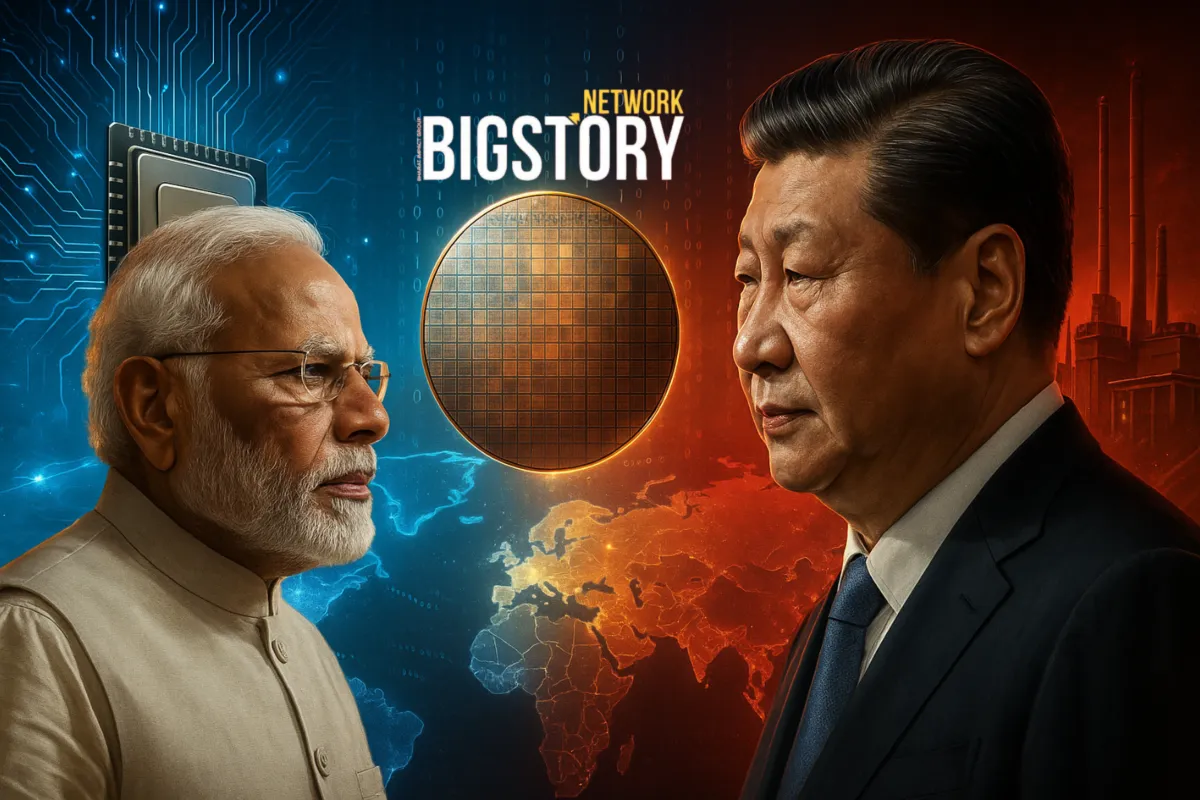
In October 2025, India’s semiconductor and electronics manufacturing ambitions reached a decisive inflection point. The government committed ₹62,900 crore of its ₹65,000 crore semiconductor fund, with ₹10,000 crore specifically reserved for modernizing the Semiconductor Laboratory in Mohali. This is the final major allocation before the fund runs dry. But the real story isn’t just about how much money is being spent — it’s what this bet reveals about India’s strategy to break free from its decades-long role as a mere assembly hub.
The Electronics Component Manufacturing Scheme (ECMS) attracted a staggering ₹1.15 lakh crore in investment proposals — almost double the ₹59,350 crore target. More tellingly, 60% of those proposals came from Indian MSMEs. This marks a fundamental shift: India isn’t just assembling imported components anymore, it’s trying to build the ecosystem to make those components itself. And the ₹10,000 crore Mohali upgrade is the symbolic capstone — a push to design India’s own chips, including a 7nm processor that aims to signal India’s arrival in the big leagues of global semiconductor competition.
On October 1, 2025, the government announced the extraordinary response to ECMS: ₹1.15 lakh crore in investment proposals from 249 applicants. Most are domestic MSMEs, not multinational giants. Just weeks later, on October 18, the IT Minister revealed India’s boldest technological leap yet: plans to design a 7nm processor through a modernized Mohali lab.
This is not happening in isolation. It sits on top of a semiconductor mission where nearly all available funds have already been committed — from Tata’s massive 28nm fab in Gujarat to Micron’s assembly plant in Sanand. Mohali is where India is now attempting to go from making chips designed elsewhere to designing its own.
India’s electronics boom has long had a hollow center. Production has exploded over the last decade, but domestic value addition has remained stuck at 15–20%. Eighty-five percent of critical components still come from abroad, mostly China. ECMS is designed to double local value addition to 35–40% by 2030.
Meanwhile, the global “China+1” diversification wave is peaking. If India doesn’t capture manufacturing now, Vietnam, Indonesia, and Mexico will. Apple’s India production has already proven scale is possible — but components remain imported. That’s the battlefield ECMS targets.
On the semiconductor side, India currently imports 100% of its chips. The mission’s ₹76,000 crore allocation is building fabs and assembly units, but Mohali’s upgrade fills the missing layer: design capability. By attempting a 7nm chip design now, India is trying to leapfrog technological stages rather than crawl through them.
The popular narrative imagined India’s semiconductor ecosystem being built by giants like Foxconn, Samsung, or TSMC. Instead, 60% of the proposals under ECMS are from Indian MSMEs. They’re betting their own capital on making components like PCBs, camera modules, lithium cells, and display units — the invisible backbone of every electronic device.
This is a double-edged sword. It democratizes manufacturing and builds domestic capacity from the ground up. But MSMEs lack the scale, technology access, and financial firepower that China’s vertically integrated giants enjoy. Whether hundreds of small firms can collectively match China’s pricing power is an open question.
The Semiconductor Laboratory in Mohali is a 38-year-old R&D facility built in the 1980s. It has never been at the global frontier. But now, it’s being positioned as the heart of India’s chip design leap.
The modernization includes EUV-compatible cleanrooms, advanced design tools, and partnerships with global chipmakers. It’s where India hopes to design its first 7nm chip by 2027 — even as the rest of the world moves toward 2nm and below.
This isn’t about immediately matching TSMC or Samsung. It’s about building indigenous design capability — the foundation on which later technological catch-up depends.
India is trying to do in five years what took other nations decades. Fabs will take until 2027–2028 to become operational. By then, 7nm will be a mature node globally, good enough for automotive and defense applications but far behind smartphones and AI accelerators. That’s not necessarily failure — it’s about occupying a viable segment of the value chain rather than chasing the bleeding edge.
The question is whether India can execute this transformation faster than technology obsolescence can outrun it.
Mohali’s 7nm ambitions depend on AI-powered electronic design automation (EDA) tools from U.S. companies. These tools are the brains behind modern chip design. If geopolitical tensions disrupt access, India’s ambitions could stall.
On the manufacturing side, AI will also determine whether India can compress the learning curve — optimizing yields, detecting defects, and accelerating ramp-up at fabs. If done well, AI can shave a decade off India’s industrial learning timeline. If not, India will be left building yesterday’s technology tomorrow.
Most analysts treat India’s semiconductor mission as a catch-up play with China and Taiwan. But it’s actually about something more fundamental: avoiding the manufacturing trap that stalled countries like Brazil and Mexico.
Those nations built assembly hubs but never developed design and fabrication capabilities. When global value chains shifted, they were left behind. India is trying to compress the timeline, leap to higher-value manufacturing, and democratize it through MSMEs — all at once.
That’s why the ₹10,000 crore Mohali investment matters so much. It’s not just another infrastructure project. It’s India’s declaration that it doesn’t want to spend the next 20 years tightening foreign screws on domestic assembly lines.
Q1. What is the ₹10,000 crore Mohali investment for?
It’s for upgrading India’s Semiconductor Laboratory to enable advanced chip design and development — starting with a 7nm processor project.
Q2. How is ECMS different from previous schemes?
Unlike past programs focused on assembling imported components, ECMS incentivizes domestic production of core components like PCBs, camera modules, and lithium cells.
Q3. Why are MSMEs important here?
Because 60% of ECMS applications are from MSMEs. If they succeed, India builds a distributed, resilient manufacturing ecosystem rather than relying solely on foreign giants.
Q4. Is 7nm too ambitious for India?
Yes and no. It’s ambitious given India’s current zero-base, but it builds design capability that can evolve to more advanced nodes over time.
Q5. How does AI fit into this?
AI powers modern chip design tools and optimizes manufacturing processes. It can accelerate India’s learning curve — but dependence on U.S. AI tools is a vulnerability.
 Exclusive Content


Sign up for the Daily newsletter to get your biggest stories, handpicked for you each day.



 Trending Now! in last 24hrs