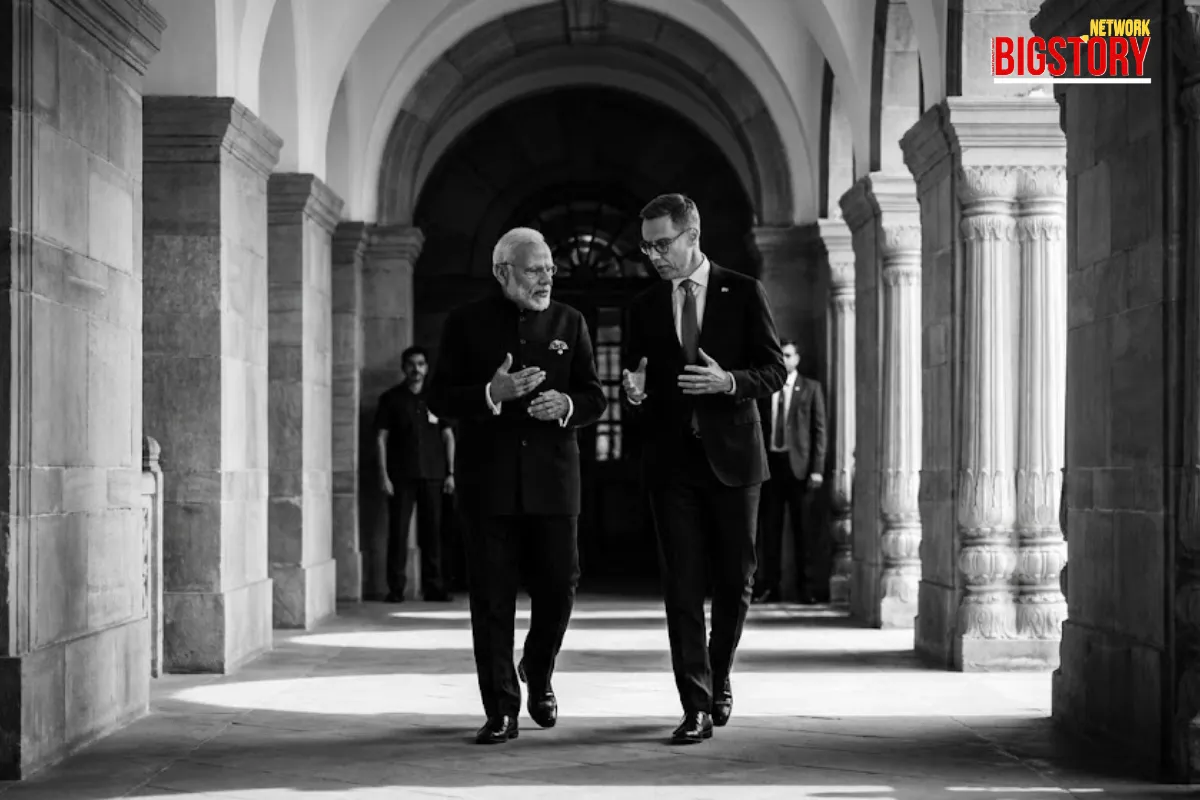
As the Middle East plunges deeper into a devastating multi-front war, New Delhi is stepping forward to fill a massive void in global leadership. On Thursday, Prime Minister Narendra Modi utilized a joint press briefing with Finnish President Alexander Stubb to deliver a sharp, unequivocal message to the warring factions in West Asia: end the hostilities immediately.
This matters because India's diplomatic stakes have never been higher. Following the massive U.S. and Israeli joint strikes on February 28—and the subsequent unconfirmed reports regarding the death of Iran’s Supreme Leader—the region is a powder keg. With global oil prices surging and the Indian Rupee hitting a record low of ₹82.80+, the economic and human costs are spiraling. By actively mobilizing diplomatic channels and elevating ties with European allies like Finland, Modi is establishing India not just as a regional heavyweight, but as the indispensable neutral mediator of the 2026 crisis.
The "BigStory" Angle (The "Democratic Peace" Narrative & AI Diplomacy)
Mainstream media is obsessing over India's "balancing act" to protect its oil shipments and diaspora. They are entirely missing the "Democratic Peace" Narrative.
Modi is reframing global peace. He is no longer presenting it merely as a moral imperative, but as an absolute prerequisite for High-Tech Sovereignty. By deliberately linking his anti-war appeal to the signing of a new India-Finland AI and 6G pact, Modi is arguing that military conflict "resets civilization backwards," threatening the very digital and quantum infrastructure the democratic world is rushing to build.
Furthermore, watch the AI Diplomacy angle. During the concurrent India AI Impact Summit, the Prime Minister utilized BHASHINI—India's real-time AI translation tool—to broadcast his peace appeal. This allowed New Delhi to bypass traditional Western media gatekeepers and deliver India's diplomatic stance directly to the Global South in multiple languages instantly, a masterclass in modern information warfare.
The Context (Rapid Fire)
- The Trigger: The joint U.S.-Israeli "Operation Epic Fury" strikes on Iran on February 28 ignited a massive wave of retaliatory ballistic missile attacks across the Persian Gulf, threatening sovereign borders and global shipping.
- The Backstory: Just days before the escalation, PM Modi concluded a landmark visit to Israel, addressing the Knesset on February 25–26 and warning that "humanity must never become a victim of conflict."
- The Escalation: By March 2, the diplomatic red phones were ringing off the hook. PM Modi held emergency, back-to-back calls with Israeli PM Benjamin Netanyahu and the leadership of Saudi Arabia and Bahrain, pleading for "maximum restraint."
Key Players (The Chessboard)
- Narendra Modi (The Global Friend): Championing the "Vishwa Mitra" initiative, he is leveraging his unique personal rapport with Donald Trump, Benjamin Netanyahu, and regional Arab leaders to force a ceasefire.
- Alexander Stubb (The European Ally): The President of Finland, who is actively backing India's bid for a permanent UNSC seat and supporting the immediate call for a "swift end" to the conflict to protect global supply chains.
- S. Jaishankar (The Crisis Manager): India's External Affairs Minister, actively working the phones with his counterparts in Tehran and Tel Aviv to prevent the localized war from spiraling into a global contagion.
The Implications (Your Wallet & World)
- Short Term (Diaspora Safety): Ignore the viral rumors of a secret naval evacuation; a mass operation has not been launched yet. However, the Ministry of External Affairs (MEA) has activated 24/7 helplines. If you have family in the Gulf, register their details immediately on the e-Migrate portal.
- Long Term (The G20 Roadmap): Diplomatic eyes are glued to the upcoming March 7 G20 emergency virtual summit. Analysts expect Prime Minister Modi to leverage India's neutral standing to propose a formal "New Delhi Peace Roadmap" to halt the missile exchanges.
The Closing Question
India is attempting to use its economic leverage and tech sovereignty to broker peace where Western ultimatums have failed. Can New Delhi’s "Vishwa Mitra" diplomacy actually stop a war in the Middle East, or is the conflict already too far gone? Tell us in the comments.

FAQs
- Q: Why did PM Modi say war is not a solution in 2026?
- A: Speaking alongside the Finnish President on March 5, 2026, PM Modi emphasized that "no issue can be resolved through military conflict alone," advocating for dialogue and diplomacy to protect global stability and high-tech supply chains.
- Q: What is India's stance on the U.S.-Israel-Iran war?
- A: India maintains a stance of strategic neutrality, acting as a "Global Friend" (Vishwa Mitra). New Delhi is calling for maximum restraint, a swift end to hostilities, and a return to diplomacy to protect the 9 million Indian expats in the region.
- Q: How is PM Modi mediating the Middle East crisis?
- A: PM Modi is utilizing direct personal diplomacy, holding emergency calls with leaders from Israel, Saudi Arabia, and Bahrain, while his External Affairs Minister engages with Tehran to open de-escalation backchannels.
- Q: Did PM Modi speak to Benjamin Netanyahu after the Iran strikes?
- A: Yes. On March 2, 2026, just days after the joint strikes on Iran, PM Modi held an emergency phone call with Israeli PM Benjamin Netanyahu to urge restraint and prevent further regional contagion.
Sources: