Canada arrests Khalistani extremist Inderjit Singh Gosal in Ottawa after India–Canada NSA talks, marking renewed counter-terror cooperation.
 Sseema Giill
In a development that could redefine India–Canada security ties, Canadian authorities arrested 36-year-old Inderjit Singh Gosal in Ottawa on firearms possession charges. This marks Gosal’s second arrest in less than a year, underscoring his continued involvement with separatist-linked extremist networks.
Gosal is widely known as a key aide and former personal security officer to Gurpatwant Singh Pannun, head of the US-based separatist outfit Sikhs for Justice (SFJ). SFJ has long been accused of orchestrating Khalistan referendum campaigns and fueling diaspora-led militancy across North America and Europe.
Inderjit Singh Gosal’s name gained prominence after the killing of Hardeep Singh Nijjar in Surrey, Canada, in June 2023. Nijjar, a designated terrorist by India, had been spearheading SFJ’s Khalistan campaigns in Canada. Following his death, Gosal stepped up to coordinate referendum-related activities, making him one of Pannun’s most trusted associates.
In November 2024, Gosal was first detained after allegedly participating in a violent attack on Hindu worshippers at a temple in the Greater Toronto Area (GTA). Though he was released under strict conditions, intelligence agencies continued to monitor his activities closely, citing his growing influence within the Khalistan network.
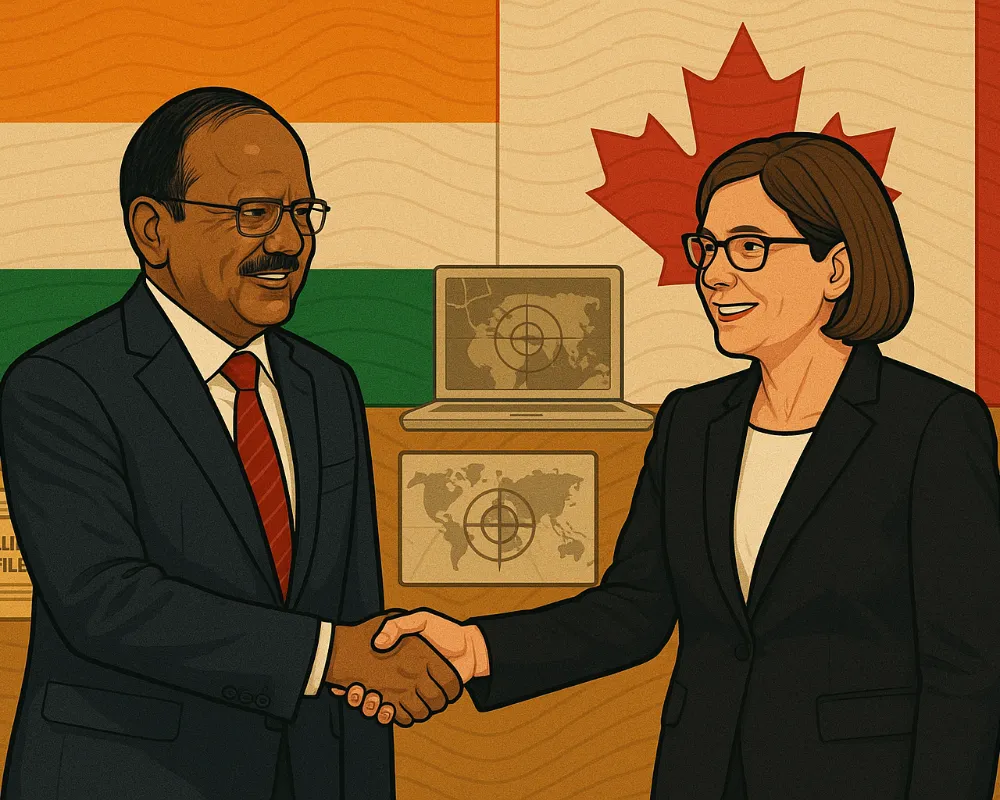
According to security officials, Gosal’s latest arrest is not an isolated development but the result of sustained intelligence sharing between New Delhi and Ottawa. The breakthrough reportedly came after India’s National Security Adviser (NSA) Ajit Doval met his Canadian counterpart Nathalie Drouin in New Delhi, as part of what diplomats describe as a “hard reset” in bilateral ties.
India, which has long urged Canada to crack down on separatist violence emanating from its soil, views the arrest as a significant shift in Canada’s stance. For Ottawa, the move signals a willingness to address Indian concerns while also tackling the threat of extremist networks that jeopardize public safety domestically.
Security analysts and former diplomats believe the arrest could serve as a turning point in India–Canada relations. Experts note that Western democracies have often struggled to act decisively against diaspora-linked extremist groups due to domestic political sensitivities. Gosal’s detention, therefore, is being viewed as tangible proof that intelligence cooperation and diplomatic pressure can yield results.
Some analysts also point out that the arrest could deter further radicalization among Khalistan supporters in Canada, where political leaders have previously been accused of overlooking extremist activities to maintain diaspora vote banks.
Beyond India and Canada, Gosal’s arrest underscores the transnational nature of extremist networks and the vital role of intelligence sharing among democratic allies. Analysts argue that as extremist groups increasingly exploit global diasporas, no single country can afford to act in isolation. The case demonstrates how diplomatic engagement can help align national security priorities across borders
 Exclusive Content


Sign up for the Daily newsletter to get your biggest stories, handpicked for you each day.


 Trending Now! in last 24hrs