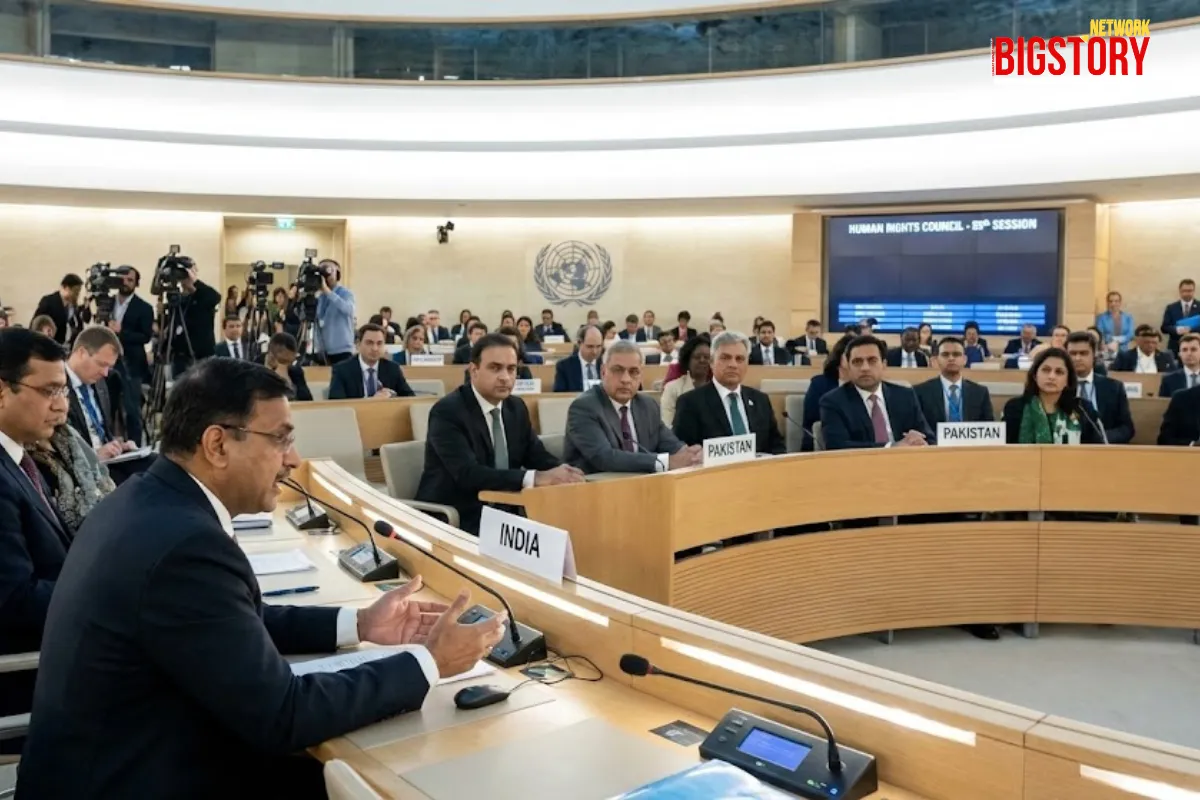
The annual diplomatic sparring match between India and Pakistan at the United Nations took a brutal, mathematically verifiable turn this week. On Thursday, February 26, 2026, the 61st Session of the UN Human Rights Council in Geneva became the stage for one of New Delhi's sharpest international rebuttals to date. Exercising its Right of Reply, India did not just reject Pakistan's standard allegations regarding Jammu and Kashmir; it weaponized economic data to expose the disparity between the two nations.
This matters because it marks a definitive end to India playing defense on the global stage. First Secretary Anupama Singh systematically dismantled the narrative presented by the Pakistani delegation and the Organisation of Islamic Cooperation (OIC). By directly comparing the towering infrastructure of J&K to Pakistan's failing national economy, India publicly rendered Islamabad's regional claims irrelevant, telling the UN assembly that Pakistan must be "living in La La Land."
The "BigStory" Angle (The "Economic Humiliation" Strategy)
Mainstream media is hyper-focused on the catchy "La La Land" soundbite. They are missing the broader strategic pivot to Financial Diplomacy.
For decades, Pakistan has attempted to internationalize the Kashmir issue using the language of human rights and occupation. India has now countered by shifting the language to sovereign solvency and infrastructure.
By pointing out that the development budget for J&K alone eclipses Pakistan’s desperate $1.2 billion IMF lifeline by more than double, India is speaking directly to the Global South. The message is clear: Pakistan is a failing state unable to govern its own economy, let alone dictate the future of a rapidly modernizing Indian territory.
Furthermore, watch the Deepfake Disinformation angle. India explicitly warned the UN about Pakistan's attempts to label massive engineering marvels like the Chenab Rail Bridge as "fake" or "CGI." This highlights a new era of diplomatic warfare where visual verification and countering AI-driven disinformation are now central to territorial disputes.
The Context (Rapid Fire)
- The Trigger: On February 5, 2026, Pakistan's UN envoy Asim Iftikhar Ahmad used "Kashmir Solidarity Day" to accuse India of systemic human rights violations and "enforced disappearances."
- The Backstory: Tensions have been at a boiling point since May 2025, when India conducted "Operation Sindoor," targeting terror launchpads in Pakistan-occupied Kashmir (PoK) following a major attack in Pahalgam.
- The Escalation: To prove regional normalization, India cited the completion of the 359-meter-high Chenab Rail Bridge—the highest in the world—challenging Pakistan to physically deny its existence.
Key Players (The Chessboard)
- Anupama Singh (The Orator): India's First Secretary at the Permanent Mission in Geneva. She delivered the surgical takedown, noting that it is "hard to take lectures on democracy from a country where civilian governments rarely complete their terms."
- Asim Iftikhar Ahmad (The Challenger): The Permanent Representative of Pakistan to the UN, who attempted to use the UNHRC to paint J&K as a "traumatized" zone of permanent occupation.
- Parvathaneni Harish (The Strategist): India’s Permanent Representative to the UN, who is currently coordinating this broader, aggressive "Active Deterrence" diplomacy across all United Nations platforms.
The Implications (Your Wallet & World)
- Short Term (Information Warfare): Expect a massive surge in cross-border social media friction. As the "La La Land" clip goes viral, digital watchdogs are anticipating retaliatory, state-sponsored bot campaigns from Islamabad aimed at discrediting Indian infrastructure data.
- Long Term (UN Irrelevance): India's strategy is designed to exhaust the UN's patience with Pakistan. By consistently contrasting J&K's democratic voter turnout and soaring budget with Pakistan's terrorism and bankruptcy, New Delhi aims to permanently demote the Kashmir issue from the UN's active agenda.
The Closing Question
India has successfully used economic data to embarrass Pakistan on the global stage. But does comparing budgets and bridges actually silence international critics regarding human rights, or does it just change the subject? Tell us in the comments.
FAQs
- Q: Why did India say Pakistan is living in "La La Land" at the UN?
- A: Indian diplomat Anupama Singh used the phrase to mock Pakistan's refusal to acknowledge the rapid infrastructure and democratic development in Jammu and Kashmir, stating that anyone calling this progress "fake" must be hallucinating.
- Q: How much is J&K's development budget compared to Pakistan's IMF loan?
- A: Indian representatives highlighted that Jammu and Kashmir's ₹1.13 lakh crore development budget for 2026-27 is more than double the size of the $1.2 billion bailout package Pakistan recently sought from the International Monetary Fund (IMF).
- Q: What is the Chenab Rail Bridge and why did India mention it at the UNHRC?
- A: The Chenab Rail Bridge is an engineering marvel in J&K, standing 359 meters high (taller than the Eiffel Tower). India cited it as undeniable physical proof of the region's socio-economic integration and progress, directly countering Pakistan's claims of an "occupied, traumatized" territory.
- Q: Did the OIC support Pakistan at the 2026 UNHRC session?
- A: Yes, the Organisation of Islamic Cooperation (OIC) raised the issue alongside Pakistan. India sharply rejected their involvement, accusing the OIC of allowing itself to be reduced to an "echo chamber" for Pakistan's political propaganda.
Sources:

 Brajesh Mishra
 Exclusive Content