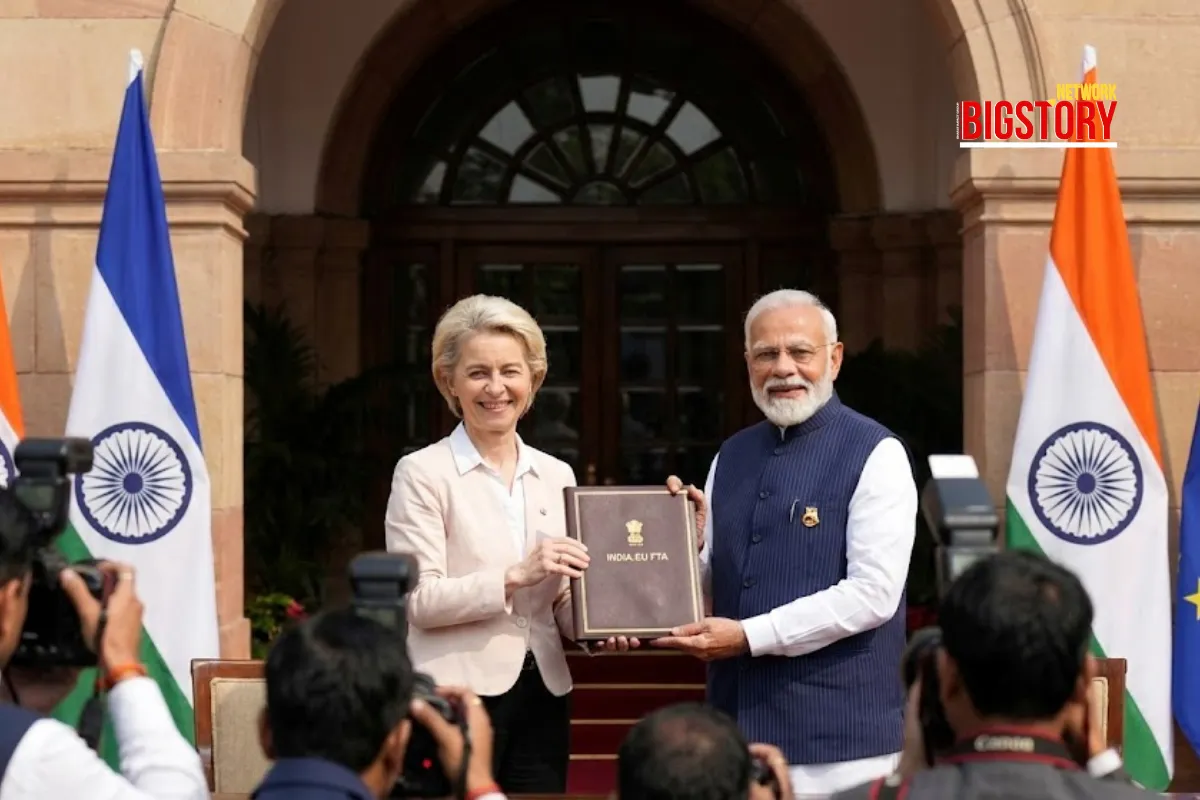
In a landmark ceremony at Hyderabad House in New Delhi today, January 27, 2026, Prime Minister Narendra Modi and European Commission President Ursula von der Leyen formally announced the conclusion of the India-EU Free Trade Agreement (FTA). Dubbed the "Mother of All Deals" by Brussels, the pact creates a free trade zone covering 2 billion people and 25% of global GDP, ending a negotiation marathon that began in 2007.
The agreement fundamentally reshapes the trade corridor: India will eliminate import duties on European luxury cars (slashing them from 110% to 10% for a fixed quota), wines, and spirits. In return, 99% of Indian exports—specifically textiles, leather, and sports goods—will now enter the European Union duty-free, leveling the playing field with competitors like Bangladesh and Vietnam.
The Context (How We Got Here)
- The Deadlock: Negotiations first launched in 2007 but collapsed in 2013 over rigid disagreements regarding Indian dairy protectionism and European data security standards.
- The Relaunch: Talks were formally rebooted in June 2022 as a geopolitical strategy to diversify supply chains away from Russia and China.
- The Accelerator: The final push in 2025 was driven by the "Trump 2.0" factor. With the US Administration reimposing isolationist tariffs, both New Delhi and Brussels rushed to finalize this deal as a defensive economic alliance.
The Key Players (Who & So What)
- Ursula von der Leyen (EU Commission President): The deal closer. Her personal presence in New Delhi signals that for Europe, this is no longer just about economics—it is about securing a democratic ally in Asia. She termed the deal a "deep connection between two of the world’s largest democracies."
- Piyush Goyal (Commerce Minister): The negotiator. He scored a significant domestic win by successfully keeping India's sensitive Dairy and Agriculture sectors completely out of the pact, protecting millions of farmers, while aggressively opening the door for labor-intensive industrial exports.
- Volkswagen & Mercedes-Benz: The big winners. The reduction of duties from 110% to 10% (on a quota of 250,000 vehicles) finally cracks open the Indian consumer market for European manufacturing, likely triggering a price war in the luxury auto segment by 2027.
The BIGSTORY Reframe (The "Trump Insurance" Policy)
Mainstream media is cheering about "Cheaper Mercedes and Scotch," but the real story is geopolitical survival.
- The Geopolitical Shield: This deal is effectively an insurance policy against American unpredictability. With the US threatening universal 10-20% tariffs, India and the EU have created a massive internal market to absorb goods that might be shut out of North America.
- The "AI Back Office": Buried in the text is a "Digital Trade Chapter." While not full GDPR equivalence, it creates a "Trusted Data Corridor." This cements India's role as the EU's "AI Back Office," allowing Indian IT giants (TCS, Infosys) to process European data with significantly fewer legal hurdles than before.
The Implications (Why This Matters)
- The Tirupur Boom: For the textile hubs of Tamil Nadu (Tirupur), this is a game-changer. Search trends for "EU export duty" are already spiking. With zero duties, Indian knitwear can finally compete head-to-head with Bangladesh, potentially sparking a manufacturing revival in the south.
- The "Wait to Buy" Effect: The deal will likely freeze the Indian luxury car market for the next 12 months. Buyers will hold off on purchases of Audi, BMW, or Mercedes models until early 2027, when the tariff cuts translate into showroom price drops of potentially lakhs of rupees.
- Make in India Pivot: While CBU (Completely Built Unit) imports get cheaper, the deal incentivizes European carmakers to source components from India. Expect stocks of auto-component makers (like Motherson Sumi) to rally as they integrate into the German supply chain.
The Closing Question (Now, Think About This)
If free trade is dead in the West (USA), has the East (India) just become the new champion of global capitalism?
FAQs
- When will car prices drop in India after the EU trade deal? While the deal is signed, ratification takes time. Consumers can expect price corrections on European cars (due to the duty drop from 110% to 10%) to hit showrooms by early 2027.
- Is Indian dairy included in the EU trade deal? No. The Indian government successfully negotiated to keep the sensitive Dairy and Agriculture sectors excluded from the FTA to protect domestic farmers from European competition.
- How does the India-EU deal benefit the textile industry? It removes import duties on 99% of Indian exports, including textiles and leather. This allows hubs like Tirupur to export to Europe duty-free, competing directly with Vietnam and Bangladesh.
- Does the India-EU deal include visa-free travel? No. The deal does not offer visa-free entry for tourists. However, it facilitates easier visa norms for professionals and service providers (Mode 4 access) moving between the two regions for work.
- Why is this deal called "Trump Insurance"? Analysts view the timing of the deal—finalized amidst rising US protectionism—as a strategic move to create a massive alternate market (India + EU) to shield both economies from potential US tariffs.
Sources
News Coverage
Context & Analysis

 Sseema Giill
 Exclusive Content