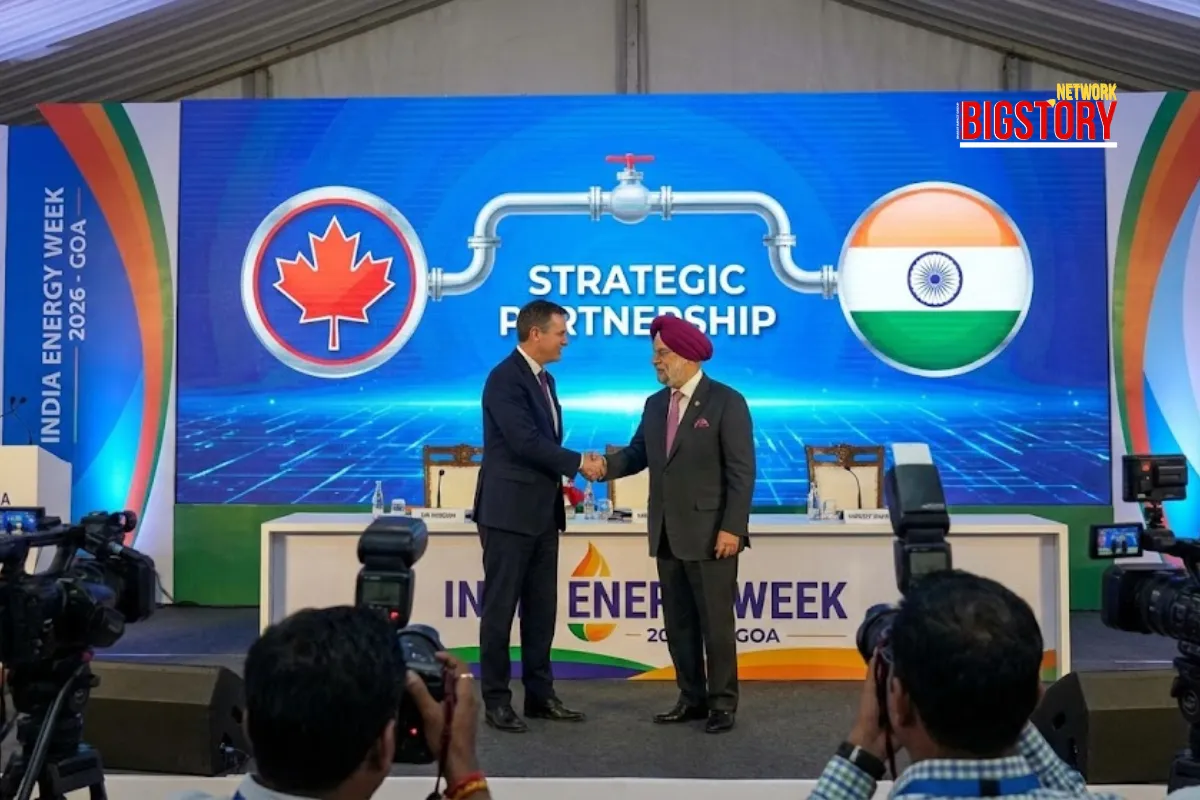
In a strategic alignment of necessity, Canada and India have formally announced a "comprehensive energy reset" today, January 27, 2026, at the India Energy Week summit in Goa. The pledge commits Canada to significantly increase exports of crude oil, Liquefied Natural Gas (LNG), and Liquefied Petroleum Gas (LPG) to India, effectively reviving the stalled "Ministerial Energy Dialogue."
The deal explicitly positions Canadian oil as a strategic alternative for India’s diversification away from Russian and Middle Eastern crude. However, the urgency is driven by Ottawa: following US President Donald Trump’s threat last week (Jan 20) to slap "100% tariffs" on Canadian goods, the Mark Carney administration is aggressively pivoting to Asia to reduce its historic reliance on the American market.
The Context (How We Got Here)
- The Enabler (TMX): The Trans Mountain Pipeline Expansion (TMX), which became fully operational in May 2024, is the physical backbone of this deal. For the first time, Canada has a high-volume direct tap to the Pacific Coast (890,000 barrels/day capacity), allowing it to ship heavy crude to Indian refineries without passing through US soil.
- The Freeze: Diplomatic relations had hit a nadir in 2024-2025 over the Khalistan/Nijjar controversy, freezing high-level trade talks. Today’s handshake signals that economic pragmatism has officially superseded political friction.
- The Catalyst: On January 20, 2026, President Trump accused Canada of being a "backdoor" for Chinese goods and threatened punitive tariffs. This accelerated Prime Minister Carney’s "Economy-First" diplomacy, forcing a rapid search for reliable G7-level buyers outside North America.
The Key Players (Who & So What)
- Tim Hodgson (Canadian Energy Minister): The Broker. Leading the delegation in Goa, he is tasked with selling Alberta’s heavy crude to Indian refiners. His explicit goal is to break the "monopsony" where the US buys 98% of Canada's energy.
- Hardeep Singh Puri (Indian Petroleum Minister): The Buyer. He successfully negotiated favorable terms for Canadian crude, which is chemically suited for India’s complex refineries like Reliance Jamnagar (capable of processing heavy, sour crude).
- Mark Carney (Prime Minister of Canada): The Strategist. His administration is driving a "pragmatic pivot," deliberately looking past recent diplomatic spats to secure economic lifelines. His "values-based realism" doctrine argues that Canada cannot afford to be economically dependent on a volatile US administration.
The BIGSTORY Reframe (The "Trump Protectionism" Catalyst)
While mainstream media frames this as a "Diplomatic Thaw," the real story is Survival Strategy.
- The Fear Factor: This deal isn't just about Canada liking India; it’s about Canada fearing the US. With US shale production peaking and Trump’s protectionism rising, Canada needs an escape valve. India, with its insatiable appetite for energy (growing 3-4% annually), is the perfect hedge.
- Refining Match: India’s refineries were built to process heavy crude (like Venezuela’s). With Venezuelan supply erratic, Canadian heavy crude from the oil sands is a near-perfect technical substitute, making this a marriage of engineering convenience, not just politics.
- The AI Angle: The joint statement explicitly mentions collaboration on "Artificial Intelligence in the energy industry." This suggests a tech-swap: Canadian AI for optimizing offshore drilling efficiency in India, exchanged for Indian IT prowess to manage Canada's pipeline logistics.
The Implications (Why This Matters)
- Shipping Boom: The TMX pipeline means more Aframax and Suezmax tankers will now move from Vancouver to Gujarat. This is a 25-day voyage compared to short pipeline runs to the US, significantly increasing global "ton-mile" demand for tankers.
- Critical Minerals Next: The energy deal is the wedge. The next phase, already hinted at by Hodgson, is Critical Minerals. India currently buys only 1% of Canada’s minerals; expect a push to link Canadian lithium and cobalt to India’s growing EV battery sector in March 2026.
- Diplomatic De-hyphenation: Both nations have agreed to "de-hyphenate" trade from political grievances. The Khalistan issue remains unresolved, but it has been "ring-fenced" to ensure it does not block the flow of oil.
The Closing Question (Now, Think About This)
If Canada is shipping its oil halfway across the world to India to avoid the US border, does "North American Energy Security" even exist anymore?
FAQs
1. Did Canada and India sign a new energy deal in 2026?Yes. On January 27, 2026, at India Energy Week in Goa, Energy Ministers Tim Hodgson and Hardeep Singh Puri announced a "comprehensive energy reset" to increase trade in crude oil, LNG, and LPG.
2. How does the Trans Mountain pipeline help India? The expanded Trans Mountain Pipeline (TMX), fully operational since May 2024, provides Canada with direct access to the Pacific Coast. This allows Canadian heavy crude to be shipped directly to India via tankers, bypassing the US pipeline network and diversifying India's supply sources.
3. Why is Canada pivoting to India for energy trade? The pivot is driven by the need to diversify markets beyond the US (which buys 98% of Canada's oil) and specifically to "de-risk" the Canadian economy following President Donald Trump's threat on Jan 20, 2026, to impose "100% tariffs" on Canadian goods.
4. Is Canada importing refined petroleum from India?Yes. The deal is reciprocal. While Canada exports raw crude and LNG to India, India will export refined petroleum products back to Canada, leveraging its massive refining capacity.
5. Who is the Prime Minister of Canada in 2026? In this timeline, Mark Carney is the Prime Minister of Canada. His administration is pursuing a "pragmatic pivot" to Asia to secure economic stability amidst US protectionism.
Sources
News Coverage
Context & Analysis

 Sseema Giill
 Exclusive Content