
Inside Jemimah Rodrigues' journey from anxiety and controversy to scoring 127* in the World Cup Semi-Final. A deep dive into resilience in elite sport.
 Rashmeet Kaur Chawla
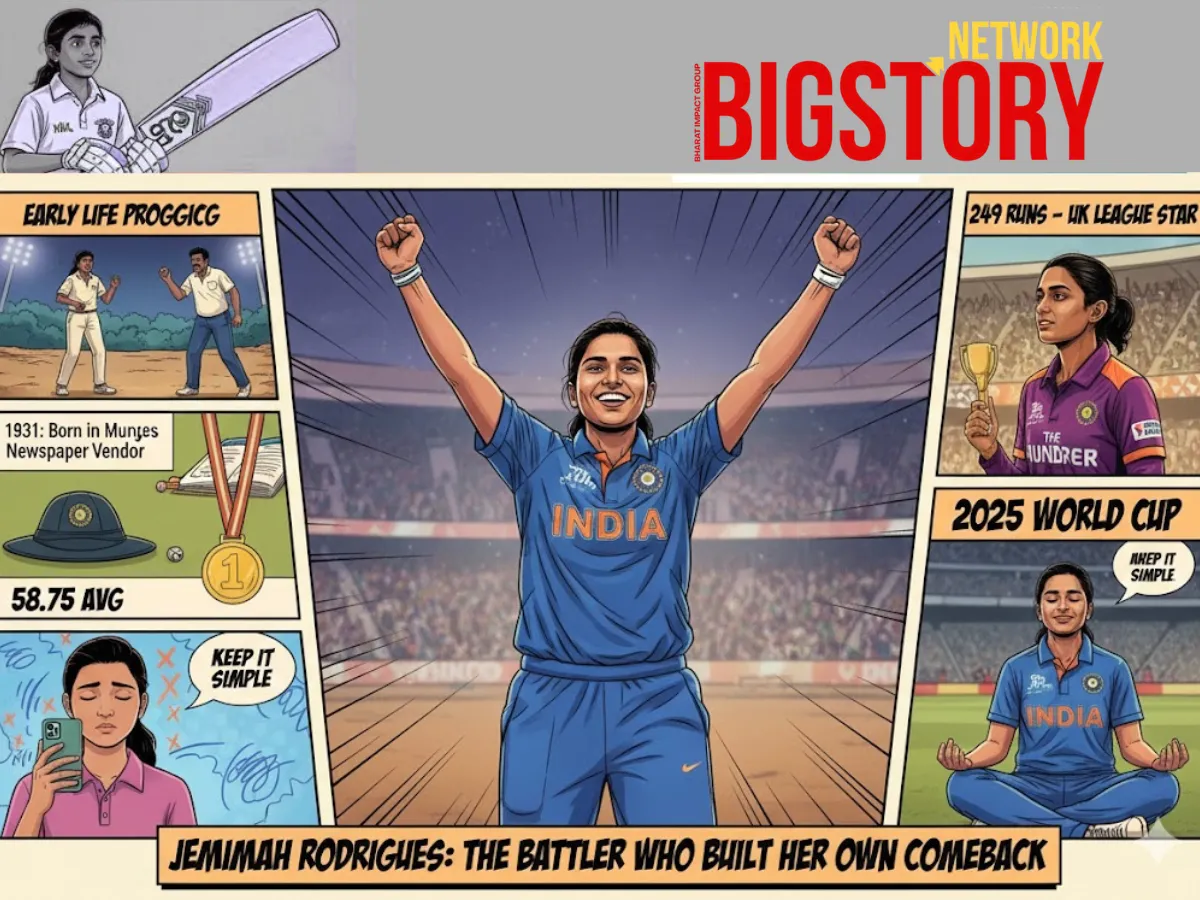
Jemimah Rodrigues is widely recognised as one of India’s most naturally gifted women cricketers of her generation. From a teenage prodigy to a World Cup match-winner, her cricketing resume reflects promise, flair, and global exposure. However, her professional journey cannot be evaluated purely through runs scored or matches won.
Jemimah’s career represents a deeper case study in how elite women athletes in India navigate mental health challenges, structural inequality in sport, public scrutiny, online abuse, and personal controversy - often simultaneously. This article examines the documented pressures she endured, the setbacks that shaped her professional mindset, and the practical decisions that enabled her to re-establish herself as a dependable international cricketer.
Born on September 5, 2000, in Mumbai’s Bhandup area, Jemimah Rodrigues grew up in a middle-class household where sport required sacrifice. Her father, Ivan Rodrigues, a junior cricket coach, played a central role in her development. Despite working night shifts, he prioritised her training, exposing her to structured coaching from an early age.
Jemimah balanced her education at St. Joseph’s Convent School and later Rizvi College alongside intensive cricket practice. Unlike many male counterparts, access to facilities, competitive exposure, and professional pathways for women were limited, making family support a decisive factor in her early progress.
Jemimah’s rise was swift. At just 13, she made her under-19 debut, scoring 178 runs, followed by a double century in domestic youth cricket. These performances placed her firmly in the national spotlight and fast-tracked her transition into international cricket.
She made her India debut at 17 and soon featured across formats. Her inclusion in overseas leagues such as the Women’s Big Bash League and later the Women’s Premier League expanded her exposure but also intensified expectations. Early success created a perception of inevitability—an assumption that performance would always follow promise.
Jemimah Rodrigues has been a regular performer for India on the international stage. She was a key member of the teams that won the Silver medal at the 2022 Commonwealth Games and then a Gold medal at the 2023 Asian Games, which clearly shows her ability to deliver in high-pressure, multi-nation tournaments.
Although always admired for her white-ball entertaining nature, Rodrigues has in fact come out with considerable red-ball basics as well. Judging by her composition of Test cricket alone, one can see an excellent batting average of 58.75 that speaks of a great level of technique, temperament, and adaptability, all qualities that are associated with long-format international cricket success.
Rodrigues has managed to achieve something quite extraordinary at the domestic level as well when she became only the second Indian woman after Smriti Mandhana to score a double century in a domestic 50-over game. This clearly exhibits her ability to control the innings for a long period of time and subdue the opposition.
Moreover, she doesn't only leave her mark in India as well. During the 2021 inaugural season of The Hundred (UK), she completed the tournament as the second leading run-scorer with 249 runs and turned out to be one of the best overseas players, thus giving another proof that she is a dependable batter in the world's franchise leagues.
Rodrigues' development as an ODI batter can be seen by the significant milestones apart from big ICC events. She recorded her first century in an ODI (102 runs off 91 balls) against Ireland at Rajkot in January 2025 and it was a very composed and attacking innings that proved her consistency not just in World Cup knockout matches but even in bilateral series.
During Jemimah’s formative and early professional years, women’s cricket in India faced:
As a result, women cricketers often operated under heightened performance pressure. Inconsistent form carried immediate selection consequences, while long-term development received less institutional patience.
Jemimah Rodrigues has openly spoken about anxiety, emotional breakdowns, and periods of self-doubt. These challenges intensified during phases of poor form and selection uncertainty. She has acknowledged making repeated emotional phone calls to her mother and struggling to regulate confidence under pressure.
In parallel, Jemimah became a frequent target of online abuse, including personal attacks. Such harassment, largely unrelated to on-field performance, compounded stress and created an unsafe psychological environment—an issue increasingly documented among female athletes globally.
In 2024, Jemimah’s membership at Khar Gymkhana, one of Mumbai’s oldest clubs, was cancelled following allegations against her father regarding religious activities at the club premises. Though Jemimah was not personally involved, the controversy escalated publicly, drawing media attention and social backlash.
The situation extended beyond sport, intersecting with sensitive social and religious narratives. Jemimah later described the accusations as false and emotionally devastating for her family.
The controversy occurred immediately after a difficult international phase, magnifying its impact. Jemimah stated that the episode “shattered” her mentally, highlighting how off-field issues can significantly influence athletic performance and emotional resilience.
Ahead of the 2022 Women’s ODI World Cup, Jemimah Rodrigues was dropped from the squad due to inconsistent form. For a player who had debuted young and carried public expectations, the omission represented a defining professional setback. The decision triggered intensified scrutiny and online criticism, reinforcing the fragility of selection security in women’s cricket.
Following her omission, Jemimah acknowledged emotional breakdowns and a temporary loss of confidence. However, instead of disengaging from the sport entirely, she reassessed her preparation, technical consistency, and mental approach.
This phase marked a transition from reliance on natural ability to structured performance management.
Through setbacks and scrutiny, Jemimah’s approach evolved into a practical belief system centred on controllables. Based on interviews and observable decisions, her outlook can be summarised as:
Performance improves when focus remains on present execution, disciplined preparation replaces emotional reaction, and team contribution outweighs personal validation.
This belief directly influenced her post-2022 comeback.
After the disappointment of 2022, Jemimah Rodrigues chose quiet determination over public defense. Rather than engaging with critics, she redirected her energy into measurable improvement. The technical work was intensive and specific refining shot selection against slow and turning pitches, strengthening her physical conditioning through dedicated training, and building the athleticism required for modern cricket's demands. This wasn't just about practicing more; it was about practicing smarter, analyzing weaknesses, and addressing the gaps exposed at the international level.
Most crucially, she recalibrated her mental approach. Instead of aggression or proving doubters wrong, Jemimah developed routines centered on clarity and presence. She learned to focus on the process—each ball, each session—rather than external noise or expectations.
Jemimah Rodrigues played a heroic role in India's historic 2025 Women's ODI World Cup triumph. In the semi-final on October 30 at DY Patil Stadium, Navi Mumbai, she scored an unbeaten 127 off 134 balls (14 fours), anchoring a record chase of Australia's 338/9 total. India won by 5 wickets with 9 balls and 2 runs remaining (341/5), thanks to her 167-run partnership with captain Harmanpreet Kaur (89), marking the highest successful ODI chase ever.
India then beat South Africa by 52 runs in the final on November 2 at the same venue, clinching their first World Cup title Rodrigues earned Player of the Match in the semi. This capped her tournament redemption after early struggles and drops.
Her approach prioritised:
Rather than emotional counter-attack, the innings reflected controlled execution under pressure.
At her core, Jemimah trusts simplicity and present-moment surrender via faith and prep: "Whenever I have kept it simple, I have done the job." This guides pressure play, failure rebounds, and format shifts, prioritizing team over ego.
Her on-field joy, off-field positivity, and vulnerability foster team bonds, proving belief outshines fear. Beyond stats, Jemimah captains Delhi Capitals (2025), infuses energy in cultures, and advocates mental health post-anxiety battles.
Jemimah’s retention at the international level is also attributable to consistency during periods of reduced visibility. Even when:
She maintained training intensity and preparation discipline, reinforcing long-term reliability.
By 2025, Jemimah Rodrigues had transitioned from a high-potential but inconsistent batter to a dependable middle-order presence. Anxiety did not disappear, bfut it became manageable. External scrutiny no longer dictated performance. Her professional value now lies in predictability under pressure—an essential attribute at the international level.
Jemimah Rodrigues’ journey illustrates that elite sporting success is not defined solely by talent or early recognition. It is shaped by:
Her career underscores a critical reality of modern women’s sport: visibility amplifies both opportunity and vulnerability.
Jemimah Rodrigues’ career qualifies as a BIGSTORY because it reflects a larger truth about modern elite sport, particularly women’s cricket in India: success is no longer defined by talent or early promise alone, but by the ability to absorb pressure, survive public scrutiny, and remain professionally relevant amid structural imbalance and constant evaluation.
Her journey intersects performance volatility, mental health disclosure, institutional inequity, online abuse, and personal controversy—elements that increasingly shape athletic careers but are rarely acknowledged as part of sporting excellence. Jemimah’s sustained presence at the international level demonstrates how resilience, disciplined preparation, and psychological adaptability have become core performance skills, making her career not just an individual narrative, but a representative case study of what it takes to endure at the highest level today.
https://en.wikipedia.org/wiki/Jemimah_Rodrigues
 Exclusive Content


Sign up for the Daily newsletter to get your biggest stories, handpicked for you each day.



 Trending Now! in last 24hrs


