
Indian Army opens fire on 5 Pakistani drones spotted across LoC and IB in Jammu. Analysis of the "swarm tactic" and recent arms drops.
 Sseema Giill
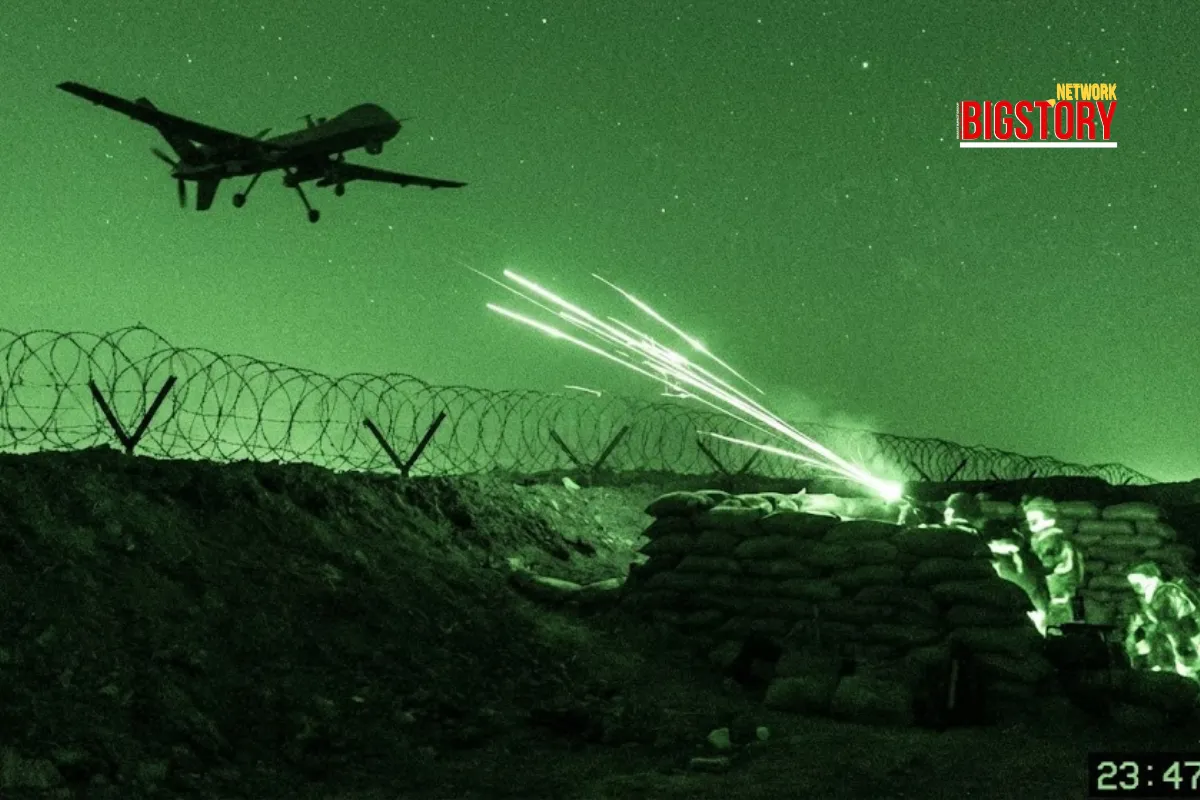
The Line of Control (LoC) witnessed a disturbing evolution in cross-border hostility on Sunday evening. Between 6:25 PM and 7:15 PM on January 11, 2026, Indian security forces detected at least five Pakistani drones appearing almost simultaneously across the Samba, Rajouri, and Poonch districts. This wasn't a stray flight; it was a synchronized "swarm probe." Indian troops engaged the targets with light and medium machine guns, forcing the unmanned aerial vehicles (UAVs) to retreat into Pakistan-occupied Kashmir (PoK). While no wreckage has been found yet, the coordinated timing suggests a deliberate stress test of India’s anti-drone grid during the low-visibility winter window.
This aerial escalation doesn't exist in a vacuum. Just 48 hours prior, on January 9, security forces in Samba’s Paloora village recovered a drone-dropped consignment containing two Chinese-made pistols, grenades, and ammunition. That drop was the "proof of concept." Sunday’s multiple incursions appear to be the "stress test." This activity comes months after the Indian Army launched "Operation Sindoor" in May 2025 to dismantle terror launchpads. With traditional ground infiltration routes blocked by heavy snow in the upper reaches, Pakistan’s deep state seems to have pivoted to an "Aerial Winter Doctrine"—using heavy-lift drones to bypass the snow-bound mountain passes that usually halt infiltration in January.
While mainstream media reports this as an "Infiltration Attempt," the deeper story is the "Swarm Probe." Smugglers don't launch five drones at once; military strategists do. By saturating the airspace across multiple sectors simultaneously, the handlers were likely mapping the reaction times and blind spots of India’s radar and anti-drone systems. If one drone draws fire in Rajouri, does the radar in Poonch pick up the second one? Sunday night was likely a data-gathering mission for future, larger assaults.
Furthermore, the "Chinese Connection" is the silent hardware partner. The pistols recovered on Jan 9 were Chinese. The drones used are invariably modified Chinese commercial quadcopters (like the DJI Matrice series). This is a proxy war where the strategy is Pakistani, but the supply chain is increasingly from Shenzhen, enabling a low-cost, high-deniability conflict.
If this "swarm" tactic becomes the norm, India’s current defense—soldiers spotting lights and firing rifles—will be insufficient. It may force the accelerated deployment of the DRDO’s laser-based Directed Energy Weapons (DEWs) or widespread RF jammers to create an "electronic wall" along the IB, escalating the technological cost of the border war.
If five drones can probe the border in 45 minutes, how many can slip through when the snow melts?
Where were Pakistani drones spotted in Jammu and Kashmir on Jan 11, 2026? Drones were spotted in three specific sectors: the Nowshera sector of Rajouri district, the Mankote sector of Poonch district, and the Ramgarh sector of Samba district.
Did the Indian Army shoot down the drones spotted on Sunday? Troops engaged the drones with light and medium machine guns, firing tracers to track them. The drones were forced to retreat into Pakistani territory. As of now, no wreckage has been recovered on the Indian side.
What was found in the drone drop near Samba on Jan 9, 2026? Security forces recovered a consignment containing two Chinese-made pistols, three magazines, 16 rounds of ammunition, and a hand grenade in Paloora village, Samba.
News Coverage
Context & Background
 Exclusive Content


Sign up for the Daily newsletter to get your biggest stories, handpicked for you each day.



 Trending Now! in last 24hrs


