
A Chinese Type 90B rocket system exploded in Cambodia, killing 8 soldiers. The incident raises fears about NORINCO's quality control and PLA reliability ahead of Taiwan scenarios.
 Sseema Giill
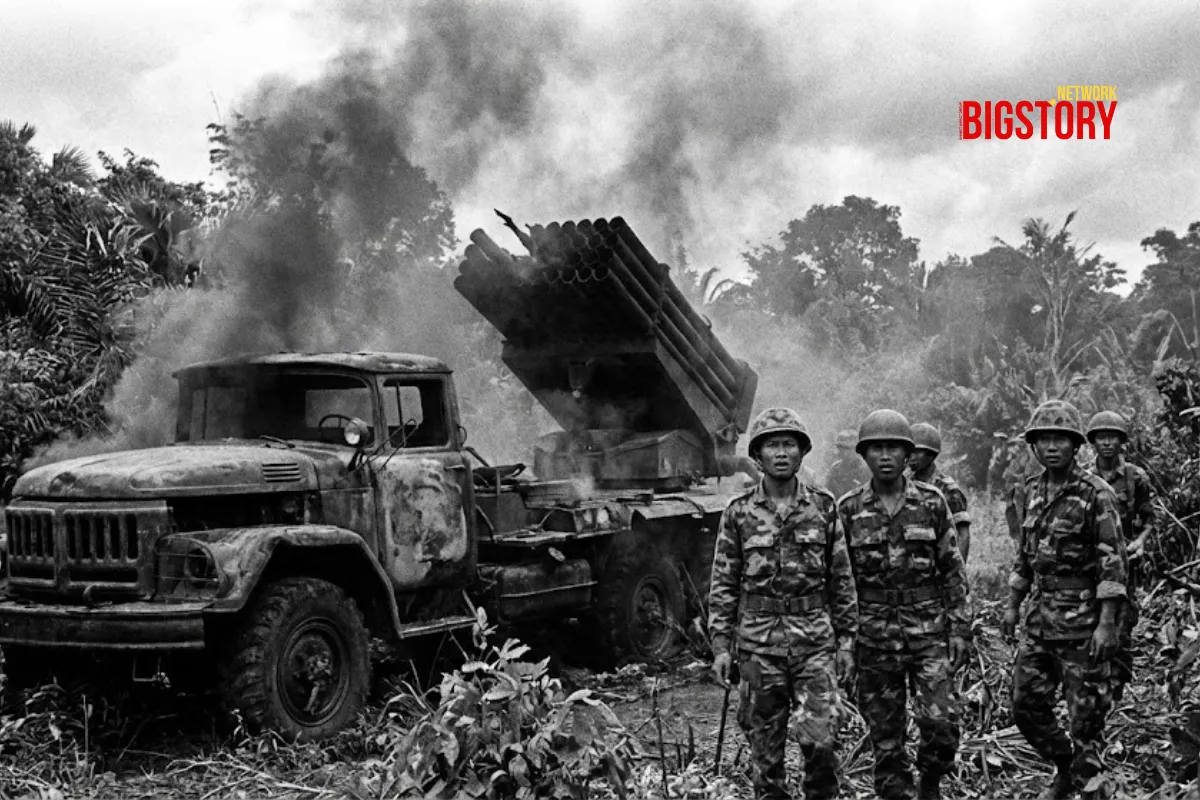
In a deadly blow to Beijing's reputation as a global arms supplier, a Chinese-made Type 90B Multiple Launch Rocket System (MLRS) reportedly suffered a catastrophic malfunction during active combat operations in Cambodia, killing eight soldiers. The incident, occurring on the frontlines of the renewed Cambodia-Thailand border skirmishes this week, involves a rocket detonating inside the launch tube rather than firing. Footage circulating on social media shows the devastating aftermath, marking one of the most high-profile failures of Chinese export-grade weaponry in recent history.
The explosion is not an isolated event but the latest in a string of failures plaguing Chinese defense exports.
While mainstream reports focus on the battlefield casualties, the deeper story is the "Taiwan Mirror Effect." Military analysts have long speculated about the "peace disease" affecting Chinese troops, but this incident highlights "Hardware Rot." If the export versions of these systems—which are supposed to be marketing showcases—are exploding on the users, it casts serious doubt on the reliability of the PLA’s domestic stockpiles. In a high-intensity conflict like a Taiwan invasion, where thousands of rockets must fire in synchronized volleys, a failure rate of even 1% could be catastrophic for the attacker.
Furthermore, this exposes the "Corruption-Quality Loop." The US-China Economic and Security Review Commission has noted opacity in Chinese defense manufacturing. This explosion is likely the kinetic result of graft: substandard propellants or faulty wiring hidden by inspection bribes—a weakness AI simulations of a Taiwan blockade often fail to account for.
Global arms markets are watching. Countries in the "Global South"—Africa, South America, and Southeast Asia—often buy Chinese gear because it is cheaper than American and freer of sanctions than Russian alternatives. This incident provides an opening for competitors like South Korea (K-Defense) and India (BrahMos/Pinaka) to pitch their hardware as "reliable alternatives." For China, this is a soft-power disaster; their "security guarantees" look significantly less secure when the weapon is as dangerous to the operator as it is to the enemy.
If China’s "iron-clad" allies cannot trust their weapons to fire without killing their own crews, how confident is President Xi Jinping that his own Rocket Force won’t misfire when he gives the order?
What happened to the Chinese rocket system in Cambodia? During a border clash with Thailand in December 2025, a Chinese-made Type 90B Multiple Launch Rocket System (MLRS) operated by the Cambodian Army malfunctioned. A rocket reportedly detonated inside the launch tube, destroying the vehicle and killing eight soldiers.
Is Chinese military equipment reliable? Recent incidents suggest systemic quality control issues. Beyond the Cambodia explosion, Pakistan has reported issues with JF-17 engines and warships, and Myanmar has grounded Chinese drones. Analysts attribute this to rapid production scaling and potential corruption within state-owned manufacturers like NORINCO.
What is the Type 90B MLRS? The Type 90B is a 122mm Multiple Launch Rocket System manufactured by China's NORINCO. It is designed for rapid saturation fire and is widely exported to countries in Africa and Southeast Asia as a cost-effective alternative to Russian or Western systems.
Incident Reporting
Technical & Strategic Analysis
 Exclusive Content


Sign up for the Daily newsletter to get your biggest stories, handpicked for you each day.



 Trending Now! in last 24hrs


