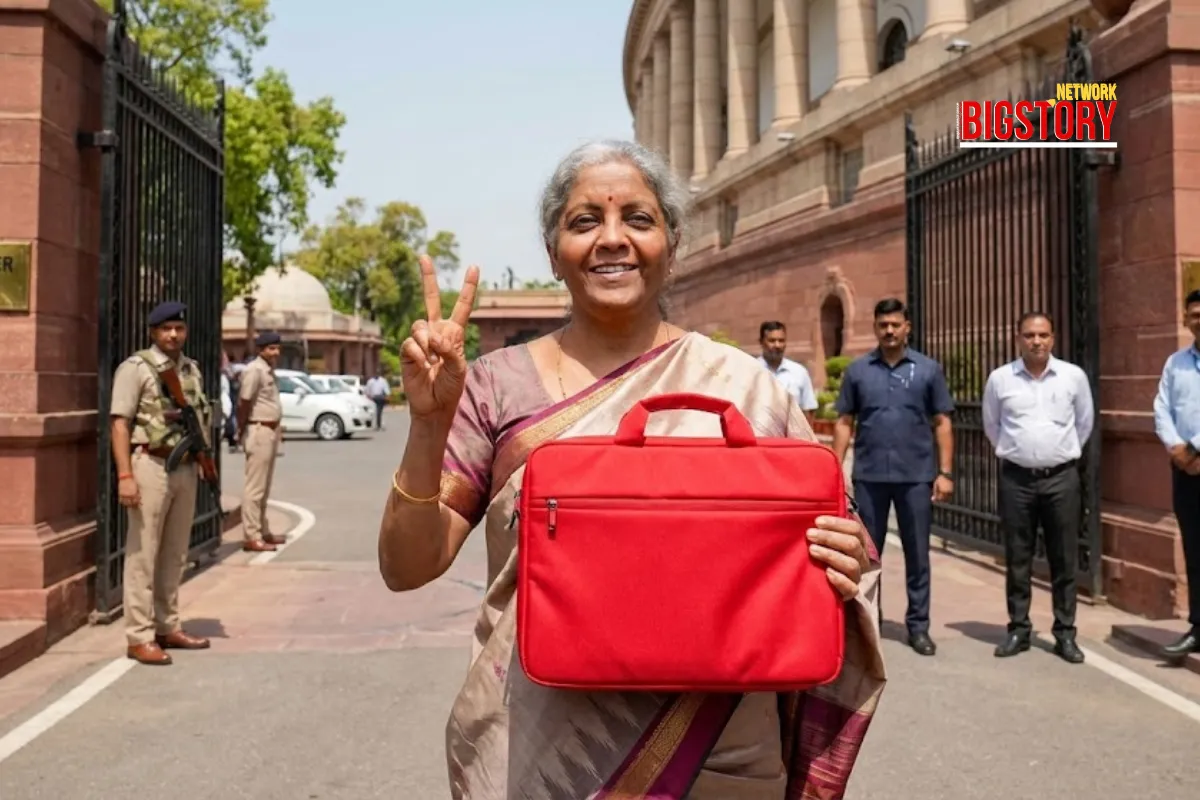
Today, January 29, 2026, Finance Minister Nirmala Sitharaman tabled the Economic Survey 2025-26 in Parliament, officially projecting a resilient real GDP growth of 6.8-7.2% for the upcoming fiscal year. While the document confirms India remains the fastest-growing major economy, it strikes a visibly cautious tone, officially acknowledging the "Trump Tariff Shock"—specifically the new 25% reciprocal plus 25% penal duties on Indian goods—as the primary external threat to the nation's momentum.
The Survey serves as the report card for the economy and sets the stage for the Union Budget presentation on February 1, which analysts now predict will be a "Shield Budget"—designed to insulate domestic industries from global trade wars while boosting internal consumption.
The Context (How We Got Here)
- The "Paradox" of 2026: The Survey highlights a unique economic paradox: India’s domestic drivers are firing on all cylinders (projected 7.4% growth for current FY26), but the global environment has turned hostile. The document cites "geopolitical fragmentation" not as a risk, but as a "new reality."
- The External Shock: For the first time, an official government document has flagged the "Reciprocal Trade Act" enforced by the US Administration. The Survey notes that sectors like Textiles and Gems & Jewellery have already seen a 44.3% dip in exports to the US, necessitating an urgent pivot to other markets like the UAE and EU.
- The Ammunition: To weather this storm, the Survey points to India's record-high foreign exchange reserves of $701.4 Billion (as of Jan 16, 2026), describing them as the ultimate strategic buffer against currency volatility.
The Key Players (Who & So What)
- Nirmala Sitharaman (Finance Minister): The Navigator. Preparing for her record-breaking 9th budget, she faces a fiscal tightrope. She must find money to support export sectors bleeding from tariffs while satisfying the middle class's demand for tax relief in a pre-election cycle.
- V. Anantha Nageswaran (Chief Economic Advisor): The Architect. The primary author of the Survey, Nageswaran issued a stark warning today: "Global trade is no longer about efficiency; it is about security." He advocated for a shift toward "Frugal AI" and reduced reliance on Western export markets.
- Donald Trump (US President - External Factor): The Disruptor. Though not named in every chapter, his administration's protectionist policies are the "ghost in the machine" of this Survey, driving India's defensive posture.
The BIGSTORY Reframe (The "Shield Budget")
Mainstream media is celebrating the "7% Growth" headline. The real story is the Defensive Pivot.
- From "Make for World" to "Make for India": The Survey subtly signals a shift away from export-led growth (which is now vulnerable to tariffs) toward consumption-led growth. This strongly implies that the Feb 1 Budget will focus on putting more money in the hands of the Indian middle class (via tax cuts) to boost domestic demand, effectively replacing the lost American buyer with the Indian buyer.
- The "Frugal AI" Doctrine: In a surprising tech pivot, the Survey explicitly rejects the global "AI Arms Race" to build massive Large Language Models (LLMs). Instead, it proposes a "Frugal AI" strategy—funding smaller, energy-efficient models for specific tasks like crop disease detection or vernacular translation. This suggests the Budget will fund application over R&D.
- The "friend-shoring" Pivot: The document emphasizes the success of the India-UAE and India-EFTA trade pacts, suggesting a deliberate strategy to decouple trade dependency from the US dollar and American markets.
The Implications (Why This Matters)
- For Taxpayers: The Survey's focus on "domestic resilience" is the strongest signal yet that the New Tax Regime will be sweetened. Expectations are high that the tax-free income limit will be raised from ₹12 Lakh to ₹15 Lakh to spur spending.
- For Investors: The "conservative" 6.8-7.2% projection might cause a temporary market dip on Jan 30. However, the Survey’s confident tone on banking health and forex reserves suggests this is a "buy the dip" moment before the populist announcements on Budget Day.
- For Exporters: The Survey admits pain in labor-intensive sectors. Expect the Budget to announce expanded PLI (Production Linked Incentive) schemes specifically for Textiles and Leather to help them absorb the tariff hits.
The Closing Question (Now, Think About This)
If the world’s largest economy (the US) is closing its doors, can India’s domestic market grow fast enough to consume everything we produce?
FAQs: Decoding the Economic Survey
1. What is the GDP growth prediction for 2026-27? The Economic Survey 2025-26 projects a real GDP growth of 6.8% to 7.2% for the fiscal year ending March 2027. This is slightly lower than the current year's estimate of 7.4%, reflecting global trade uncertainties.
2. Did the Economic Survey mention the US Tariffs? Yes. The Survey explicitly flagged the new US tariff structure (25% reciprocal + 25% penal duties) as a significant external shock, noting its negative impact on Indian exports like textiles and jewelry.
3. What is "Frugal AI"? "Frugal AI" is a strategy proposed in the Survey that prioritizes developing small, low-cost, and energy-efficient AI models to solve specific local problems (like agriculture or health), rather than competing with the US/China to build massive, expensive "General AI" models.
4. Is the Budget on Feb 1 a full budget? Yes. Unlike the "Interim Budget" presented in election years, the Union Budget to be presented on February 1, 2026, is a Full Budget, meaning it can introduce major policy changes and tax reforms.
5. What does the Survey say about Inflation? The Survey calls India’s inflation management a "Goldilocks moment"—not too hot, not too cold. It credits the government's supply-side measures for keeping retail inflation within the RBI's tolerance band, despite volatile food prices.
Sources
Official Documents
News Coverage

 Brajesh Mishra
 Exclusive Content