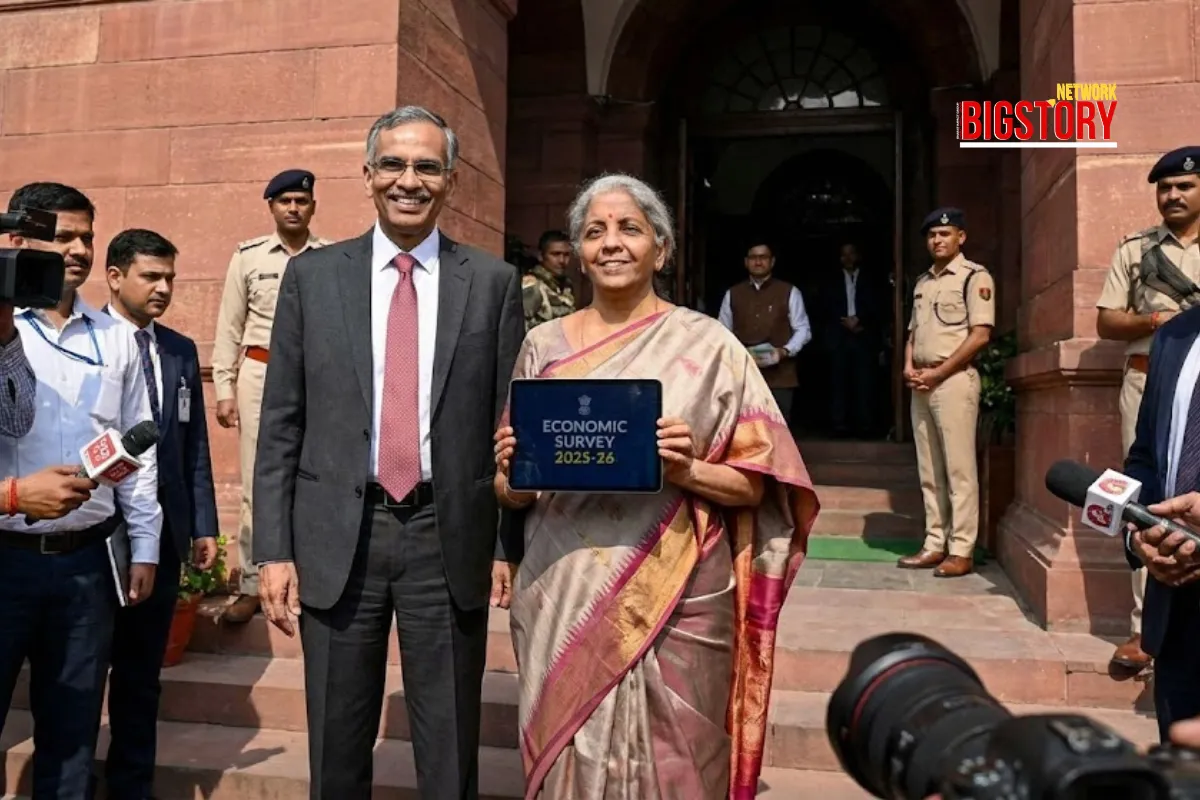
Today, January 29, 2026, Finance Minister Nirmala Sitharaman tabled the Economic Survey 2025-26 in Parliament, presenting a blueprint that projects a resilient real GDP growth of 6.8-7.2% for the upcoming fiscal year (FY27). While the growth figures confirm India’s status as the fastest-growing major economy, the document's tone is the real headline.
Authored by Chief Economic Advisor V. Anantha Nageswaran, the survey explicitly endorses "Swadeshi" (self-reliance) not just as a slogan, but as a "legitimate strategic response" to a fracturing global order. By framing India as an "oasis of stability," the government has effectively set the intellectual stage for a protectionist, manufacturing-heavy Union Budget to be presented this Sunday.
The Context (How We Got Here)
- The "Oasis" Performance: The Survey estimates that India will close the current fiscal year (FY26) with a robust 7.4% growth, exceeding earlier market projections. This momentum provides the fiscal space to pivot strategies.
- The Weekend Shift: Released two days before the Budget (instead of the usual one) due to the weekend schedule, the Survey serves as a teaser for February 1, when FM Sitharaman will present the Union Budget on a Sunday for the first time in history.
- The Global Fracture: The document paints a grim picture of the external world, citing "rising global protectionism" and "weaponized trade" as reasons why India must stop relying on export-led services growth and start building "industrial resilience."
The Key Players (Who & So What)
- V. Anantha Nageswaran (Chief Economic Advisor): The Architect. He introduced the concept of "Strategic Sobriety," advising the government to prepare for a long marathon. His assertion that "the market is no longer neutral" is a direct challenge to free-trade orthodoxy.
- Nirmala Sitharaman (Finance Minister): The Presenter. Her tabling of the document signals a shift in the government's stance: while the economy is strong, the upcoming budget will likely include "defensive" economic measures to shield domestic industries.
- The Manufacturing Sector: The Pivot. The Survey explicitly moves the spotlight from Services ("code and consultants") to Manufacturing ("factories and exports"), calling it the only path to genuine employment resilience in a volatile world.
The BIGSTORY Reframe (The "End of Globalization")
Mainstream media is celebrating the "7% Growth" headline. The real story is the Return of Economic Nationalism.
- Validating Protectionism: The most radical shift in the Survey is its language on trade. By admitting that "globalization is fragmenting," the CEA is effectively validating "Swadeshi" policies. This suggests the government is preparing the world for a Protectionist Budget on Sunday—one that might raise tariffs to protect domestic manufacturers under the guise of "national security."
- Sovereign AI: The Survey hints at a new frontier: "Sovereign AI." It positions Digital Public Infrastructure (DPI) like UPI not just as tech, but as a "productivity unlock," arguing that India must build its own AI capabilities to prevent dependence on foreign tech giants—aligning perfectly with the "Swadeshi" theme.
The Implications (Why This Matters)
- Market Strategy: Investors should watch for a potentially tepid reaction to the "conservative" 6.8% lower-band forecast tomorrow (Jan 30). However, the Survey’s tone suggests that Manufacturing and Defense stocks will be heavily incentivized in Sunday's Budget.
- Job Market Shift: The document drops a hard truth for the IT sector: "Services alone cannot sustain job growth." It emphasizes "Gig & Platform" jobs as a permanent structural shift, signaling that the next wave of employment policy will focus on blue-collar industrial skills and digital logistics rather than just coding.
- Inflation Comfort: With average retail inflation at a remarkably low 1.7% (April-Dec 2025), the RBI has significant room to cut rates, potentially fueling a credit boom in the next fiscal quarter.
The Closing Question (Now, Think About This)
If the "global market is no longer neutral," as the Chief Economic Advisor claims, is India’s move toward an "Economic Fortress" a protective shield, or a wall that will isolate it from future innovation?
FAQs: Decoding the Economic Survey
1. What is the GDP growth projection for 2026-27? The Economic Survey projects a real GDP growth of 6.8% to 7.2% for FY27. This is a deliberately conservative estimate that accounts for global geopolitical risks.
2. Who prepared the Economic Survey 2025-26? The document was authored by the Chief Economic Advisor, V. Anantha Nageswaran, and his team at the Ministry of Finance.
3. Did the Survey recommend removing the Old Tax Regime? No. The Survey focused on macroeconomic stability, inflation, and trade strategy. It did not make specific recommendations regarding personal income tax regimes, leaving those announcements for the Budget speech.
4. Why is the Budget being presented on a Sunday? This is a historic first. Since February 1, 2026, falls on a Sunday, the government has decided to proceed with the presentation to maintain the fiscal calendar, rather than delaying it to Monday.
5. What is the "Swadeshi" angle in the Survey? The Survey argues that in a world where free trade is being weaponized by global powers, "Swadeshi" (self-reliance) is a legitimate strategic response to protect national interests and ensure economic security.
Sources
Official Documents
News Coverage

 Sseema Giill
 Exclusive Content