
Anthony Tan pitched a taxi app at Harvard in 2012 and built Grab into Southeast Asia's dominant superapp — then forced Uber to exit the entire region. This is the playbook for out-knowing a better-funded competitor on their own terms.
 Rashmeet Kaur Chawla
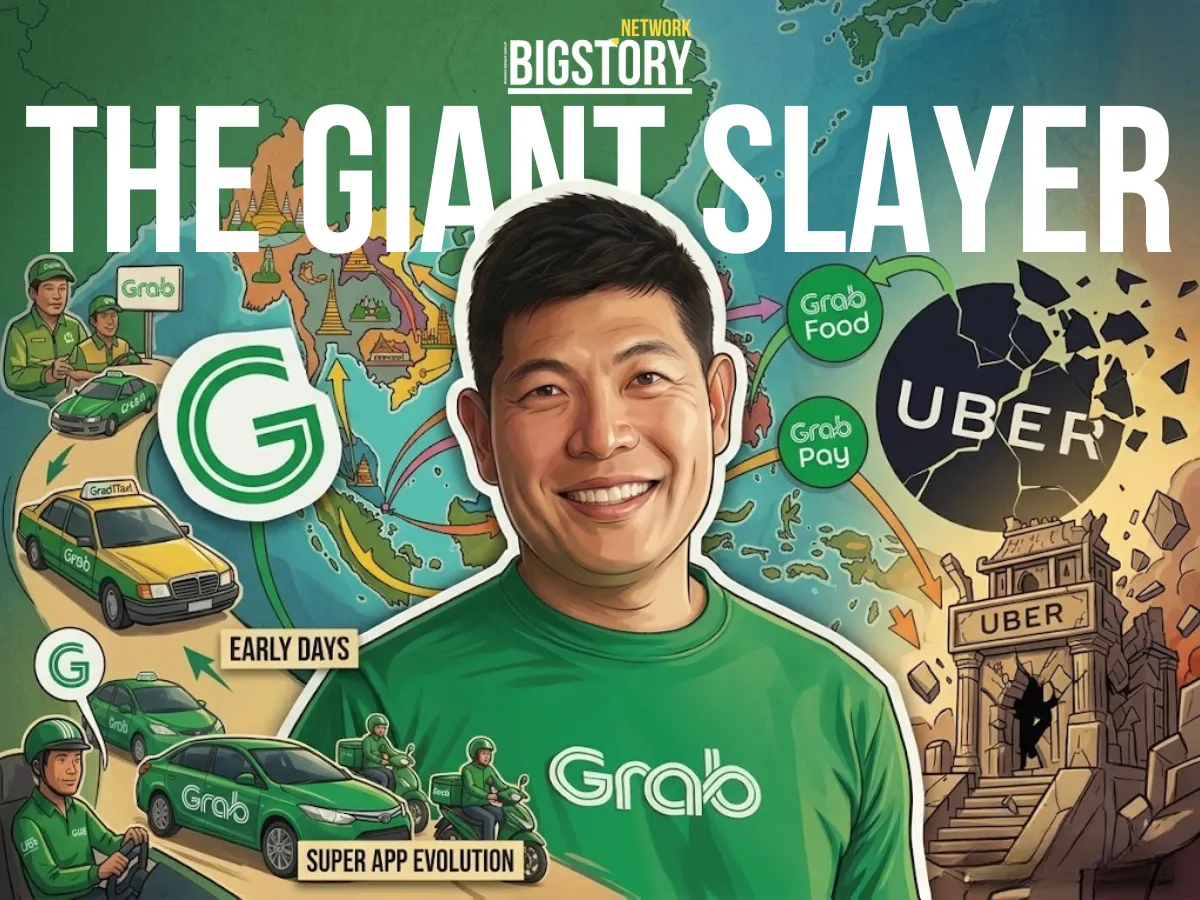
In 2012, a young Malaysian entrepreneur stood in front of a Harvard Business School competition stage, pitching a taxi-booking app to an audience of sceptics. The idea was not exactly glamorous — matching passengers to licensed cabs in a chaotic, fragmented Southeast Asian market. His co-founder, Tan Hooi Ling, helped him see what others missed. Within six years, that man — Anthony Tan — would force Uber, the most heavily funded startup in the history of Silicon Valley, to pack its bags and leave an entire continent.
He did not do it with more money. He did not do it with better engineers. He did it because he understood something Uber never fully could: that Southeast Asia is not one market. It is dozens of them. And he built accordingly.
When Uber entered Southeast Asia with its brand, deep pockets, and battle-hardened playbook from Western markets, industry observers wrote off local players. Analysts predicted a familiar script: the global giant would blitz the region with subsidies, absorb the losses, and bury the competition. Grab, operating in a handful of cities and still known as MyTeksi in Malaysia, was considered a footnote at best.
The pressure was enormous. Investors questioned whether a regional startup could possibly match Uber's engineering resources and capital deployment?
Drivers worried about being poached by better incentives. Passengers were being wooed by a brand they already knew from New York and London. For Anthony Tan, this was not just a business problem — it was an existential test of whether a Southeast Asian founder could compete at the highest level on home turf.
This is the story of how he proved that belief — and what every entrepreneur building in an emerging market can take from it.
Anthony Tan is the co-founder and Group CEO of Grab Holdings, Southeast Asia's leading superapp and one of the most consequential technology companies to emerge from the Asia-Pacific region. Born in Malaysia into a family with deep roots in the automotive industry his grandfather co-founded Tan Chong Motor, the Malaysian distributor of Nissan vehicles Anthony could have coasted into a comfortable corporate inheritance.
He chose a different road. Today, Grab operates across eight countries, serves hundreds of millions of users, and offers services spanning ride-hailing, food delivery, digital payments, financial services, and logistics. Grab went public on the Nasdaq in December 2021 through one of the largest SPAC mergers in history, valuing the company at approximately $40 billion at the time of listing.
Anthony Tan builds a platform that reshaped how hundreds of millions of people move, eat, pay, and access financial services — in a region that global tech largely misunderstood.
Anthony Tan grew up in a privileged household in Kuala Lumpur, Malaysia. His family's wealth was not inherited passively the Tan family had built Tan Chong Motor into a significant business over generations, and Anthony was surrounded by the language of enterprise from childhood. Cars, dealerships, supply chains, customer service — these were dinner-table conversations.
There was, naturally, an expectation. The family business was there, waiting. Anthony attended Epsom College in the United Kingdom before returning to pursue his undergraduate education at the University of Chicago. He was clearly academically capable, commercially aware, and socially positioned for a predictable, successful career.
But something about that path did not sit right with him. He has spoken in interviews about feeling a pull toward building something of his own something that could serve people who were not already being served well. That instinct eventually led him to Harvard Business School, where everything changed.
It was at Harvard, working on a case study about the broken transportation ecosystem in Southeast Asia, that Anthony Tan first articulated the problem he wanted to solve. Taxis were unreliable. Passengers — especially women travelling alone — did not feel safe. Drivers had no accountability system. The market was ripe for disruption, and crucially, it was a market Anthony understood in his bones because he had grown up in it.
Anthony Tan and his co-founder Tan Hooi Ling launched MyTeksi in Malaysia in 2012. The app had one core promise: you could book a licensed taxi from your phone, track its location, and know the driver's identity before you got in. In a market where hailing a cab on the street came with genuine safety uncertainty, this was not a trivial upgrade. It was a structural improvement to the experience of moving through a city.
The Harvard Business School New Venture Competition gave the founders their first external validation. They did not win the top prize, but the process forced them to sharpen the concept and make the business case rigorous. Anthony has since noted that defending every assumption in front of sharp, sceptical evaluators was invaluable preparation for what followed.
MyTeksi quickly rebranded as GrabTaxi and began expanding across Southeast Asia — Singapore, Thailand, Indonesia, the Philippines, Vietnam. One by one, the company entered markets that had never had a reliable, technology-enabled alternative to walking into the street and hoping. The rebrand to Grab came later, as the company moved beyond taxis into motorbike taxis (GrabBike), private cars (GrabCar), and eventually an entirely different conception of what a ride-hailing company could be.
Each market entry was not a copy-paste of the Malaysian model. Grab studied local payment preferences, language requirements, dominant vehicle types, regulatory environments, and driver economic conditions. In Indonesia, motorbike taxis were central to urban mobility. In Vietnam, cash payments dominated. In the Philippines, fragmented geography demanded different logistics thinking.
Grab adapted to each context rather than imposing a universal solution.
By 2016, the competition between Grab and Uber across Southeast Asia had become a full-scale war. Both companies burned cash on driver subsidies and passenger promotions. Uber had deeper global reserves. Grab had local relationships, market intelligence, and — increasingly — the loyalty of drivers and passengers who found the platform more intuitive and more trustworthy.
Grab also secured crucial strategic investment from SoftBank, Toyota, and major sovereign wealth funds including Singapore's GIC, giving it the financial firepower to sustain the fight. But money alone would not have been enough. What tipped the balance was that Grab's hyper-local strategy was producing a stickier product in every market it competed in.
In March 2018, Uber announced it was exiting Southeast Asia and selling its regional operations to Grab. In exchange, Uber received a minority stake in Grab. It was a watershed moment — not just for Grab, but for the entire global narrative about whether regional startups from emerging markets could take on Silicon Valley's most aggressive exporters. They could. Anthony Tan had proved it.
Anthony Tan had always believed that transportation was only the entry point. The deeper opportunity was to become the operating system for everyday life in Southeast Asia — the platform through which hundreds of millions of people accessed not just rides, but food, financial services, insurance, healthcare logistics, and more.
GrabFood launched and grew rapidly into one of the region's dominant food delivery platforms. GrabPay became a significant digital payments network in markets where banking penetration was low and cash remained king. GrabFinance began offering loans and insurance products to drivers and small merchants who had historically been excluded from formal financial systems. The superapp thesis was now being executed with Southeast Asian specificity.
Grab went public on the Nasdaq in December 2021 through a SPAC merger with Altimeter Growth Corp the largest SPAC deal in history at the time. The listing gave Grab access to public markets and cemented its status as one of the defining technology companies of Southeast Asia's digital decade. It also brought new scrutiny: public markets demanded a clear path to profitability, and Grab's losses became a consistent point of investor focus. Anthony Tan has been transparent about this tension, framing it as a deliberate strategic trade-off — growth and market share now, sustainable economics as the platform matures.
Every significant decision Grab has made traces back to beliefs that Anthony Tan has been remarkably consistent about articulating over more than a decade of building.
"Technology companies in emerging markets have a responsibility to generate real social value, not just financial returns."
First, he believes deeply in the power of local knowledge, understanding the cultural context, economic realities, and daily friction points of a market at granular depth is more valuable than any technology advantage that can be imported from outside.
Second, Anthony Tan believes that the informal economy — the millions of drivers, food vendors, small merchants, and gig workers who power Southeast Asian urban life — deserves access to the same financial tools and growth opportunities as the formal sector. Grab's ability to offer financial services to drivers who cannot get bank loans, or to help small food merchants grow their revenue through GrabFood, creates loyalty that pure pricing competition cannot replicate.
Third, he believes in safety as a non-negotiable baseline. The origin of Grab was, at its heart, a safety problem. That founding instinct has persisted through every phase of the company's growth and shapes how Grab thinks about trust, accountability, and community standards.
The years of cash burn during the Uber war were not comfortable. Anthony Tan has spoken about the pressure of sustaining thousands of drivers' livelihoods while competing with a better-funded rival. Regulatory pressure has been persistent. In multiple markets, Grab's growing dominance attracted scrutiny from competition authorities. After Uber's exit, critics argued that reduced competition had lowered pressure on Grab to keep fares low and driver earnings high. The Singapore Competition and Consumer Commission fined both Grab and Uber for anti-competitive effects of the merger a signal that market dominance, however earned, comes with obligations.
Despite its scale and market leadership, Grab has continued to report losses as it invests in growth and new service categories. COVID-19 presented a crisis of a different kind. Ride-hailing volumes collapsed almost overnight as lockdowns swept Southeast Asia. Grab pivoted rapidly expanding food delivery, supporting merchants moving online, and launching programmes to help drivers whose income had disappeared. The crisis tested the resilience of the superapp model and ultimately validated it. Grab's diversification meant it could absorb the shock in ways a single-service company could not.
If there is one moment that defines the Anthony Tan narrative for the global startup community, it is March 26, 2018 — the day Uber announced its exit from Southeast Asia.
The announcement rippled through the technology industry worldwide. It was not merely a business transaction. It was a statement about the limits of global playbooks in local markets. It was evidence that a regional startup, founded in Kuala Lumpur and built on a hyper-local thesis, could take on one of the most formidable technology companies in history and win — not by outspending, but by out-knowing.
"Winning the ride-hailing war was not the goal. It was the starting line."
In interviews following the Uber deal, Anthony Tan was characteristically measured. He spoke about responsibility — to drivers, to passengers, to the region — and about the risk of complacency that comes with removing your biggest competitor. He seemed more focused on what came next than on celebrating what had just happened. That quality — the ability to absorb a major win and immediately look forward — is one of the most instructive things about how he leads.
Anthony Tan's leadership style has been characterised by people who have worked closely with him as unusually values-driven for a high-growth tech environment. He does not fit the archetype of the Silicon Valley founder — the visionary-genius-disruptor who moves fast and breaks things. His approach is more deliberate, more community-minded, and more explicitly tied to social impact.
He has spoken about building an 'evergreen' business — something not optimised for a single exit event but for durable, compounding value creation over decades. This shapes his decision-making in visible ways: Grab's CSR initiatives are not afterthoughts or PR exercises. They are embedded in the company's operational model, from driver welfare programmes to merchant support schemes to digital inclusion efforts.
Anthony Tan is also known for his emphasis on execution culture. Ideas in Southeast Asia's startup ecosystem are not scarce. The ability to translate a good idea into operational reality across eight different countries, multiple languages, and dozens of regulatory environments — that is rare, and he has built a company that does it.
Anthony Tan has been asked, in many forums and interviews over the years, what he would say to founders building in Southeast Asia and other emerging markets. His answers have been remarkably consistent.
"Do not be ashamed of building for your own backyard. The world's most important problems are right in front of you."
He consistently urges founders not to dismiss their local context as a limitation. The fact that you grew up navigating a system that does not work — unreliable transport, limited banking access, fragmented logistics — is not a disadvantage. It is the source of your insight. Build from that insight, not from a second hand understanding of problems someone else has already solved in a different market.
He pushes back on the idea that social impact and commercial success are in tension. In emerging markets, the most commercially durable companies are often the ones that genuinely improve the lives of the communities they serve. Build with that in mind from day one — not as a mission statement, but as a product and business model principle.
He frequently acknowledges the role of timing, circumstance, and co-founders in Grab's success. The Grab story is a team story, a regional story, a market-timing story. Founders who understand that are more likely to build cultures that can sustain success than those who credit everything to individual brilliance.
At BIGSTORY, we distil each Challenger's journey into living principles — not borrowed frameworks, but beliefs tested under real pressure. From Anthony Tan's story, we draw these.
The scale of recognition Anthony Tan and Grab have received internationally deserves documentation, because it contextualises how seriously the global business community has taken what he has built:
Anthony Tan personally has been named to Fast Company's 100 Most Creative People in Business (2018), The Bloomberg 50 (2017), and Fortune's 40 Under 40 list in both 2016 and 2018. These are not regional accolades. These are global rankings that placed a Southeast Asian founder building in markets that global media rarely covers alongside the most recognised names in international technology.
Grab as a company has earned second place on Fast Company's Most Innovative Companies list (2019), consistent placement on the CNBC Disruptor 50, and a position on Fortune's Change the World list in 2020 — the year that, incidentally, was one of the hardest in the company's history due to the pandemic.
A Challenger is something more specific. It is a founder who did not just win within the rules of the game — but whose win forced everyone else to rethink what the rules even were.
Anthony Tan did not just build a successful company. He dismantled a deeply held assumption — that Silicon Valley-originated models carried an inherent superiority that regional startups from emerging markets simply could not overcome. He did not write an essay about why that assumption was wrong. He did not give a conference talk about the untapped potential of Southeast Asia. He went head-to-head with the company that embodied that assumption at its most powerful — and he made them leave.
That alone would earn him a place here. This was a story worth telling at full depth is not the Uber exit. It is what Anthony Tan believed before the Uber exit — when the outcome was genuinely uncertain, when the funding was tight, when drivers were being poached and investors were asking hard questions. He believed then, as he believes now, that the right way to build technology in an emerging market is to begin with the lived experience of the people you serve. To earn their trust before you ask for their money. To build something that creates value for communities, not just cap tables.
That is a philosophy that sits in direct tension with how tech entrepreneurship has been practiced and it turns out in the markets that will matter most to the next billion people coming online — it is the philosophy that works.
 Exclusive Content


Sign up for the Daily newsletter to get your biggest stories, handpicked for you each day.


 Trending Now! in last 24hrs


