
Dhirubhai Ambani started with ₹500 and no connections in a system designed to stop him. This is the thinking that made Reliance inevitable.
 Rashmeet Kaur Chawla
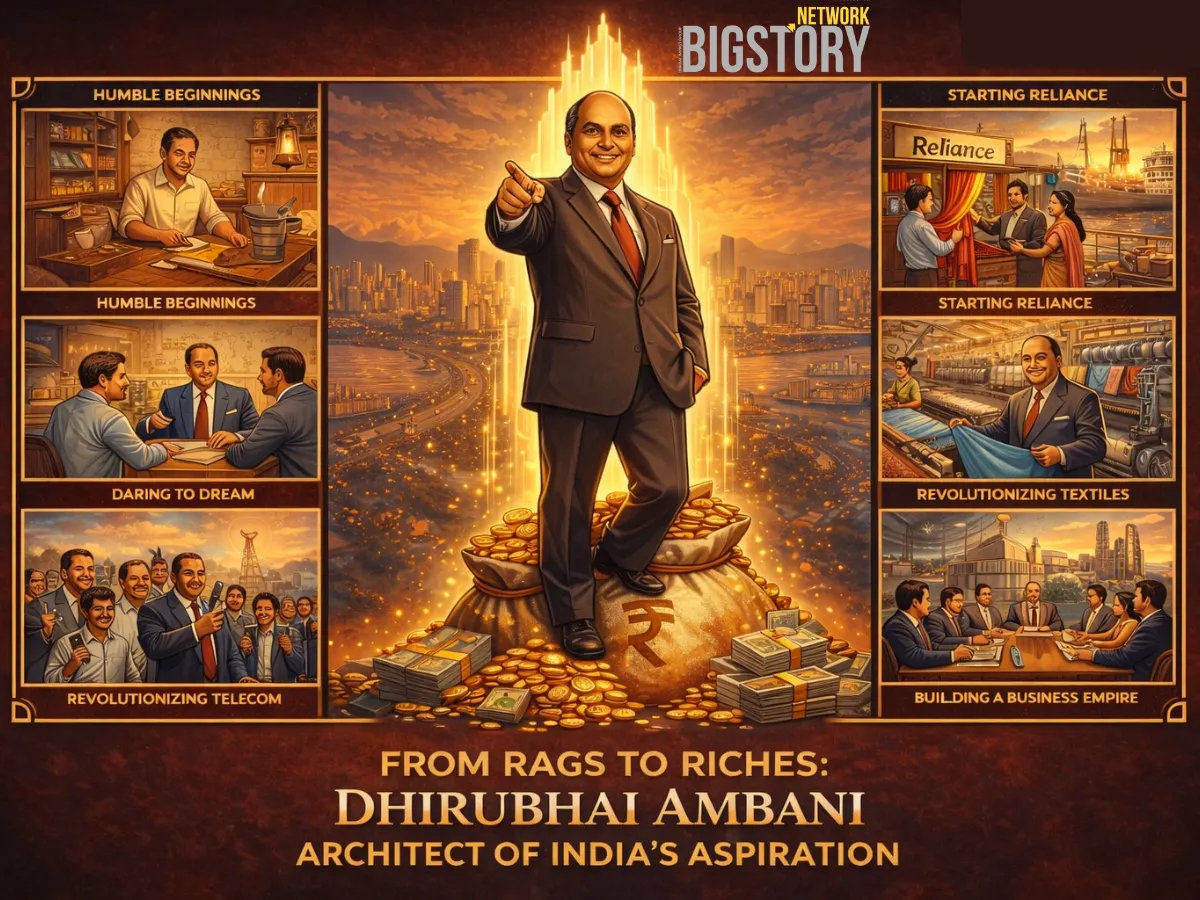
Imagine a man without formal education navigating India’s License Raj, getting the better of top-notch competitors like Nusli Wadia, and creating a trillion-dollar business empire though he faced charges of stock manipulation and crony capitalism. Dhirubhai Ambani changed his fortune drastically, starting Reliance Industries amid aggressive controversies.
His saga combines the audacity of a visionary, brutal battles, and revolutionary strategies that changed the face of Indian business.
In the decades following India’s independence, the country found itself trapped in what economists called the “Hindu rate of growth”—a meager 3.5% annual expansion that kept millions in poverty. The License Raj strangled entrepreneurship, foreign exchange was scarce, and the business elite operated within protected oligopolies. Into this suffocating economic environment stepped a yarn trader’s son who would dare to dream impossibly large dreams.
Dhirajlal Hirachand Ambani, known as Dhirubhai, was born on December 28, 1932, in the small coastal village of Chorwad in Gujarat’s Junagadh district. He would go on to found Reliance Industries, transforming it from a textile trading company into India’s largest private sector enterprise.
By the time of his death on July 6, 2002, at age 69 after suffering a second stroke, Dhirubhai had not only built a multi-billion-dollar conglomerate but had fundamentally altered India’s business culture, capital markets, and the relationship between entrepreneurs and the state.
What distinguished Dhirubhai from other industrialists wasn’t merely his commercial success—it was his democratization of wealth creation. He made millions of middle-class Indians stakeholders in his vision, creating what would become India’s largest base of retail shareholders. His life story represents the quintessential rags-to-riches narrative, but more importantly, it embodies the transformation of post-independence India from a socialist economy to a market-driven powerhouse.
At 17, he left for Aden, Yemen, working as a gas station attendant earning only $300 per year—refuelling cars during the day and inspiring himself to great things at night. This humble beginning would become the foundation of one of history’s most remarkable business transformations. He returned to India in 1958 with just ₹500 and started Reliance Commercial Corporation from a cramped 350 square foot room in Mumbai’s Masjid Bunder, dealing in spices and polyester yarn. This tiny operation, barely large enough for a few people to work comfortably, would become the seed from which a trillion-dollar empire would grow.
Dhirubhai’s battles with the bureaucratic establishment exposed the absurdities of the License Raj and built public pressure for economic reforms. When established competitors used regulatory mechanisms to block Reliance’s expansion, Dhirubhai didn’t just fight quietly in government corridors—he took his case to the public, to shareholders, to the media.
These conflicts, while controversial, performed an important historical function: they demonstrated how the licensing system was being weaponized by incumbents to prevent competition, how it stifled innovation and capacity creation, and how it ultimately hurt consumers and the national interest.
When economic liberalization finally came in 1991, the groundwork had been laid partly by entrepreneurs like Dhirubhai who had pushed against the system’s constraints.
Dhirubhai created the blueprint for Indian companies thinking globally. While other Indian industrialists focused on protected domestic markets, he thought in terms of world-class scale and international competitiveness from the beginning.
The Jamnagar refinery wasn’t built to serve just India—it was designed as an export-oriented facility that could compete globally. This mindset shift was crucial. Today, when we see Indian companies like TCS, Infosys, or Tata acquiring global brands, they’re following a path Dhirubhai pioneered: the belief that Indian enterprises can and should compete on the world stage, that Indian management can operate world-class facilities, and that “Made in India” can mean world-class quality.
The trajectory of Dhirubhai’s life changed dramatically during his years in Aden, Yemen. Coming from a modest background—his father was a village schoolteacher earning barely enough to support the family—young Dhirubhai moved to Aden at age 16 in 1949 to work with A. Besse & Co., a trading firm. Those eight formative years (1949-1957) working initially as a gas station attendant and later as a dispatch clerk exposed him to international trade, currency fluctuations, and the mechanics of global commerce. The experience was transformative.
He observed how large trading houses operated, understood arbitrage opportunities, and developed an intuitive grasp of market dynamics that would serve him throughout his career.
Before Dhirubhai, stock ownership in India was confined to wealthy urban elites. Company shares were traded in closed circles, and the average middle-class family viewed the stock market with suspicion, if they thought about it at all. Dhirubhai democratized equity participation in ways that fundamentally transformed Indian capital markets.
His aggressive retail shareholder campaigns in the 1970s and 1980s brought housewives, teachers, small shopkeepers, and government clerks into the equity markets. Reliance AGMs (Annual General Meetings) became legendary events, held in stadiums with thousands of people watching at home on TV. It turned out to be mass mobilization that created India’s equity culture, preparing the ground for the mutual fund boom and retail participation that characterizes Indian markets today.
During his Aden years, Dhirubhai discovered an arbitrage opportunity involving Yemeni currency and silver. The Yemeni rial contained more silver than its face value in certain market conditions. He would buy rials, melt them down, and sell the silver, pocketing the difference. This wasn’t illegal—it was pure market intelligence and execution, demonstrating the entrepreneurial instinct that would later build an empire.
The critical turning point came when Dhirubhai recognized an opportunity in yarn trading. Returning to India in 1958 with savings of just ₹500, he established “Reliance Commercial Corporation” in Mumbai with his cousin Champaklal Damani.
Initially, Dhirubhai and his cousin Champaklal Damani were running a business importing yarn and exporting spices. However, their different perspectives—Damani was cautious and conservative while Dhirubhai was aggressive and visionary—caused their business philosophies to drift apart, finally leading to a split in 1965.
This separation proved to be a defining moment. Dhirubhai picked the risky path of synthetics, establishing Reliance’s very first textile mill in 1966 in Naroda, Gujarat. He implemented his signature strategy of backward integration, cutting out middlemen and controlling the entire production chain to save costs while maintaining quality.
This vertical integration strategy turned Reliance into a textile powerhouse that could offer superior products at lower prices, making the *“Vimal” brand synonymous with quality synthetic textiles.
The “Only Vimal” tagline became iconic, marking Reliance’s evolution from trader to manufacturer and setting the stage for even more ambitious expansions.
His first core belief was that scale creates its own advantages. While competitors thought incrementally, Dhirubhai believed in creating capacity ahead of demand, often investing in technology and infrastructure that seemed excessive at the time but positioned Reliance perfectly for future growth.
His second fundamental principle was backward integration. Rather than remaining dependent on suppliers, Dhirubhai insisted on controlling every aspect of the value chain. It was about strategic independence and the ability to maintain quality while reducing costs.
Perhaps most revolutionary was Dhirubhai’s belief in equity democratization. At a time when stock ownership was confined to the wealthy elite, he pioneered the concept of making every Indian a potential shareholder. “If you don’t own a share in Reliance, you don’t own a share in India’s growth story,” became an unofficial motto that resonated across the nation.
Dhirubhai also maintained an unshakeable faith in Indian talent and capability. When critics claimed India couldn’t match international standards, he imported world-class technology and proved that Indian workers and managers could operate at global benchmarks. This nationalism wasn’t jingoistic—it was practical confidence backed by investment in human capital.
Dhirubhai believed conventional wisdom is usually wrong. When everyone said Indian textiles couldn't compete with Japan and Korea, he built facilities that undercut them on price while maintaining quality. When experts claimed India lacked infrastructure for world-class petrochemical complexes, he proved them wrong at Patalganga and Jamnagar. His contrarian streak wasn't stubbornness—it was careful analysis that revealed opportunities others missed.
"Business is nothing but a web of relationships and obligations," Dhirubhai often said. He understood that in India's complex regulatory environment, success required more than business acumen—it demanded strategic relationships across bureaucracy, politics, and media. This philosophy guided his approach to building "centers of power" that would become crucial to Reliance's growth.
During the License Raj era in India, permits were like precious gold—scarce, valuable, and controlled by a complex bureaucracy that determined winners and losers in the economy. Dhirubhai leveraged his understanding of this “permit raj” by cunningly securing quotas and licenses through non-stop lobbying and cultivating political connections across party lines.
Dhirubhai embodied the archetype of a market challenger an outsider determined to disrupt entrenched systems and redistribute market power. Unlike established industrial houses like the Tatas and Birla’s, who had cultivated relationships over generations. What he possessed was infinitely more powerful: vision, determination, and an uncanny ability to navigate bureaucratic mazes.
When banks declined loans for expansion, Dhirubhai chose a revolutionary path: he took Reliance public in 1977. This move drew millions of small investors, mostly attracted by the high dividends he offered, thus democratizing the stock market in an unprecedented way. The 1977 public issue of Reliance Textiles was oversubscribed 7 times, with applications from over 58,000 investors—unprecedented for an Indian company at that time.
He personally travelled across India, holding investor meetings in small towns, explaining his vision in languages ordinary people understood. Annual general meetings became so packed that they had to be held in stadiums, with thousands of people attending in person and many more watching at home on TV.
The battle between Calcutta's Bear Cartel initiated Reliance's rights issue, as the former came up with the strategy of short-selling the shares. Then, "Friends of Reliance" brokers took the opposite step of buying shares, thus resulting in the forced closure of the BSE market for three days. The grapes of wrath were that Dhirubhai could be supplying shares through NRI firms like Crocodile and Lota, trademarking the profits RBI gave Reliance the green light, yet the critics were up in arms over the benami shares and the rigged market.
Finance Minister Pranab Mukherjee disclosed that ₹220 million of NRI investments had been mysteriously routed.
Nusli Wadia of Bombay Dyeing was the rival who engaged in a heated tussle with Dhirubhai over the licensing of polyester. Wadia managed to get DMT approval during the Janata rule, but the Congress government delays helped Reliance to get the PTA plant ready. The Indian Express's Ramnath Goenka supported Wadia and initiated a crusade against Reliance, shedding light on their "excess capacity" and smuggling which eventually led to the detainment and a fine of ₹1.19 billion. The conflict also led to a human casualty: Jamnadas Moorjani, said to be Wadia's associate, was stabbed; there was also a plot to kill Wadia which the Reliance people were implicated in. During the whole mess, Dhirubhai was stroke-hit in 1986.
To What Extent Did Politicians Help or Harm Reliance?
Dhirubhai managed to create "centers of power" within the bureaucracy, among politicians, as well as in the media and he was always known for saying, "Business is nothing but a web of relationships and obligations."
Allegations were tax evasion, cronyism, regulatory capture among others. Reliance did not just survive but also diversified into petrochemicals, plastics, power and also that was before it became India's number one exporter and the first private Fortune 500 company. He bequeathed the leadership to his sons Mukesh and Anil in the 1980s and passed away on July 6, 2002, at the age of 69 after suffering a second stroke.
Throughout his career, Dhirubhai faced serious allegations:
These accusations were never definitively proven in ways that resulted in criminal convictions, but they created a cloud of controversy that followed Reliance throughout Dhirubhai’s life.
Despite—or perhaps because of—these controversies, Reliance did not just survive but thrived. The company aggressively diversified into:
Reliance became India’s number one exporter and the first private Indian company to enter the Fortune Global 500 list—achievements that validated Dhirubhai’s vision even as critics questioned his methods.
1. Dream Big, Execute Bigger
Dhirubhai proved that vision only matters when backed by execution. He imagined the impossible—and then built systems to make it inevitable.
2. Turn Stakeholders into Believers
He didn’t build Reliance alone. Employees, investors, suppliers, and partners all saw their growth tied to his vision—and became its strongest advocates.
3. Make Speed a Strategy
Fast decisions, empowered teams, and zero fear of honest mistakes gave Reliance a decisive edge. Speed wasn’t chaos—it was discipline.
4. Earn Loyalty Through Generosity
Dhirubhai rewarded trust disproportionately. Those who stood by him in tough times were backed for life, creating unshakable loyalty.
5. Persuasion Over Power
He mastered influence by understanding what others truly wanted and aligning it with his goals—turning resistance into partnership.
6. Build Resilience Before You Need It
From business wars to personal health crises, Dhirubhai showed that setbacks don’t stop leaders—mindsets do.
7. Treat Information as an Asset
His deep networks ensured he knew market shifts before others did. In leadership, awareness is advantage.
While less publicized than his business achievements, Dhirubhai was deeply committed to education and healthcare in his home region. He funded schools in rural Gujarat, established scholarships for deserving students, and built medical facilities. This wasn’t just corporate social responsibility—it reflected his belief that those who succeeded had obligations to communities that shaped them.
Dhirubhai’s story matters because it did more than create a business—it expanded the boundaries of belief. This is where his journey becomes a BIGSTORY, not just a record of success.
For decades, large-scale enterprise in India was widely perceived as something that emerged over long periods of time, shaped by inheritance, established networks, and access accumulated across generations. The idea that someone could build a massive industrial institution from scratch felt distant for most Indians.
Dhirubhai Ambani quietly dismantled that assumption.
Beginning with just ₹50,000—roughly $10,000 in 1958—he went on to create an enterprise valued at nearly $60 billion by the time of his passing. But the true magnitude of this achievement was not financial. It was psychological.
His rise triggered a shift in national mindset. Aspiring entrepreneurs in small towns and villages began to see a path where none had existed before. Possibility no longer felt inherited—it felt achievable. If a schoolteacher’s son from Chorwad could build an institution of that scale, then ambition itself needed no permission.
That is why Dhirubhai Ambani’s life stands as a BIGSTORY not because of what he built, but because of what he made others believe was possible.
https://www.icmrindia.org/free%20resources/casestudies/Dhirubhai%20Ambani%20and%20Reliance6.htm
https://en.wikipedia.org/wiki/Dhirubhai_Ambani
https://www.reliancegroupindia.com/about-shri-dhirubhai-ambani
https://www.britannica.com/money/Dhirubhai-Ambani
https://www.ril.com/about/founder-chairman
 Exclusive Content


Sign up for the Daily newsletter to get your biggest stories, handpicked for you each day.


 Trending Now! in last 24hrs


