
Zelenskyy rejects Russian claims of a drone attack on Putin's Valdai residence as "lies" aimed at sabotaging peace talks with Trump. Read the analysis.
 Sseema Giill
In a volatile escalation of the information war, Ukrainian President Volodymyr Zelenskyy has categorically denied Russian accusations that his military launched a massive drone strike on Vladimir Putin’s Valdai residence. The denial follows a claim by Russian Foreign Minister Sergei Lavrov on December 29, alleging that Ukraine fired 91 long-range drones at Putin’s lakeside estate overnight, calling it an act of "state terrorism." Zelenskyy dismissed the allegation as "another lie," arguing that the narrative was strategically timed to derail the momentum of peace negotiations following his successful summit with President Donald Trump in Florida just 24 hours earlier.
The timing of the accusation is critical. On December 28, Zelenskyy met with President Trump at Mar-a-Lago for a 2.5-hour session that both sides described as a breakthrough. Trump declared the parties were "closer than ever" to a deal, with reports suggesting 95% agreement on a 20-point peace framework. The very next morning, Moscow announced the alleged attack on Putin’s residence. This pattern mirrors previous Kremlin tactics: escalating rhetoric or manufacturing security incidents precisely when diplomatic solutions appear viable, aiming to fracture Western resolve or justify new military offensives.
While mainstream coverage treats this as a "he said, she said" military dispute, the deeper story is the "Negotiation Sabotage" strategy. Russia’s Ministry of Defense has a documented history of "institutional lying"—a fact noted by the Institute for the Study of War (ISW). This accusation isn't just about drones; it is a Diplomatic IED (Improvised Explosive Device) planted to blow up the peace talks. By claiming Ukraine tried to assassinate Putin, Moscow creates a domestic narrative that makes signing a peace deal with "terrorists" politically impossible, allowing Putin to drag the war out until 2029 as analysts predict he desires.
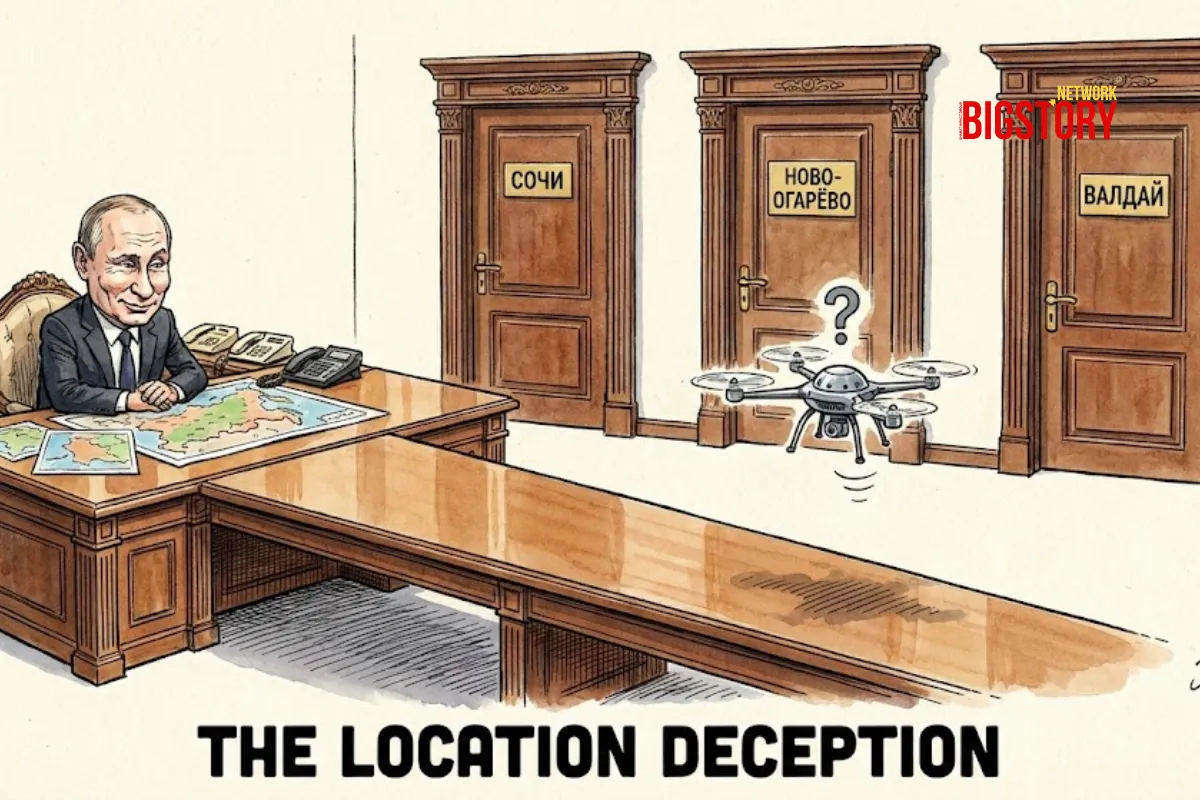
Furthermore, the "Geography of Deception" casts doubt on the claim itself. Investigative reports have revealed that Putin uses three identical office replicas in different locations (Sochi, Novo-Ogaryovo, and Valdai) to conceal his true whereabouts. If the Kremlin systematically fakes the President’s location, how credible is a claim that drones targeted his specific residence at a specific time? The accusation relies on a premise—Putin’s presence—that is itself a state secret often guarded by lies.
If the Trump administration accepts the Russian narrative, it could pause the security guarantee discussions, forcing Ukraine to make further concessions. If the US dismisses it, Putin may feel cornered and escalate militarily to "prove" the threat is real. The "91 drones" claim sets the stage for a potentially massive Russian retaliatory strike on Kyiv, testing the fragility of the 95% agreed-upon peace deal.
If Vladimir Putin’s location is a state secret protected by decoys, how did 91 drones know exactly where to go—or is the only thing that was launched yesterday a lie?
Did Ukraine really attack Putin's residence at Valdai? Ukraine has categorically denied the attack. President Zelenskyy called the claim "another lie." Independent verification is difficult, but analysts note the suspicious timing immediately following successful peace talks, suggesting it may be a fabricated pretext by Russia to escalate the conflict or stall negotiations.
Why did Russia make this claim right after the Trump-Zelensky meeting? Analysts believe this is a strategic move to sabotage the momentum of the peace deal. By accusing Ukraine of an assassination attempt ("state terrorism"), Russia creates a justification to "revise" its negotiating position and reject the 20-point peace plan that Trump and Zelenskyy were reportedly close to finalizing.
What is the Valdai residence and why does it matter? The Valdai residence is one of Vladimir Putin's secluded estates in the Novgorod region. It is significant because investigative reports suggest Putin uses it, along with identical office replicas in other locations, to conceal his true movements. An attack there would symbolize a deep breach of Russian security, but the opacity of Putin's location makes the claim hard to verify.
News Coverage
Diplomatic Context
 Exclusive Content


Sign up for the Daily newsletter to get your biggest stories, handpicked for you each day.



 Trending Now! in last 24hrs


