
US forces bomb Caracas and claim President Maduro is captured. Venezuela declares emergency. Trump says "locked and loaded." Read the full investigation.
 Brajesh Mishra
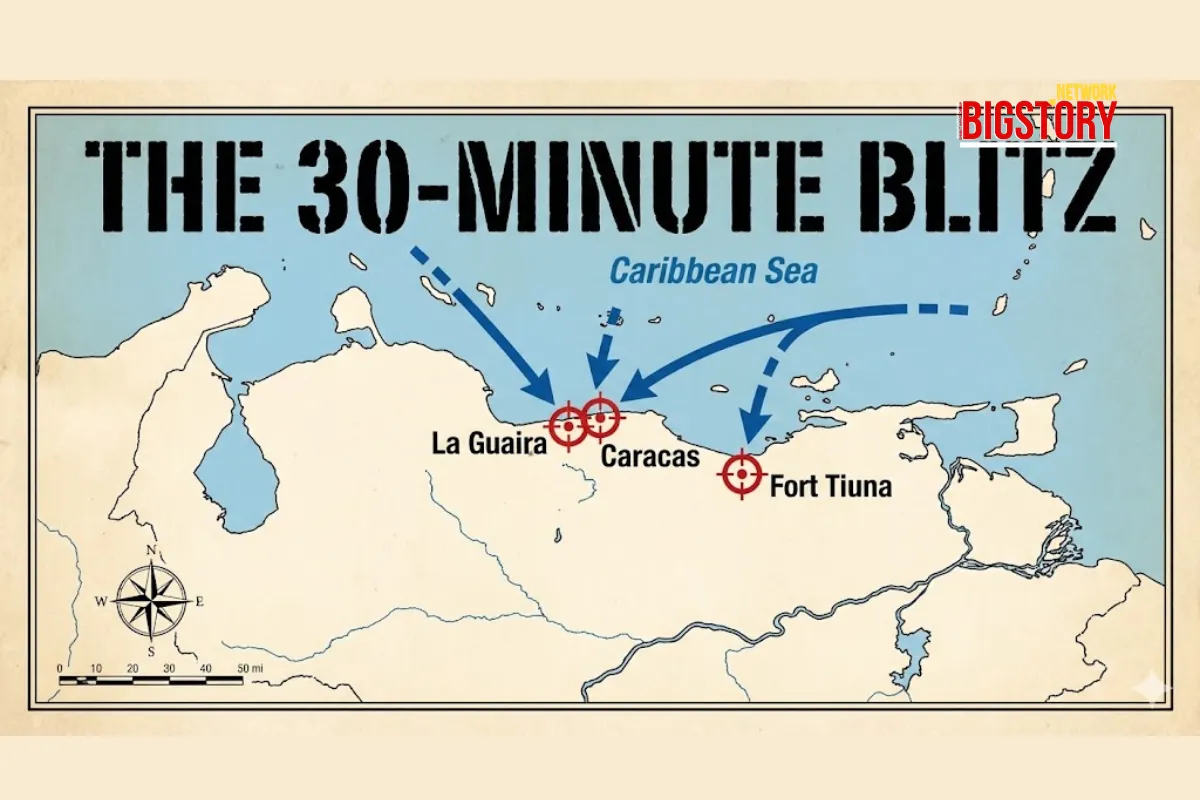
The geopolitical map of the Americas was rewritten in thirty minutes on Saturday. At 2:00 AM local time on January 3, 2026, a barrage of U.S. missiles and airstrikes slammed into strategic military installations across Caracas, including the Fort Tiuna base and La Carlota airfield. Moments later, U.S. President Donald Trump announced that Venezuelan President Nicolás Maduro and his wife, Cilia Flores, had been "captured" by U.S. special forces and flown out of the country. The operation, described as a "decapitation strike" against the regime, has plunged Venezuela into a national emergency, with Interior Minister Diosdado Cabello rallying troops but failing to produce Maduro, fueling a global mystery: Is the President a prisoner, or is he in hiding?
This was not a sudden skirmish; it was the climax of a six-month shadow war. Tensions spiked in August 2025 when the U.S. deployed carrier strike groups to the Caribbean, ostensibly for counter-narcotics operations. By December, the U.S. Coast Guard had begun seizing Venezuelan oil tankers, tightening the economic noose. The January 3 strikes were surgical and overwhelming, targeting air defenses at El Volcán and naval assets at La Guaira port to clear a path for what Trump claims was a Delta Force extraction mission. The operation marks the most significant U.S. military intervention in Latin America since the invasion of Panama in 1989.
While mainstream media focuses on the explosions, the deeper story is the "Proof of Life Standoff." This is no longer a military battle; it is an information war. Trump claims checkmate; Cabello claims resistance. The absence of a "hostage video" or a photo of Maduro in U.S. custody is glaring. Until Washington produces the prisoner, or Caracas produces the President, the country is effectively leaderless. This ambiguity invites a dangerous power vacuum where rogue military factions could seize control.
Furthermore, the "Oil War" subtext cannot be ignored. Venezuela holds the world’s largest proven oil reserves. With global energy markets volatile, a U.S.-installed transition government could reopen the taps to Western markets, fundamentally altering global oil politics. This wasn't just a drug bust; it was likely an energy security operation disguised as regime change.
If Maduro is gone, the Chavista power structure faces an existential splintering. Without their figurehead, loyalists may turn on each other. Regionally, this signals the return of the Monroe Doctrine with a vengeance—the U.S. is willing to decapitate sovereign governments to secure its "backyard." For Latin America’s leftist leaders, the message is chilling: sovereignty is conditional.
The Closing Question (Now, Think About This)
If the U.S. can extract a head of state from his capital in 30 minutes, does any nation truly have sovereignty, or just permission to exist?
Did the US capture Nicolás Maduro? President Donald Trump claimed on January 3, 2026, that U.S. forces captured Maduro and his wife during a military operation. However, the Venezuelan government has not confirmed this, and no visual proof of his custody has been released by the U.S. as of yet.
What targets were hit in the Venezuela bombing? Reports confirm airstrikes on key military and infrastructure sites including Fort Tiuna (military HQ), La Carlota airbase, Higuerote Airport, and the port of La Guaira. Signal antennas at El Volcán were also destroyed to disrupt communications.
Why did the US attack Venezuela in January 2026? The operation followed months of rising tensions, with the U.S. accusing the Maduro regime of drug trafficking and threatening regional stability. The immediate trigger appears to have been an opportunity for a "decapitation strike" to remove the leadership, amid escalating naval confrontations in the Caribbean.
News Coverage
Context & Updates
 Exclusive Content


Sign up for the Daily newsletter to get your biggest stories, handpicked for you each day.


 Trending Now! in last 24hrs


