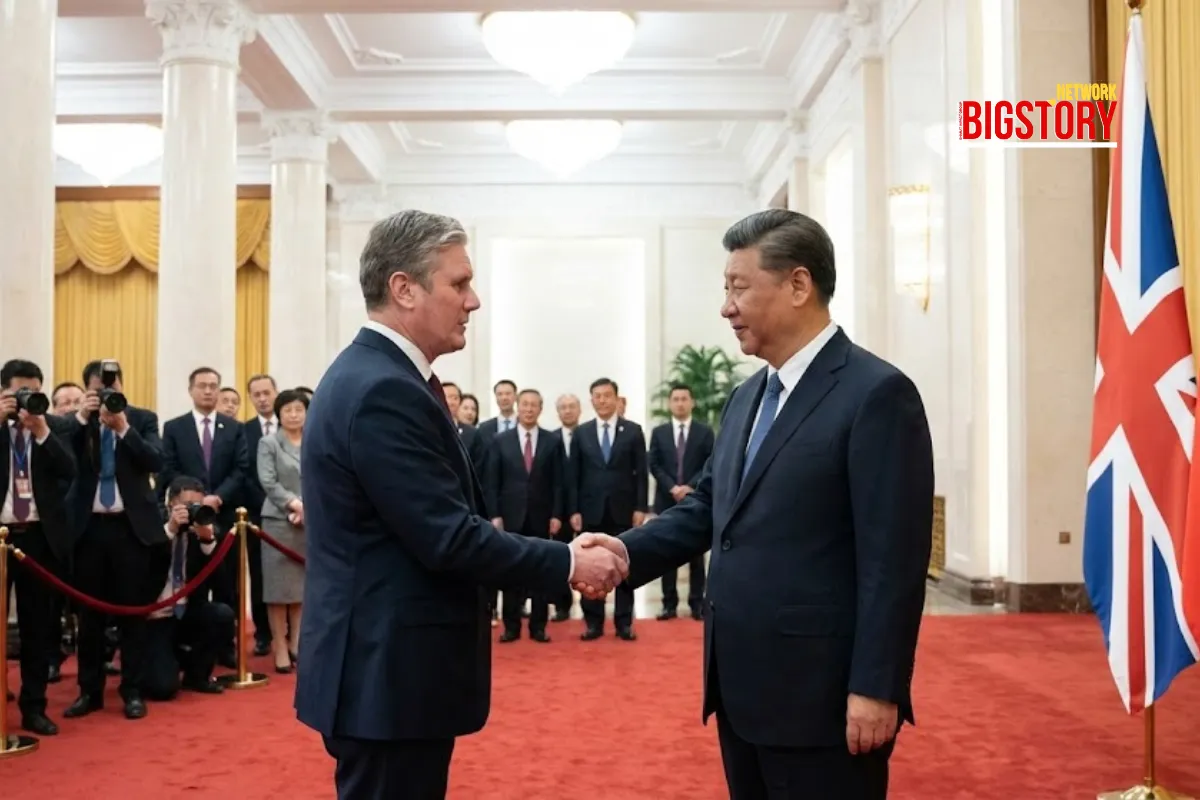
In a geopolitical maneuver explicitly driven by economic survival, British Prime Minister Keir Starmer met with President Xi Jinping in Beijing today, January 29, 2026, to formally announce a "Long-Term Strategic Partnership". This historic summit—the first by a UK premier in eight years—signals a decisive end to the diplomatic "ice age" between London and Beijing.
Starmer signed the "Beijing Declaration" on trade and climate, a move designed to decouple the UK’s economic fate from an increasingly hostile Washington. The reset comes just days after US President Donald Trump threatened universal tariffs of 10-20% on all imports, including British goods, forcing Downing Street to seek an urgent economic "Plan B" in the East.
The Context (How We Got Here)
- The "Greenland" Trigger: Tensions with the US spiked on January 20, 2026, when President Trump clashed with London over the "Greenland Dispute" and threatened tariffs. This accelerated Starmer’s pivot, transforming a cautious engagement strategy into a full-blown reset.
- The "Mega Embassy" Quid Pro Quo: To unlock the Beijing summit, the UK government quietly approved China’s controversial plan for a £600 million "Mega Embassy" at the Royal Mint Court in London on January 23. This approval, previously stalled by security and local opposition, was the key Chinese demand to roll out the red carpet.
- The Economic Collapse: The urgency is underpinned by grim data: UK exports to China plummeted by 52.6% in 2025. Starmer’s "Growth Mission" cannot succeed without reversing this trend, especially with the US market becoming a walled fortress.
The Key Players (Who & So What)
- Keir Starmer (Prime Minister): The Pragmatist. Starmer is executing a high-risk "Progressive Realism" doctrine. He argues that "we must take the world as it is," prioritizing the British economy over ideological purity. His goal is to stop the post-Brexit stagnation, even if it means angering human rights activists.
- Xi Jinping (President of China): The Host. Xi welcomed Starmer with a full state reception, eager to exploit the rift between London and Washington. By offering trade access, Xi aims to peel a key G7 ally away from the US containment strategy.
- Iain Duncan Smith (Conservative MP): The Critic. Leading the backlash from the Inter-Parliamentary Alliance on China (IPAC), Smith accused Starmer of "kowtowing" to Beijing and betraying Hong Kong activist Jimmy Lai for the sake of "investment crumbs."
The BIGSTORY Reframe (The "Trump Refugee" Strategy)
Mainstream media is asking if Starmer raised human rights issues. The real story is that this is a Defensive Pivot against America.
- Geopolitical Hedging: Starmer (much like Canada’s Mark Carney in parallel moves) is executing a "Trump Refugee" strategy. The UK is terrified of the US trade war. By hugging China, Starmer is signaling to Washington that the UK has options. It is a classic hedge—using Beijing as leverage against Washington's unpredictability.
- The AI Bridge: Surprisingly, the joint statement includes a clause on "AI Safety Governance." While the US is trying to blockade China’s access to AI chips, the UK is positioning itself as a "neutral bridge," agreeing to host joint safety summits. This risks Washington's ire but positions London as the global arbiter of AI regulation, refusing to pick a side in the tech cold war.
The Implications (Why This Matters)
- For Londoners: The approval of the embassy at Royal Mint Court (Tower Hamlets) will likely trigger fierce local protests this weekend. Residents and activists view the site—bordering the Tower of London—as a symbol of Chinese surveillance expanding into the capital.
- For Business: The reset opens the door for Green Tech and Financial Services. Banks like HSBC and Standard Chartered, which have lobbied hard for this thaw, are the immediate winners. Exporters of luxury goods and EVs are also expected to see "administrative blocks" at Chinese ports vanish overnight.
- For the "Special Relationship": This visit marks the lowest point in UK-US relations in decades. By choosing Beijing’s trade over Washington’s security alignment, Starmer is effectively declaring that the UK’s economic survival takes precedence over the Atlantic Alliance.
The Closing Question (Now, Think About This)
If a staunch US ally like the UK feels forced to pivot to China to survive American protectionism, is the "Western Alliance" fracturing not because of its enemies, but because of its leader?
FAQs: Decoding the China Reset
1. Why did Keir Starmer visit China in January 2026? Starmer visited China to secure a "trade lifeline" following threats of 10-20% tariffs from US President Donald Trump. The visit aims to reverse a 52.6% drop in UK exports to China and stimulate economic growth.
2. Did the UK approve the new Chinese Embassy?Yes. On January 23, 2026, the UK government quietly approved the plans for China’s new "Mega Embassy" at the Royal Mint Court in London. This approval was widely seen as a diplomatic precondition for President Xi to agree to the summit.
3. What is the "Beijing Declaration"? It is the joint statement signed by Starmer and Xi, outlining a "Long-Term Strategic Partnership." It focuses on trade cooperation, climate change action, and surprisingly, AI Safety Governance, effectively decoupling the UK's economic strategy from US foreign policy constraints.
4. Did Starmer lift the ban on Huawei?No. The reset focuses on non-sensitive trade sectors like electric vehicles, finance, and green technology. The ban on Huawei in the UK's critical telecom infrastructure remains in place.
5. What is the "Greenland Dispute"? The "Greenland Dispute" refers to a diplomatic clash between the US and UK/European allies in early January 2026, which precipitated Trump’s threat of tariffs. It served as the immediate catalyst for Starmer to seek an alternative economic partner in China.
Sources
News Coverage
Context & Analysis