
Experts warn the VB-G RAM G Bill will fail to deliver its 125-day promise due to 60:40 state funding, agricultural pauses, and tech barriers.
 Brajesh Mishra
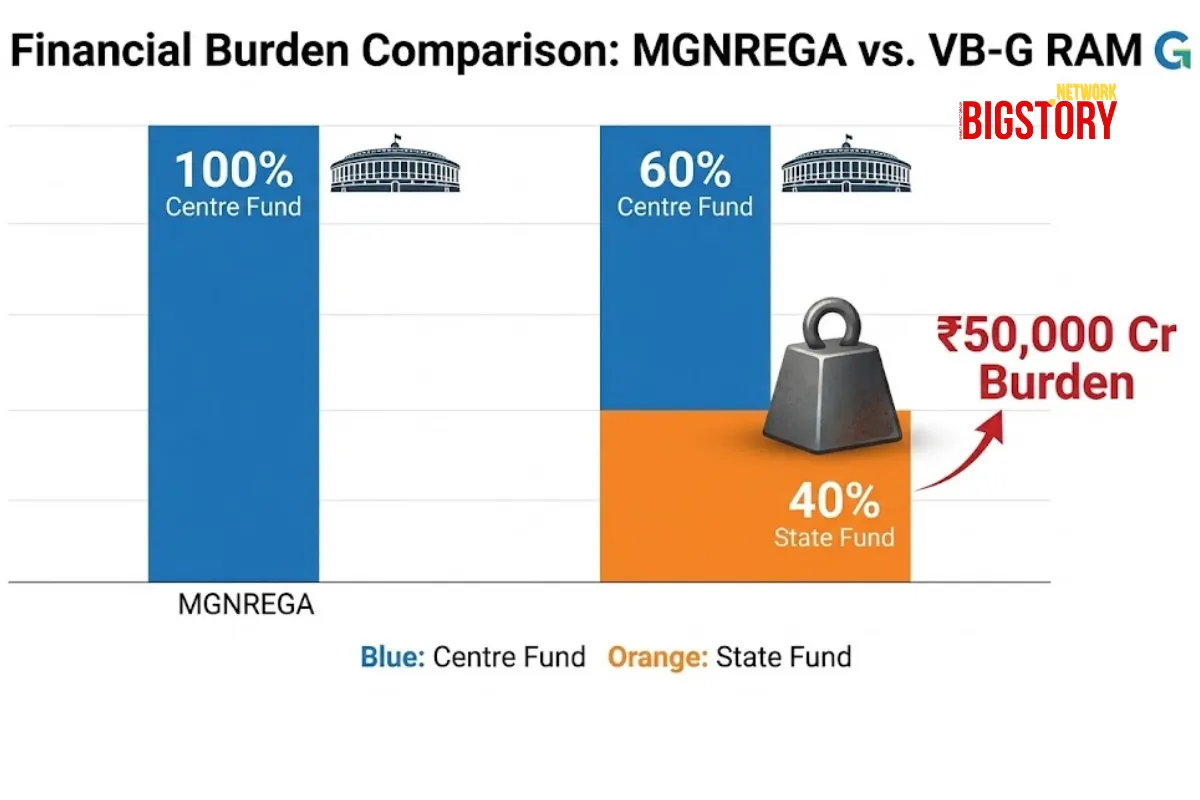
Even as the government celebrates the Lok Sabha's passage of the VB-G RAM G Bill, which replaces MGNREGA with a promise of 125 days of work, experts are sounding the alarm. The bill, passed on December 18, 2025, fundamentally restructures India's rural safety net by shifting 40% of the wage burden to states and mandating a 60-day agricultural pause. Analysts argue these changes create a paradox: while the promise has increased, the structural capacity to deliver it has been slashed. If the fully centrally-funded MGNREGA could only deliver an average of 50 days over 20 years, the new, state-burdened model risks collapsing delivery to historic lows.
For two decades, MGNREGA served as a demand-driven lifeline, fully funded by the Centre. Yet, despite a statutory 100-day guarantee, data shows that only 7-9.5% of households ever completed the full quota annually. The system failed due to administrative bottlenecks, not lack of demand. The new bill, framed as "modernization," attempts to fix this with AI fraud detection and biometrics. However, it introduces fiscal hurdles that poorer states like Bihar and Odisha—already struggling with revenue—cannot clear. By capping federal support and shrinking the work window, the legislation ignores the root causes of MGNREGA's underperformance and adds new financial barriers.
While headlines focus on the "125 days," the deeper story is the "Compressed Calendar Trap." The mandatory 60-day agricultural pause shrinks the effective work year to 305 days. Mathematically, fitting 125 days of work into this compressed window requires a logistical efficiency (41% utilization) that no state has ever achieved. It creates a scheduling bottleneck that, combined with the fiscal disincentive for states to spend their own money, creates a "guarantee" in name only. This isn't just a policy tweak; it's a shift from a "rights-based" model to a "ration-based" one, where work is allocated based on budget availability rather than legal entitlement.
The transition period in mid-2026 looms as a potential disaster. As the administrative machinery switches from MGNREGA to VB-G RAM G, millions could face a 4-6 month wage vacuum right during the agricultural off-season. Politically, this creates a time bomb for the 2026 state elections, where the gap between the "125-day promise" and the "zero-day reality" of the transition could alienate the rural voter base.
If the government genuinely wanted to guarantee 125 days of work, why did it make it financially harder for states to pay for it?
What are the main problems with the VB-G RAM G Bill? Experts cite three structural flaws: (1) The 60:40 funding split places an unsustainable burden on poorer states; (2) The 60-day agricultural pause compresses the work window, making 125 days logistically harder to deliver; (3) Mandatory biometric authentication risks excluding elderly and manual laborers with worn fingerprints.
If MGNREGA delivered only 50 days, why will VB-G RAM G deliver 125? Experts argue it likely won't. MGNREGA failed due to administrative capacity despite 100% central funding. The new bill adds financial hurdles (state burden) and operational constraints (tech mandates, pauses), leading analysts to predict actual delivery could drop to 30-40 days.
How much burden does the 60:40 split place on states? Estimates suggest an additional aggregate burden of over ₹50,000 crore annually on states. Kerala alone projects an extra cost of ₹2,500 crore, raising fears that cash-strapped states like Bihar and Odisha will be forced to ration work.
Who will be excluded by the biometric requirements? The mandatory digital attendance system threatens to exclude elderly workers (whose fingerprints fade), manual laborers (callused hands), and women in rural areas who may lack formal ID or face social barriers to accessing digital centers.
News Coverage
Research & Analysis
 Exclusive Content


Sign up for the Daily newsletter to get your biggest stories, handpicked for you each day.


 Trending Now! in last 24hrs


