
Discover the life of JRD Tata, the visionary pilot who founded Air India and scaled the Tata Group to 95 companies while putting human dignity before profit.
 Rashmeet Kaur Chawla
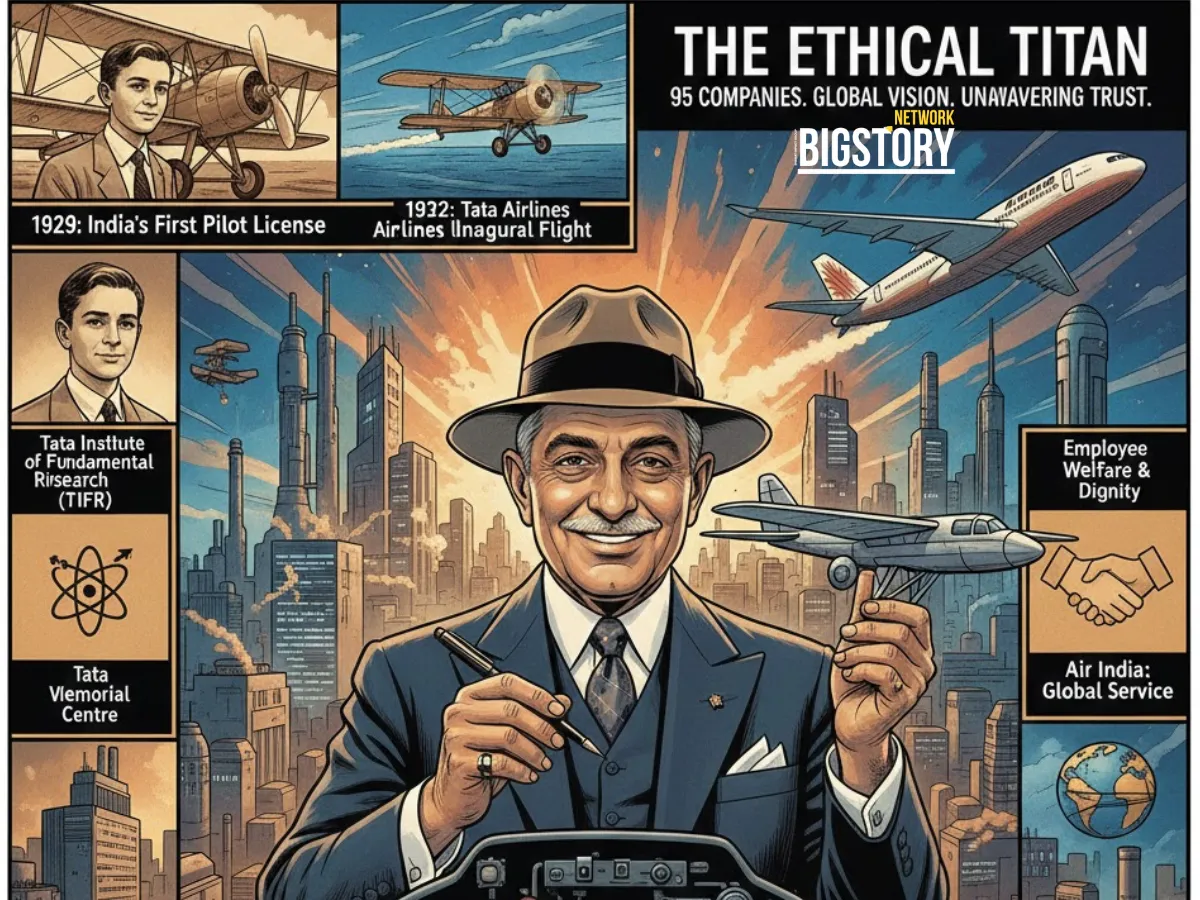
Could a shy child born in France grow up to change how India looked from the sky—and, in the process, quietly reshape its industries, institutions, and ethics of leadership? Could one individual transform a modest business house into a 95-company conglomerate while believing, almost stubbornly, that people mattered more than profit?
This is the story of Jehangir Ratanji Dadabhoy Tata—the pilot who gave India wings, the nation-builder who trusted quietly, and the gentle challenger who redefined what leadership in India could look like.
JRD Tata’s life began with a contradiction. Born on 29 July 1904 in Paris, to industrialist Ratanji Dadabhoy Tata and his French wife Suzanne “Sooni” Brière, he grew up between continents, cultures, and expectations. His first language was French. His education unfolded across Paris, Yokohama, and London. India, the country he would one day help shape, was initially distant—emotionally and geographically.
Raised in privilege, JRD was also deeply shy and introspective. From an early age, he felt the tension between personal freedom and inherited responsibility. On one hand, he longed for a life driven by curiosity, engineering, and exploration. On the other, the Tata name carried an unavoidable weight—a moral obligation toward a nation still under colonial rule.
This inner conflict sharpened painfully when his mother passed away and JRD was summoned back to India after a brief stint in the French army. His dreams of pursuing engineering at Cambridge were set aside. At just 21, he joined Tata Sons—not as a visionary leader, but as a reluctant apprentice in a land he barely knew. It was not ambition that brought him to India; it was duty.
Yet this reluctant beginning would become the foundation of one of India’s most quietly transformative leadership journeys.
If responsibility anchored JRD to India, aviation gave him perspective. As a teenager in Europe, he became captivated by early aviation pioneers, especially Louis Blériot, the first man to fly across the English Channel. At 15, JRD experienced his first flight—an event that permanently altered his imagination. To him, flying was not just a technological marvel; it was a metaphor for freedom, discipline, and global thinking.
On 10 February 1929, JRD Tata earned India’s first-ever pilot license. The achievement carried symbolism far beyond aviation. In a colonized country conditioned to believe that complex systems belonged to the West, this was a declaration of Indian capability.
Colonial India had no aviation infrastructure, no airstrips worth the name, and no ecosystem to support commercial flying. But JRD saw constraint as challenge. In 1932, he personally piloted a single-engine Puss Moth aircraft carrying airmail from Karachi to Bombay, marking the birth of Tata Airlines.
From these early struggles emerged JRD Tata’s defining belief:
"If capable people are trusted with dignity and freedom, they build institutions that outlive individuals and uplift nations."
He rejected the idea of capitalism as mere profit extraction. For JRD, business was service at scale, and leadership was about creating systems strong enough to endure beyond one lifetime.
Launching an airline in pre-independence India bordered on audacity. Tata Aviation Service, later Tata Airlines, and eventually Air India, became living proof of this conviction. JRD obsessed over punctuality, safety, and service quality. Even after Air India was nationalized, he continued to chair it, safeguarding its standards. This philosophy earned him the enduring title “Father of Indian Civil Aviation.”
When JRD became chairman of Tata Sons in 1938, at just 34 years old, the group consisted of 14 companies. When he stepped down decades later, it had grown to 95 companies. Companies like TELCO (now Tata Motors), TCS, Titan, and Tata Power flourished because leaders were empowered, not controlled.
Perhaps JRD Tata’s most enduring legacy lies in his treatment of people. Decades before labor laws mandated them, he introduced:
In Jamshedpur, he helped build one of the world’s most humane industrial townships. JRD believed that fear may extract output, but respect builds loyalty—and loyalty builds nations.
JRD Tata never chose between passion and responsibility. He fused them. Beyond business, his influence shaped India’s intellectual backbone:
His awards, including the Padma Vibhushan and the Bharat Ratna, recognized not wealth, but wisdom. When he passed away in 1993, the Indian Parliament adjourned in tribute—an honor rarely accorded to industrialists.
JRD Tata challenges today’s leaders to unlearn noise, speed, and obsession with optics.
This is a BIGSTORY because it isn’t about dominance; it’s about quiet disruption. Because JRD Tata didn’t merely build companies—he built standards.
Q1. Why is JRD Tata called the Father of Indian Civil Aviation? Because he founded India’s first commercial airline in 1932 and laid the foundation for Air India, setting global standards in Indian aviation.
Q2. What was JRD Tata’s leadership style? Quiet, ethical, trust-based, and decentralized. He empowered professionals and focused on long-term institution building.
Q3. Did JRD Tata believe in profit-driven capitalism? No. He believed business existed to serve society and that profit was a byproduct of ethical, responsible leadership.
Q4. What are JRD Tata’s biggest achievements? Founding Indian aviation, expanding the Tata Group globally, pioneering employee welfare, and establishing India’s leading social and scientific institutions like TIFR.
 Exclusive Content


Sign up for the Daily newsletter to get your biggest stories, handpicked for you each day.



 Trending Now! in last 24hrs


