
Dorabji Tata inherited an unfinished empire and a collapsing steel company under colonial rule. He mortgaged everything he owned to save it. This is the thinking behind the institutions that outlasted him.
 Rashmeet Kaur Chawla
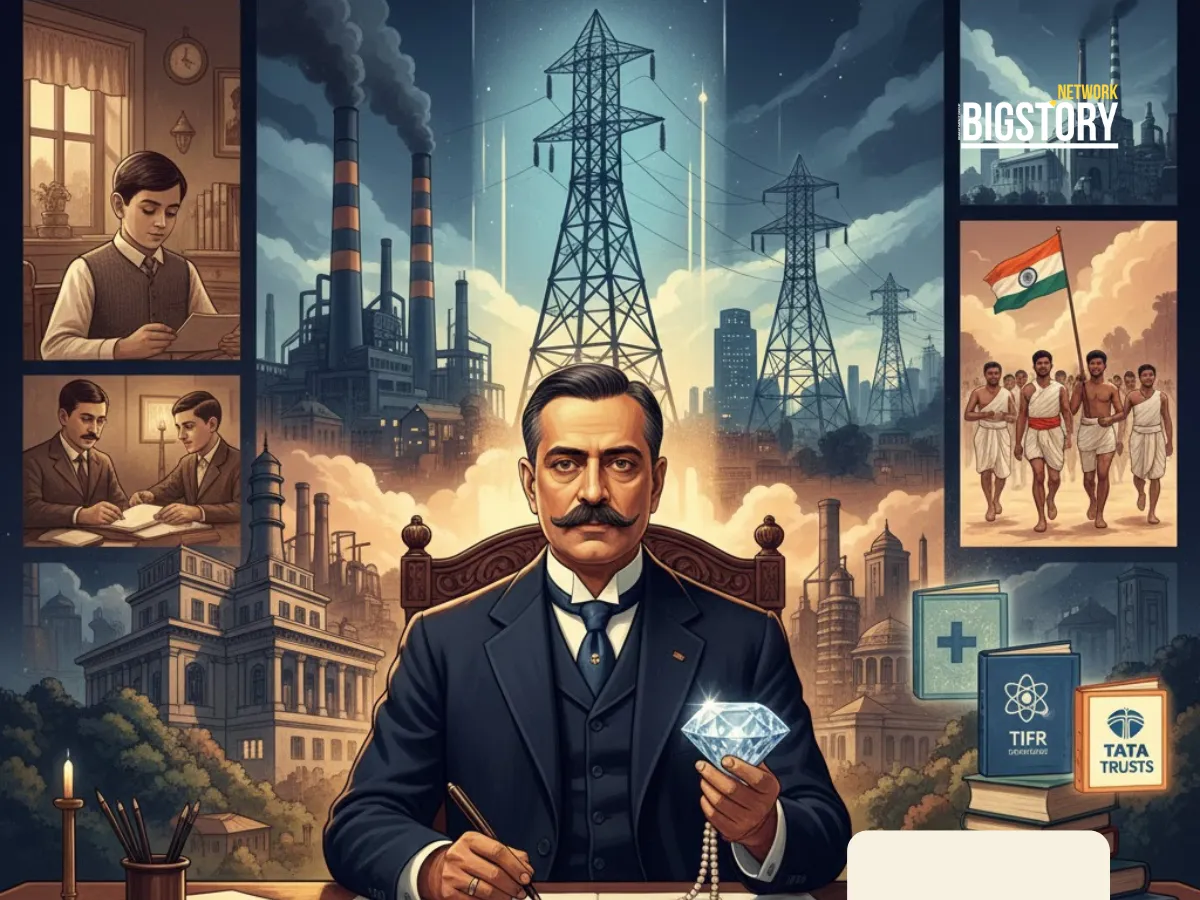
Could a man born under colonial rule imagine a sovereign future?
Is it possible that a young man growing up in colonial Bombay under British rule, racial hierarchy, and economic suppression could imagine a future where India would produce its own steel, generate its own electricity, and nurture scientific minds equal to the world’s best?
Could someone living in an era where Indians were largely excluded from power envision institutions meant not just to survive colonialism, but to outlast it?
Even more improbable — could the son of a rising business family gamble away everything he owned, including his mother’s jewellery, not for personal rescue but for the industrial future of a nation that did not yet exist?
This is the inspiring journey of Sir Dorabji Tata the quiet challenger who transformed his father’s dreams into living institutions and laid the invisible foundations of modern India.
Sir Dorabji Jamsetji Tata was born on 27 August 1859 in Bombay, into the illustrious Tata family, as the eldest son of Jamsetji Nusserwanji Tata and Hirabai Tata. While history remembers him as an industrialist and philanthropist, Dorabji’s early life was shaped by discipline, expectation, and exposure to ideas far larger than commerce.
Raised in a progressive Parsi household, Dorabji grew up in conversations that revolved around reform, enterprise, and national progress. Through blood relations like Shapurji Saklatvala and later through marriage into the Bhabha family, he was surrounded by individuals who believed India deserved global stature intellectually, industrially, and morally.
Yet proximity to greatness did not mean preparation was easy. Jamsetji Tata believed that business leadership without education was hollow. Dorabji’s schooling reflected that philosophy. He began his education at Proprietary High School, Bombay, moved to England for private tutoring, attended Gonville and Caius College, Cambridge, and finally completed his degree at St. Xavier’s College, Bombay in 1882.
Unlike many heirs of industrial families, Dorabji did not immediately step into authority. Instead, he chose an unconventional path — journalism. He worked for The Bombay Gazette for two years, observing governance, markets, and human behaviour from the sidelines.
This phase sharpened something crucial within him: perspective. Journalism taught Dorabji how power operates, how narratives shape public perception, and how policy impacts ordinary lives — lessons that would later guide his decisions as an industrialist.
Only after this grounding he formally enter the Tata business. But even then, there were no shortcuts. Dorabji started in the cotton department, conducted field studies in Pondicherry for potential textile mills, and later worked at Empress Mills in Nagpur, where he immersed himself in day-to-day factory operations.
It was here that he learned an enduring truth — industry is not built in boardrooms alone; it is built where labour, machinery, and human dignity intersect.
In 1897, Dorabji married Meherbai Bhabha, daughter of Dr. Hormusji Bhabha, India’s first Inspector-General of Education in Mysore. The match, encouraged by Jamsetji Tata himself, was rooted in shared values — education, social responsibility, and inner strength.
Their marriage, though childless, became Dorabji’s emotional sanctuary. Meherbai was not merely a companion; she was his intellectual equal and moral anchor. Her prolonged struggle with leukaemia and eventual death in 1931 left an indelible mark on Dorabji’s conscience.
That personal loss later transformed into institutional compassion shaping his lifelong commitment to medical research, women’s education, and philanthropy that addressed suffering at its roots.
What Dorabji faced was not privilege — it was pressure multiplied by responsibility. Jamsetji Tata’s passing did not mark an inheritance of freedom for Dorabji; it marked the beginning of responsibility. His father had publicly articulated a vision that went beyond profit: steel for national strength, power for progress, and science for sovereignty. Dorabji inherited not just wealth, but the weight of national expectation.
As the eldest son in the Tata family tree, Dorabji was constantly measured against a legend. Unlike Jamsetji, he lacked formal technical expertise and operated in a colonial economy deeply hostile to Indian enterprise. British authorities imposed discriminatory tariffs, restricted access to resources, and favoured European firms.
At the same time, Dorabji attempted the near-impossible — running capital-intensive industries like Tata Steel and Tata Power, while simultaneously funding institutions in science, medicine, education, and sports in a country with almost no institutional support.
Resistance came from everywhere. Investors panicked during downturns. Colonial administrators delayed approvals. Even within the Tata ecosystem, senior executives questioned risky expansions into minerals like Gorumahisani iron ore.
The true crucible came after Jamsetji Tata’s death in 1904, when Dorabji, only 37 years old, was forced into full leadership. Projects were incomplete, finances uncertain, and credibility untested. Steel plants existed only on paper; power projects were dreams awaiting validation.
The discovery of iron ore at Gorumahisani in Odisha proved transformative. It confirmed that India possessed the raw materials necessary for industrial independence. By 1912, Tata Steel produced Asia’s first steel rails a symbolic and strategic victory.
Yet success was fragile. After World War I, Dorabji approved a massive expansion of Tata Steel, convinced India needed scale to survive. But global steel prices collapsed. Transport strikes, labour unrest, and the devastating 1923 earthquake in Japan, a key export market, pushed the company to the brink. By 1924, Tata Steel stood inches from collapse.
At this moment of crisis, Dorabji revealed his defining belief — not through words, but action. “Nations rise when wealth is converted into institutions that outlive individuals.” To him, industry was meaningless unless it enabled national capability. Science, sport, and health were not indulgences — they were pillars of sovereignty.
When Tata Steel faced bankruptcy, Dorabji made a decision that redefined leadership. He mortgaged nearly all his personal assets including his wife’s jewellery to keep the company alive. This was not financial bravado. It was an ideological conviction.
Leaders such as Jawaharlal Nehru and Mohammed Ali Jinnah later acknowledged that saving Tata Steel was not merely a corporate rescue, but an act that safeguarded India’s industrial future. In that moment, Dorabji did not behave like a shareholder protecting returns — he acted like a custodian protecting national capability.
The same philosophy guided Tata Power, commissioned in 1915. Rather than chasing short-term dividends, the project prioritised long-term infrastructure, electrifying Bombay and enabling Indian industry to grow independent of colonial energy dependence.
Dorabji understood that political independence without intellectual strength would be fragile. After Jamsetji Tata’s death, he ensured that the Indian Institute of Science (IISc) did not merely survive, but evolved into India’s foremost scientific institution.
Following the death of his wife Meherbai, personal grief transformed into public purpose. Dorabji founded the Lady Tata Memorial Trust, funding global research in leukaemia at a time when medical philanthropy was rare and largely unrecognised.
He also laid the foundations for institutions such as the Tata Memorial Centre and early scientific initiatives that would later culminate in the Tata Institute of Fundamental Research (TIFR). Crucially, these efforts were structured as independent trusts, not personal charities.
For Dorabji Tata, nation-building did not end at factory gates or laboratory doors. He believed national confidence was also forged on playing fields, where identity, discipline, and pride are tested.
At a time when India was still under colonial rule, he personally financed the country’s participation in the 1920 Antwerp Olympics and the 1924 Paris Games. He later went on to preside over the Indian Olympic Association, ensuring Indian athletes could stand on global platforms even before political freedom was achieved.
Was he only a businessman, or also a nation-builder in sports and science? Dorabji felt that national pride was not something that ended at the factories; it was also alive on sports fields and in research labs. As a sports enthusiast, he became the father of India's Olympic movement and made possible the participation of Indian athletes in the Antwerp Games of 1920, even before the existence of a formal National Olympic Association.
Later on, he bankrolled the Indian delegation to the Paris Olympics in 1924 and presided over the Indian Olympic Association as its president. He contributed to the very foundation and growth of Indian sports at that time while simultaneously endorsing his father's vision of the Indian Institute of Science. He was instrumental in its founding in 1909 and was a great supporter of higher education and engineering both locally and internationally. Before independence, he built steel cities, power grids, research universities, hospitals, sports movements, and trusts — structures designed to endure political change and personal absence.
Following Meherbai's death, Dorabji devoted his time and energy to philanthropy. He established the Lady Tata Memorial Trust to fund research in leukaemia and the Lady Meherbai D. Tata Education Trust to educate women for social service.
In March 1932, a few months before his demise, he founded what is now known as the Sir Dorabji Tata Trust. He gave directions that the money be spent "without any distinction of place, nationality or creed" for education, research, relief in case of calamities, and public welfare.
Sir Dorabji Tata leaves behind a question that still unsettles modern leaders: Will your wealth merely make life comfortable or will it build something that outlive you? If your success collapses when you exit, it was never success. It was consumption. Build institutions, not empires. Build systems, not symbols. Build legacies that don’t need your name to survive.
This is not a success story. This is a BIGSTORY of responsibility. When the odds were colonial and the costs were personal, he built institutions, not empires. Sir Dorabji Tata challenged history by preparing a nation for freedom before freedom arrived.
1. Who was Sir Dorabji Tata and what were his major contributions to India? Sir Dorabji Tata (1859 – 1932) was a prominent Indian industrialist who led the Tata Group after his father. He expanded Tata Steel, Tata Power, and established the Sir Dorabji Tata Trust.
2. What is the Sir Dorabji Tata Trust and why is it significant? The Sir Dorabji Tata Trust, founded in 1932, is one of India’s oldest philanthropic organisations, supporting education, healthcare, and research regardless of creed or nationality.
3. How did Sir Dorabji Tata support science and research in India? He helped develop the Indian Institute of Science (IISc) and his Trust later funded the Tata Institute of Fundamental Research (TIFR) and Tata Memorial Centre.
4. What role did Sir Dorabji Tata play in India’s Olympic history? He financed Indian participation in the 1920 Antwerp and 1924 Paris Olympics and became the first President of the Indian Olympic Association.
5. Why did Sir Dorabji Tata invest personal wealth in philanthropy? Guided by the belief that wealth should be used constructively for the nation, he donated nearly all his assets — including the 245-carat Jubilee Diamond — to trusts that would support India's civic welfare.
Tata Trusts — About Sir Dorabji Tata Primary source for biographical details and Trust founding. https://www.tatatrusts.org/about-tatatrusts/about-sir-dorabji-tata
Wikipedia — Dorabji Tata Source for biographical chronology, industrial achievements, and philanthropy. https://en.wikipedia.org/wiki/Dorabji_Tata
Britannica — Dorabji Jamsetji Tata Source for verified biographical facts and historical context. https://www.britannica.com/biography/Dorabji-Jamsetji-Tata
Tata Trusts — SDTT Board and History Source for Trust governance structure and historical mandate. https://www.tatatrusts.org/about-tatatrusts/sdtt-board-of-trustees
India Today — Dorabji Tata and Olympics Source for Indian Olympic participation in 1920 and 1924 and Dorabji's role. https://www.indiatoday.in/education-today/gk-current-affairs/story/dorabji-tata-elder-son-of-jamsetji-tata-tata-family-took-india-to-olympics-2588808-2024-08-27
Wikipedia — Sir Dorabji Tata and Allied Trusts Source for Trust structure, founding directive, and asset details. https://en.wikipedia.org/wiki/Sir_Dorabji_Tata_and_Allied_Trusts
Oxford Dictionary of National Biography Source for historical biographical detail and colonial context. https://www.oxforddnb.com
 Exclusive Content


Sign up for the Daily newsletter to get your biggest stories, handpicked for you each day.



 Trending Now! in last 24hrs


