
Supreme Court stays its Nov 20 order defining Aravalli Hills by 100m elevation. New expert committee formed to prevent mining in ecological gaps
 Sseema Giill
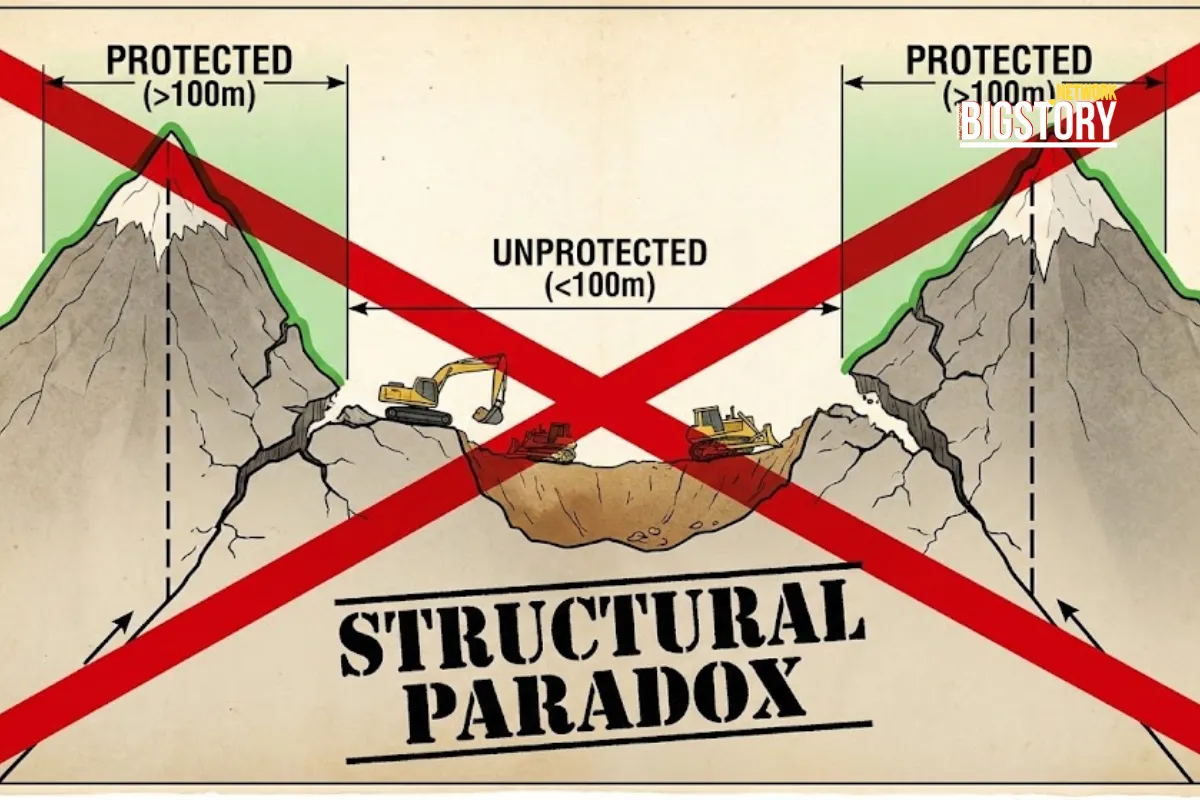
The legal battle for India’s oldest mountain range has taken a dramatic turn. On December 29, 2025, a Supreme Court bench led by Chief Justice of India (CJI) Surya Kant stayed its own previous order dated November 20, effectively halting the implementation of a controversial "100-meter elevation" rule. This decision immediately freezes all fresh mining licenses in the Aravalli regions of Haryana, Rajasthan, Delhi, and Gujarat. The Court has now directed the formation of a fresh "high-powered expert committee" to redefine what actually constitutes the Aravalli Hills, admitting that the previous definition risked leaving vast ecological gaps open for exploitation.
This reversal stems from a contentious order passed just last month. On November 20, 2025, a different SC bench accepted a government committee’s recommendation to define "Aravalli Hills" only as landforms exceeding 100 meters in height. Critics and environmentalists immediately flagged this as a disaster, noting that only 1,048 out of 12,081 hillocks in the region met this arbitrary criteria. This would have effectively stripped protected status from 90% of the range, opening the door for massive stone quarrying and real estate development in the "lower" hills.
While mainstream reports frame this as "judicial confusion," the deeper story is the shift from "Spot Protection" to "Landscape Ecology." The previous order treated the Aravallis as a collection of isolated peaks. The new bench is forcing the government to view it as a continuous corridor. The "Structural Paradox" highlighted by the CJI is crucial: if you protect two hills but allow mining in the 500-meter gap between them, you effectively destabilize the entire range. The court is moving to close the "Valley Loophole" that developers in Gurugram and Faridabad have long exploited.
Furthermore, this sets the stage for a Data War. The previous committee relied on manual surveys and bureaucratic definitions. The new committee will likely be mandated to use LiDAR and satellite mapping (ISRO data) to prove that the "small" hills are geologically identical to the "big" ones. This is no longer just a legal dispute; it is a geospatial one.
For the mining lobby in Rajasthan and real estate giants in Haryana, this is a massive setback. The "100m rule" was their golden ticket to regularize operations. With the stay order, the legal status of thousands of acres of "gair mumkin pahar" (uncultivable hill land) remains frozen. The new committee's findings will likely determine the ecological future of the National Capital Region (NCR) for decades.
If a hill is only protected when it’s 100 meters tall, does the ecosystem stop existing at 99 meters?
Why did the Supreme Court stay its own Aravalli order in December 2025? The Supreme Court stayed its November 20 order because the "100-meter elevation" definition was found to be scientifically flawed. It risked excluding nearly 90% of the actual hill range (protecting only 1,048 out of 12,081 hillocks), creating a "structural paradox" where mining could occur in the valleys between protected peaks.
What is the new committee for Aravalli hills tasked with? The new high-powered expert committee is tasked with holistically redefining the "Aravalli Hills" based on ecological continuity rather than just height. It will examine the validity of the 100m rule, determine if mining should be allowed in gaps (up to 500m wide) between hills, and ensure no ecological corridors are broken.
Is mining allowed in Aravalli hills now? No. Following the December 29 order, the Solicitor General confirmed that the Centre has directed all relevant states (Haryana, Rajasthan, Delhi, Gujarat) to halt the granting of any fresh mining leases until the new committee submits its report and the Supreme Court gives a final ruling.
News Coverage
Legal Analysis
 Exclusive Content


Sign up for the Daily newsletter to get your biggest stories, handpicked for you each day.


 Trending Now! in last 24hrs


