
Supreme Court bans new mining leases in Aravallis across 4 states until a sustainable plan is ready. New 100m definition aims to stop illegal flattening of hills.
 Brajesh Mishra
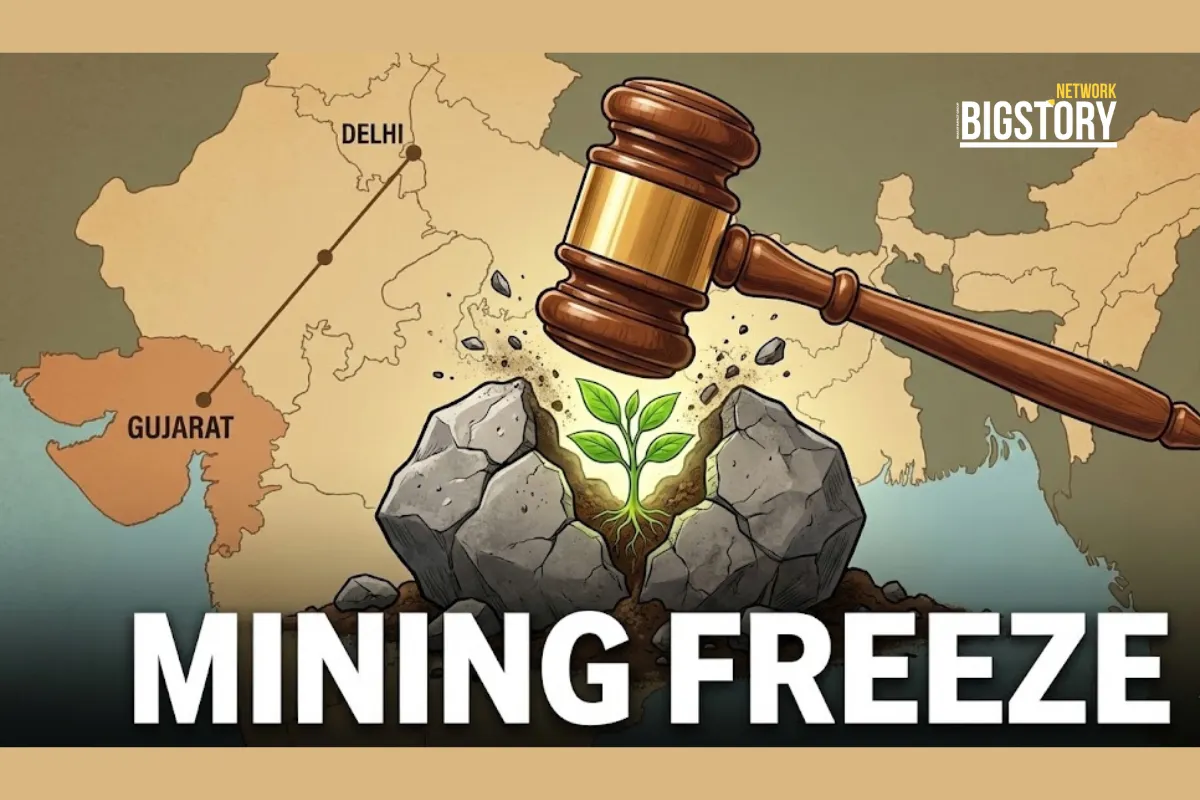
In a decisive move to save India's oldest mountain range from physical erasure, the Supreme Court of India has imposed an immediate freeze on all fresh mining leases across the 692 km Aravalli expanse. The landmark November 21 judgment, delivered by a bench led by CJI B.R. Gavai, accepts a new, uniform definition of the hills—effectively closing the legislative loopholes used by states like Rajasthan to declassify hills as "revenue land" for exploitation. This order halts expansion until a comprehensive "Management Plan for Sustainable Mining" (MPSM) is finalized.
The legal battle for the Aravallis has raged since 2002, but enforcement has been crippled by semantic games. State governments frequently argued that lower elevations didn't count as "forests" or "hills." The urgency of this ruling stems from a shocking 2018 Forest Survey of India (FSI) report revealing that 31 hillocks had physically disappeared in Rajasthan due to illegal mining. The new order mandates that any landform with a local relief of 100 meters or more is legally an Aravalli hill, extending protection across Delhi, Haryana, Rajasthan, and Gujarat.
While environmentalists are celebrating the freeze, the deeper story is the "Sustainable Pivot." The Supreme Court has effectively admitted that the "Total Ban" model failed. By explicitly stating that bans encourage the mining mafia, the Court is pivoting to a market-based solution: legalize and strictly regulate to kill the black market. However, there is a "Real Estate Trap" hidden in the fine print. By setting the definition threshold at 100 meters, the court may have inadvertently stripped protection from the lower-lying Aravalli foothills and scrublands (common in Gurugram and Delhi). These areas, crucial for groundwater recharge but lacking height, could now be vulnerable to real estate developers arguing they don't meet the "100-meter hill" criteria.
The enforcement of this order relies on a technological leap. The mandate for "scientific mapping" signals a shift toward AI-driven Satellite Surveillance. Instead of relying on corruptible ground inspectors, compliance will likely move to change-detection algorithms using ISRO satellite feeds to flag illegal excavation in real-time. For the construction industry in NCR, this signals a potential supply shock in raw materials, while for the "mining mafia," it signals the end of using ambiguity as a legal shield.
The Closing Question (Now, Think About This)
If 31 hills can vanish under the government's watch, can a "Sustainable Plan" actually save the 32nd, or will it just legalize its destruction in a "permissible zone"?
What is the Supreme Court's new order on Aravalli mining 2025? The Supreme Court has banned the granting of all new mining leases in the Aravalli range across Delhi, Haryana, Rajasthan, and Gujarat. This ban stays in effect until the government finalizes a "Management Plan for Sustainable Mining" (MPSM).
What constitutes the Aravalli Range according to the new SC definition? The Court accepted the expert committee's definition: A hill is part of the Aravalli range if it has a local elevation relief of 100 meters or more. Associated features like hillocks and slopes within 500 meters of such hills are also protected.
Are existing mines allowed to operate in Aravalli after the 2025 judgment? Yes, existing legal mines with valid permits can continue operations, provided they strictly adhere to the new environmental guidelines being drafted. The Court emphasized that a total ban often fuels illegal mining, opting instead for strict regulation.
Why did the Supreme Court intervene in Aravalli mining? The intervention was driven by data showing ecological collapse, specifically a 2018 report revealing that 31 hillocks had physically disappeared in Rajasthan due to unchecked illegal mining, which was facilitated by states using ambiguous definitions of what constituted a "hill."
News Coverage
Legal & Analysis
 Exclusive Content


Sign up for the Daily newsletter to get your biggest stories, handpicked for you each day.



 Trending Now! in last 24hrs


