
RSS Chief Mohan Bhagwat denies paramilitary status during centenary. Investigation reveals 2,500 affiliates and contradicting past statements.
 Brajesh Mishra
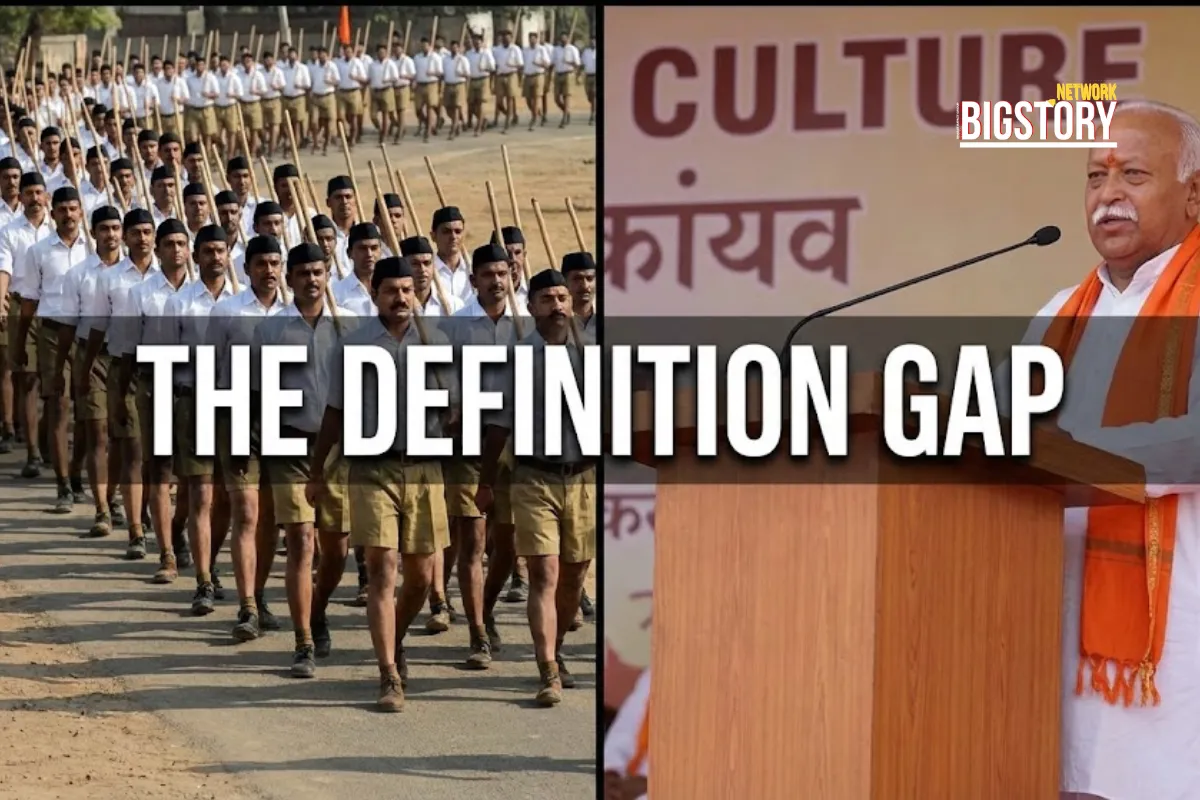
As the Rashtriya Swayamsevak Sangh (RSS) kicks off its centenary year celebrations, a battle over its definition has erupted. On January 2, 2026, RSS Chief Mohan Bhagwat explicitly stated that viewing the organization as "paramilitary" would be a "mistake," despite its uniformed cadres, stick drills, and marches. This denial stands in stark contrast to his own 2018 assertion that the RSS could "prepare military personnel within three days," a feat he claimed the Indian Army would take months to achieve. The timing is critical: with state elections looming in West Bengal and the organization expanding to 8,000 units there, the RSS is attempting to rebrand its militant image into one of "cultural service" while leveraging its massive ground network for political mobilization.
The RSS has walked this tightrope for a century. Founded in 1925 with a mission to militarize Hindu society, it was banned in 1948 after Mahatma Gandhi's assassination but reinstated in 1949 after agreeing to a written constitution defining it as "cultural." In July 2024, the Indian government officially reclassified it as "non-political," allowing civil servants to join—a move that reversed a 58-year-old restriction. Yet, the organization's structure—hierarchical command, daily drills, and ideological indoctrination—remains indistinguishable from paramilitary formations. Bhagwat's current denial appears to be a strategic pivot to sanitize this legacy for a global audience and the 2026 electorate.
While mainstream coverage focuses on the "Denial," the deeper story is the "Definition Game." By every academic metric—uniforms, drills, hierarchy, mobilization capacity—the RSS fits the paramilitary definition. Bhagwat’s argument relies solely on intent ("character building") to negate structure. This semantic loophole has allowed the RSS to evade the "militia" label internationally while functioning as one domestically.
Furthermore, the "Centenary Strategy" in West Bengal reveals the true purpose of this rebranding. The rapid expansion from 4,500 to 8,000 units in a key opposition state isn't a cultural project; it's a political machine gearing up for the 2026 elections. The "cultural" tag is the legal shield that allows this paramilitary-style mobilization to operate without the scrutiny applied to political militias.
If the RSS successfully cements its "cultural" status in its centenary year, it normalizes the presence of a private, uniformed army in India's civic life. The 2024 government order allowing bureaucrats to join completes the merger of state and Sangh, effectively erasing the line between the constitutional republic and the RSS's majoritarian project.
The Closing Question (Now, Think About This)
If an organization wears uniforms, trains with weapons, and claims it can mobilize an army in three days, does calling it "cultural" change what it is, or just what it can do legally?
Is the RSS considered a paramilitary organization? Academically and structurally, the RSS exhibits key paramilitary characteristics: uniforms, drills, hierarchical command, and mobilization capacity. However, the organization officially defines itself as "cultural" and "social," a classification the Indian government affirmed in 2024 by removing restrictions on civil servants joining it.
What did Mohan Bhagwat say about the RSS in 2026? On January 2, 2026, RSS Chief Mohan Bhagwat stated that despite its uniforms and drills, calling the RSS a "paramilitary organization" would be a "mistake," emphasizing its focus on character building and social unity.
What is the Yashwant Shinde affidavit regarding the RSS? In 2022, former RSS full-timer Yashwant Shinde filed an affidavit alleging that the RSS was involved in organizing bomb training camps and terror attacks between 2003 and 2008 to polarize voters. He claimed senior leaders, including Mohan Bhagwat, were aware of or involved in these activities.
News Coverage
Context & Data
 Exclusive Content


Sign up for the Daily newsletter to get your biggest stories, handpicked for you each day.

 Trending Now! in last 24hrs


