As Tamil Nadu enters the post-Pongal election cycle for 2026, internal BJP assessments and recent surveys project that the National Democratic Alliance (NDA) is poised to convert its 18.28% vote share (achieved in 2024) into a double-digit seat tally in the 234-member assembly.
This marks a strategic pivot from "growth" to "governance." The confidence stems not from a massive surge in new voters, but from the disruptive entry of actor Vijay's Tamilaga Vettri Kazhagam (TVK). With Vijay declaring the BJP his "ideological enemy" but largely cutting into the anti-incumbency votes of the DMK and AIADMK, the NDA believes the threshold for winning a seat in a four-cornered contest has dropped from 45% to roughly 30-32%, making victory mathematically plausible in specific urban pockets.
The Context (How We Got Here)
- The Baseline: In the 2024 Lok Sabha polls, the NDA achieved a historic 18.28% vote share but won zero seats due to the ruthless First-Past-The-Post (FPTP) system.
- The Disruptor: In August 2025, Actor Vijay launched TVK, fracturing the opposition space. His aggressive stance against the DMK's "corruption" and the BJP's "ideology" has turned the state's traditional bipolar contest into a quadrangular one.
- The Pragmatism: In December 2025, Union Home Minister Amit Shah visited TN, signaling a willingness to let the AIADMK lead the alliance locally while focusing BJP’s resources on high-strike-rate pockets in the Kongu Belt and South Tamil Nadu.
The Key Players (Who & So What)
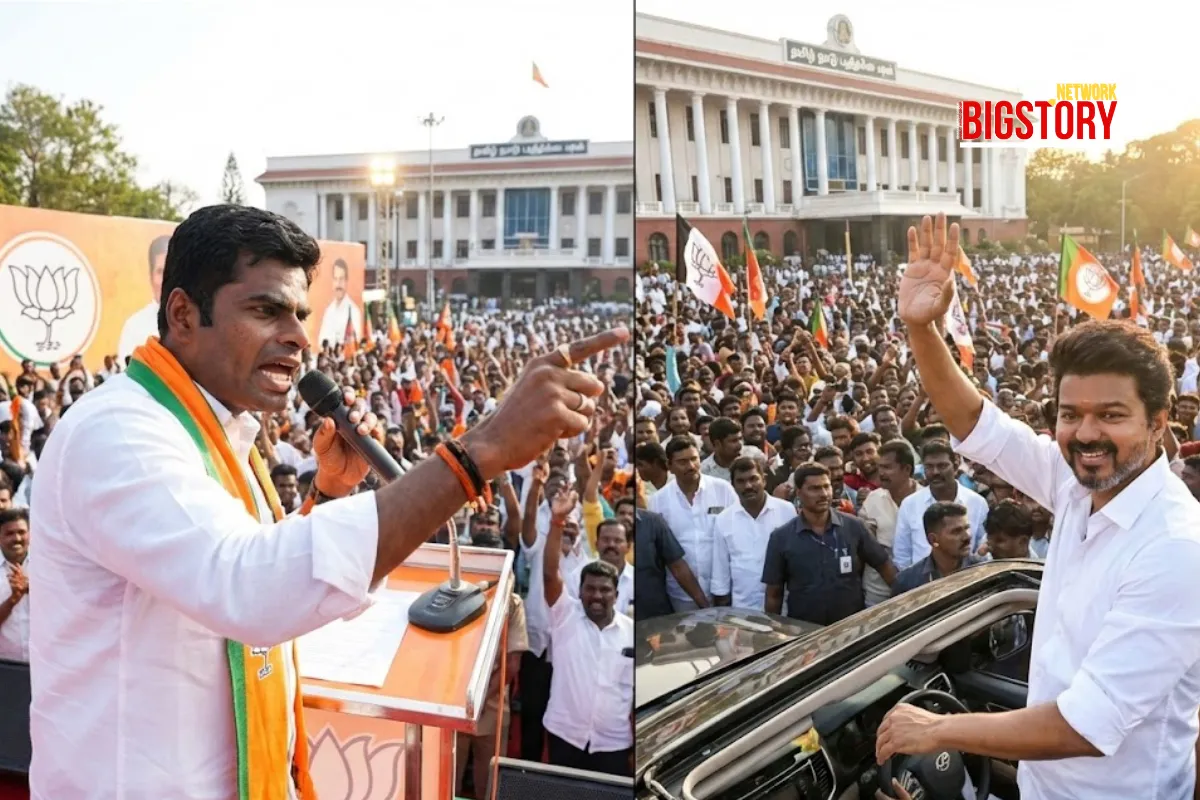
- K. Annamalai (BJP TN President): The aggressive campaigner. He has framed the 2026 election as a "Political Pongal" to burn corruption. His strategy relies on the "Sticky Floor"—the belief that the BJP's core Hindutva/Modi vote (10-12%) is immovable, while the remaining ~20% needed to win can be consolidated from disaffected AIADMK voters.
- Actor Vijay (President, TVK): The "Wildcard." His party claims a 30% vote share in internal surveys. However, his entry hurts the AIADMK and DMK more than the BJP. If he splits the "Anti-DMK" vote three ways, he inadvertently lowers the bar for the NDA.
- Amit Shah (Union Home Minister): The Architect. By reportedly pressing AIADMK chief Edappadi K. Palaniswami (EPS) for "Cabinet Share" (a first for TN), Shah is signaling that the BJP is no longer content with just being an alliance partner; it wants a stake in governance.
The BIGSTORY Reframe (The "Quadrant Theory")
Media coverage focuses on the "North vs. South" narrative, but the real story is the Mathematical Fracture.
- The Old Math: In a bipolar fight (DMK vs. AIADMK), you needed 45%+ to win.
- The New Math: In a Quadrangular Fight (DMK vs. AIADMK vs. BJP vs. TVK), the winner takes it all with just 30-32%.
- The "Sticky" Advantage: In this chaos, the party with the most committed core voter wins. The Dravidian votes are fluid (moving between DMK, AIADMK, and TVK). The BJP's vote is "sticky." The NDA's bet is that while the giants kill each other, the "Lotus" can bloom in the gaps of Coimbatore and Kanyakumari by simply holding its ground.
The Implications (Why This Matters)
- The "Cabinet Share" Friction: Tensions are rising between AIADMK and BJP. While BJP wants a coalition government (Cabinet berths), EPS is adamant about an "AIADMK-led government." This friction could derail the alliance if not managed before seat-sharing talks.
- The "Kongu" Fortress: The BJP is likely to demand a bulk of its seats in the industrial Kongu region (Western TN), where Annamalai polled 30%+ in 2024. A win here would give the BJP its first real legislative foothold in the Dravidian heartland.
- AI Sentiment Tracking: Parties are heavily relying on AI-driven sentiment analysis of YouTube comments (a massive news source in TN) to track hyper-local swing factors—specifically, how many "Vijay fans" are actually converting into "TVK voters."
The Closing Question (Now, Think About This)
If the anti-DMK vote splits three ways, does the BJP need to win new hearts, or does it just need its opponents to cannibalize each other?
FAQs
- What is the NDA's vote share target for Tamil Nadu 2026? The NDA aims to convert its 18.28% vote share (from 2024) into a double-digit seat tally (10-15 seats). The strategy relies on concentrating this vote in specific strongholds rather than a state-wide spread.
- Will BJP ally with AIADMK for 2026 TN elections? Current indications suggest a likely alliance, with Union Home Minister Amit Shah hinting at an AIADMK-led coalition. However, friction remains over the BJP's demand for Cabinet berths.
- How does Vijay's TVK party impact NDA's chances? Vijay's TVK is expected to split the anti-incumbency vote that usually goes to the AIADMK. By fracturing the opposition field into four corners (DMK, AIADMK, BJP, TVK), the "winning threshold" drops, potentially helping the NDA win seats with a lower vote percentage (approx. 30%).
- Which regions are BJP's strongholds in Tamil Nadu? The BJP is focusing its resources on the Kongu Belt (Coimbatore, Tiruppur) and South Tamil Nadu (Kanyakumari, Tirunelveli), where it has historically polled higher than its state average.
- What is the "Quadrant Theory" in TN politics? It refers to the shift from a bipolar contest (DMK vs. AIADMK) to a quadrangular contest (DMK vs. AIADMK vs. BJP vs. TVK). In this scenario, the party with the most "sticky" core vote (like BJP's Hindutva base) has a tactical advantage over parties fighting for the same fluid vote bank.
Sources
News Coverage
Context & Analysis

 Brajesh Mishra
 Exclusive Content