
Laxmi Organic imported machinery from Italy's banned Miteni plant to Ratnagiri. With no PFAS laws in India, fears of "forever chemical" contamination rise.
 Sseema Giill
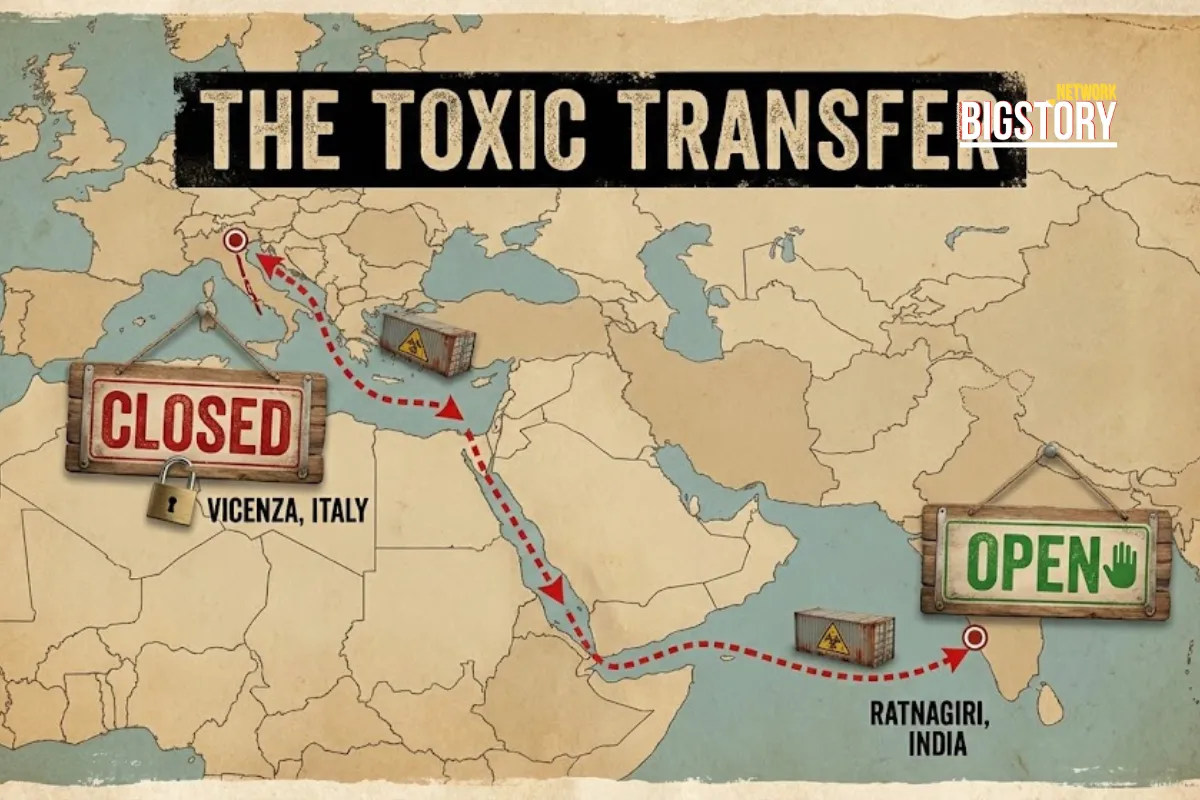
In a stunning case of regulatory arbitrage, the rusting heart of one of Europe’s worst environmental disasters has started beating again—this time in Maharashtra’s Ratnagiri district. On December 23-24, 2025, political and regulatory alarm bells rang after NCP (SP) MLA Rohit Pawar exposed that Laxmi Organic Industries had imported and installed machinery from Miteni, a defunct Italian chemical firm. Miteni was shut down in 2018 after being found guilty of contaminating the drinking water of 350,000 Italians with carcinogenic PFAS ("forever chemicals"). While the Maharashtra Pollution Control Board (MPCB) has now issued a "routine" show-cause notice, the deeper story is how a factory deemed too dangerous for Europe was legally welcomed into India.
The saga began in Vicenza, Italy, where Miteni operated for decades until it collapsed under the weight of a massive environmental scandal. In June 2025, an Italian court convicted 11 former executives to a total of 141 years in prison for poisoning the region’s groundwater. Yet, back in 2019, while the legal noose was tightening in Italy, the plant’s machinery, patents, and technical blueprints were quietly auctioned off. The buyer? Viva Lifesciences, a subsidiary of India’s Laxmi Organic. Over the next four years, the banned factory was dismantled, shipped in 300+ containers to India, and reassembled in the Lote Parashuram MIDC area—a region already grappling with pollution but lacking any specific laws against PFAS emissions.
While local media frames this as a "Politician vs. Company" spat, the real story is "The Regulatory Escape Hatch." Miteni didn’t move to India by accident; it moved because environmental convictions in Europe created a business opportunity in a jurisdiction with weaker rules. This is Regulatory Arbitrage: when pollution becomes too expensive in the First World, it is exported to the Third.
Furthermore, the "Drinking Water Loophole" is the ticking time bomb. India’s food safety authority (FSSAI) recently proposed banning PFAS in food packaging, but there is still zero federal standard for PFAS in drinking water. This means even if the Ratnagiri plant contaminates the local water supply exactly as Miteni did in Italy, it might not technically be breaking any Indian drinking water law until it’s too late.
For the residents of Ratnagiri and the downstream Konkan coast, the risk is not theoretical—it’s historical. The Miteni machinery has a proven track record of leaking. Without advanced filtration systems (which standard Indian effluent plants lack), these "forever chemicals" could enter the Alphonso mango belt and coastal fisheries, entering the food chain of millions.
If a factory killed workers and poisoned a province in Italy, does shipping its pipes to India make it safe, or does it just change the nationality of the victims?
What is PFAS and why is it called a forever chemical? PFAS (Per- and polyfluoroalkyl substances) are a group of man-made chemicals used in non-stick cookware and water-resistant fabrics. They are called "forever chemicals" because their strong carbon-fluorine bonds do not break down in the environment, allowing them to accumulate in water, soil, and the human body over time.
What happened to Miteni in Italy and why was it shut down? Miteni was a chemical manufacturer in Vicenza, Italy, that operated from the 1960s until 2018. It was shut down after being found responsible for contaminating the drinking water of over 350,000 people with PFAS. In June 2025, an Italian court sentenced 11 former executives to prison for environmental crimes and worker deaths.
Is Maharashtra's Ratnagiri plant producing PFAS right now? Laxmi Organic Industries, which bought Miteni's machinery, claims that PFAS-related products will make up only 0.15% of its portfolio. However, the plant is operational, and the Maharashtra Pollution Control Board (MPCB) has issued a notice to verify exactly what chemicals are being produced and if they comply with environmental standards.
News Coverage
Context & Analysis
 Exclusive Content


Sign up for the Daily newsletter to get your biggest stories, handpicked for you each day.


 Trending Now! in last 24hrs