
Bhubaneswar AQI hits severe 348 on Dec 20, 2025. Winter inversion and construction dust blamed for hazardous air quality. Check latest health advisories.
 Brajesh Mishra
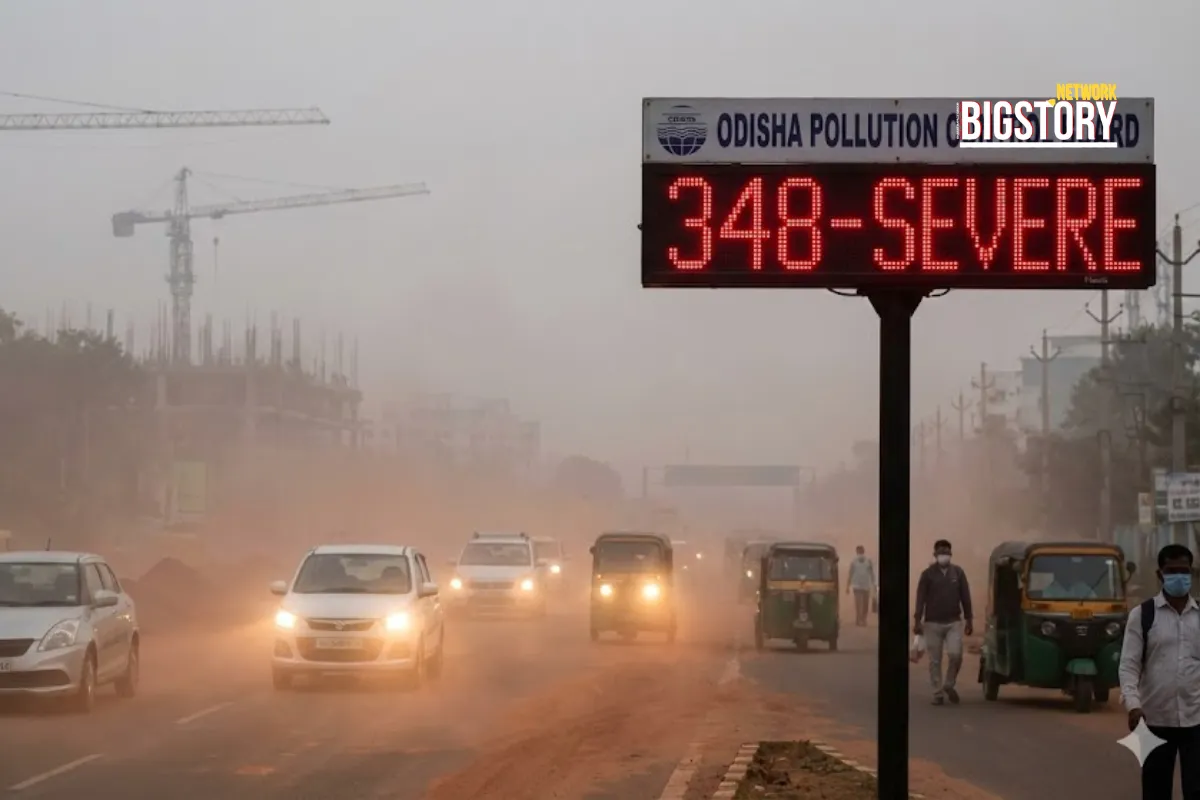
Bhubaneswar, once famed for its greenery and clean air, is currently gasping for breath. On December 20, 2025, the city's Air Quality Index (AQI) spiked to a hazardous 348, placing it firmly in the "Severe" category—a classification usually reserved for pollution hotspots like Delhi. The crisis has escalated rapidly; after hovering near the "Very Poor" mark for weeks, the toxic combination of dipping temperatures and heavy particulate matter has turned the state capital’s atmosphere into a health hazard, prompting environmentalists to warn that the city's air has become "poisonous" for its residents.
The deterioration has been steady and alarming. On November 25, the city recorded a PM2.5 level of 321 µg/m³, five times the safe limit. By early December, both Bhubaneswar and its twin city, Cuttack, were consistently clocking AQI levels between 280 and 300. The situation worsened this weekend due to "winter inversion"—a meteorological phenomenon where cold air traps pollutants close to the ground. However, officials admit this isn't just weather; it is a man-made crisis driven by the dense corridor of construction and vehicular emissions along NH-16.
While local media blames the "Winter Chill," the deeper story is the "Smart City Irony." Bhubaneswar’s aggressive push for urban modernization—metro lines, flyovers, and expansion—is paradoxically making the city unlivable. Unlike Delhi, which has a Graded Response Action Plan (GRAP) to halt construction when AQI hits severe levels, Odisha lacks a triggered emergency protocol. The government is building a "Smart City" infrastructure while ignoring the basic "Smart" requirement of breathable air. This isn't a weather event; it is an unregulated construction crisis.
The sustained high AQI poses an immediate threat to public health, specifically for children and the elderly. If levels remain above 300, we may see a surge in respiratory hospitalizations similar to those in North India. Politically, this puts pressure on the municipal corporation (BMC) to explain why dust mitigation measures—like water sprinkling and construction covers—are largely absent despite the "Smart City" funding.
If Bhubaneswar is developing at the cost of its lungs, is it becoming a Smart City, or just another choked metropolis?
Why is Bhubaneswar's AQI so high in December 2025? The surge in AQI (reaching 348) is caused by "winter inversion," a weather phenomenon where cold air traps pollutants near the ground. This is exacerbated by massive construction dust from metro and road projects, alongside high vehicular emissions in the Twin Cities.
Is it safe to go outside in Bhubaneswar today? With an AQI exceeding 300 ("Very Poor" to "Severe"), it is not safe for sensitive groups (children, elderly, asthmatics) to be outdoors. Healthy individuals should avoid vigorous outdoor exercise like running or cycling until levels drop below 200.
What is the current PM2.5 level in Bhubaneswar? As of late December 2025, PM2.5 levels have been recorded as high as 321 µg/m³, which is more than five times the safe limit prescribed by Indian environmental standards.
News Coverage
Data & Monitoring
 Exclusive Content


Sign up for the Daily newsletter to get your biggest stories, handpicked for you each day.



 Trending Now! in last 24hrs


