
NZ PM Christopher Luxon hails the India-New Zealand FTA as a "promise delivered," opening access to 1.4B consumers. Deal excludes dairy but adds 5,000 visas.
 Sseema Giill
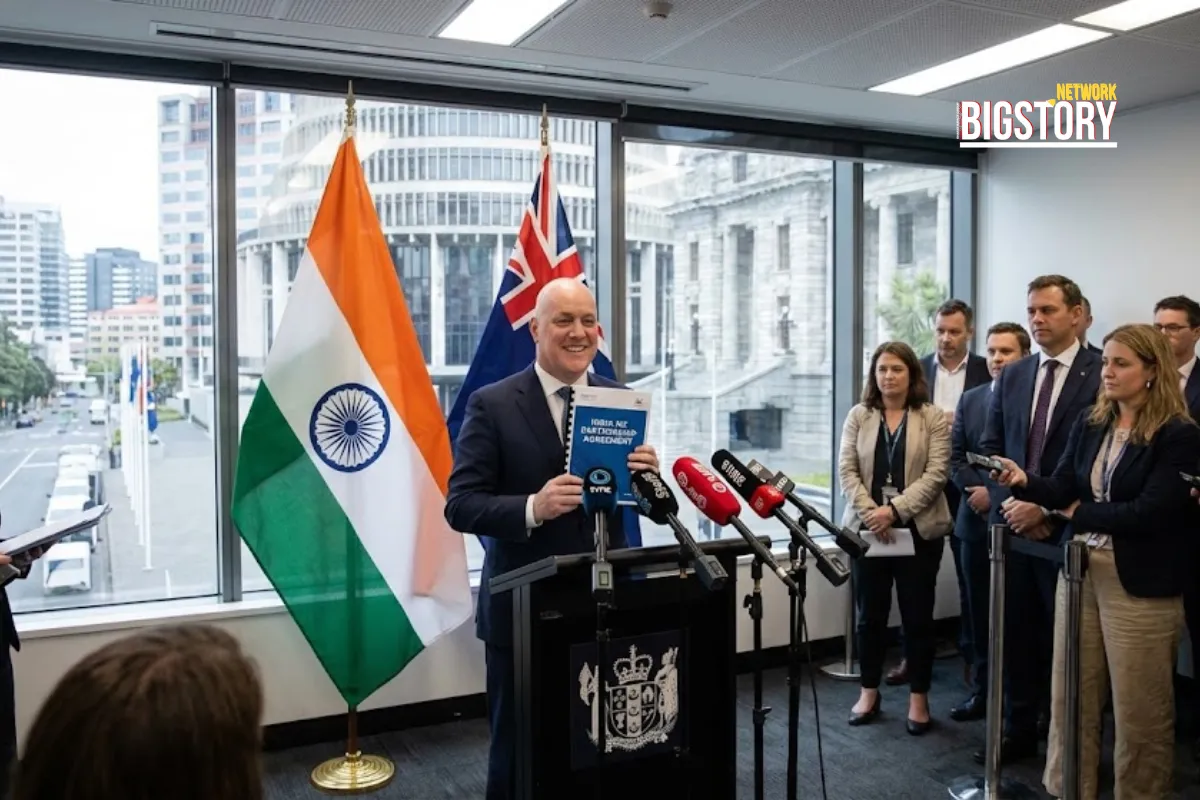
New Zealand Prime Minister Christopher Luxon has formally staked his political capital on the newly concluded Free Trade Agreement (FTA) with India, declaring it a "promise delivered" for his administration. In a public endorsement on December 26, 2025, Luxon hailed the pact—finalized in a record nine months—as a "landmark deal" that will open doors to 1.4 billion Indian consumers, create jobs, and raise incomes for Kiwis. His statement, framed under his governance slogan "Fixing the Basics, Building the Future," serves as a definitive counter to domestic critics who argued a deal without full dairy access was not worth signing.
The agreement, finalized via a telephone call with Prime Minister Narendra Modi on December 22, marks a significant geopolitical pivot for Wellington. Facing a recession and an over-reliance on China, New Zealand rushed to diversify its trade portfolio. The deal eliminates tariffs on 100% of Indian exports to New Zealand immediately, while India will remove duties on 95% of New Zealand goods. Crucially, India successfully firewalled its sensitive "core dairy" sector (milk, cheese, yogurt) from the pact, a red line that had stalled negotiations for over a decade until Luxon’s government decided to bypass it for broader strategic gains.
While the headlines focus on "Trade Volume," the deeper story is the "People vs. Products Trade-Off." New Zealand didn't just give up dairy access for nothing; they traded it for human capital. The deal grants 5,000 new work visas to Indian professionals (chefs, nurses, yoga instructors). In a New Zealand facing acute labor shortages, this is a strategic import of workforce disguised as a trade concession. Luxon is effectively telling his electorate: We couldn't sell them milk, so we're importing their talent to fix our economy.
Furthermore, the "Coalition Stress Test" is the hidden political narrative. Luxon’s endorsement ignores the objections of his own Foreign Minister, signaling that in the post-2025 world, "China Hedging" (security/geopolitics) is now more important to Wellington than "Dairy Purity" (traditional economics).
For Indian exporters in Tirupur (textiles) and Pune (auto components), the 100% duty-free access is an immediate win against competitors like Bangladesh. For New Zealand, the $20 billion investment target over 15 years offers a lifeline for infrastructure development. However, the exclusion of dairy sets a precedent: future trade partners like the EU now know that New Zealand can be persuaded to sign deals even without its primary export commodity if the geopolitical stakes are high enough.
If New Zealand is willing to sideline its dairy industry to secure a strategic foothold in India, does this signal the end of "commodity diplomacy" and the rise of "workforce geopolitics"?
What did New Zealand PM Christopher Luxon say about the India FTA? On December 26, 2025, Prime Minister Christopher Luxon publicly endorsed the agreement, calling it a "landmark deal" and a "promise delivered." He emphasized that the FTA would open doors to 1.4 billion Indian consumers, create jobs, and raise incomes for New Zealanders, framing it as a key part of his economic recovery plan.
Did India allow dairy imports in the New Zealand FTA? No. India successfully negotiated to exclude core dairy products (like milk, cheese, and yogurt) from the tariff elimination schedule to protect its domestic farmers. This was a major point of contention, with reports suggesting NZ Foreign Minister Winston Peters had reservations about the concession.
What are the benefits of the India-New Zealand FTA 2025? The deal offers:
News Coverage
Official Context
 Exclusive Content


Sign up for the Daily newsletter to get your biggest stories, handpicked for you each day.

 Trending Now! in last 24hrs


