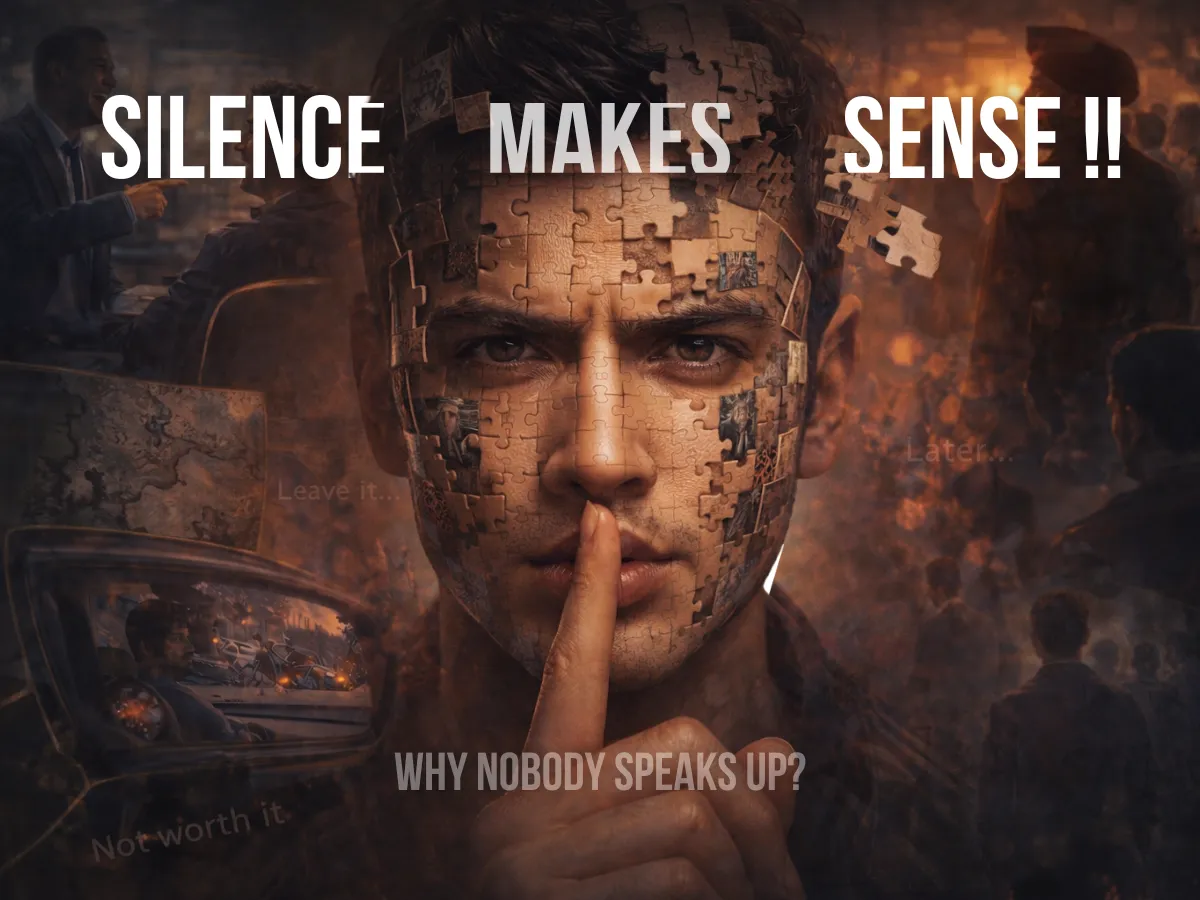
India's silence is not a personality flaw. It is a rational calculation built over 150 years of systematic proof that speaking up costs the speaker and protects no one else.
 Brajesh Mishra
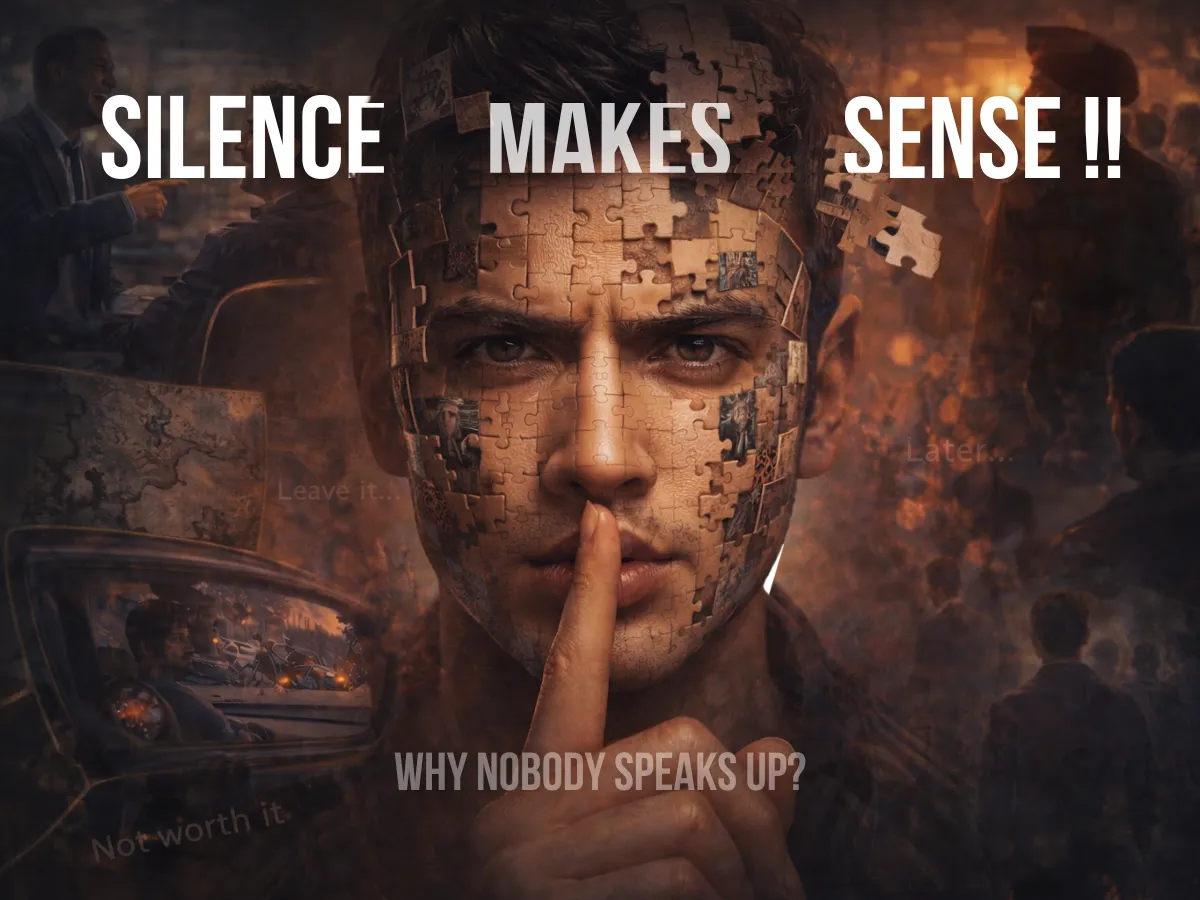
Ever had that feeling when you sit and think back on the words you should have actually said but didn't?
Definitely not a whistleblower moment but, the story that doesn't make it into any story you tell about yourself, yet sometimes has that brooding feel. Maybe your manager said something at a meeting that wasn't right, not catastrophically wrong but wrong enough that you felt it land in your chest. You had the words, had the evidence and even a reasonable tone prepared but just as you look around the room and notice who was watching, you do the calculation that took less than a second and you utter nothing. "Probably isn't the right moment," said deep inside, that you'd bring it up later, one-on-one, when the conditions were better and the funny part, it didn't come up later, ever.
You've been in that room before. And you'll be in it again.
In today's world most people are in that same room. How many?... Close to 90% of Indian employees report struggling at their workplace. 788 out of 1,200 companies surveyed reported zero workplace complaints — and this was just last year. Not because nothing was wrong but because the people inside those companies are making the same calculation you made, arriving at the same conclusion.
Data is everything in today's world but this is not something everybody would like to notice or read. Nearly 70% of women in Indian corporate environments have experienced at least one form of workplace harassment, with one in three never getting reported and the most common reason isn't ignorance of the process but the knowledge of what comes after. Nobody threatens you directly but suddenly the performance reviews seem odd, the good projects stop coming your way, and in hindsight you see a slow, deniable withdrawal of opportunity, of visibility, of the small signals that tell a person they belong, until the message lands and it always lands.
If you remember the case of Anna Sebastian Perayil, she was twenty-six years old when she joined EY in March 2024. Within four months the workload had broken her down to the point her mother describes in a letter that is almost unbearable to read. She raised her concerns, her managers heard them, the system processed her complaint and continued unchanged. Unfortunately we lost her in July 2024. Statements flew, legal conversations followed and at the end, silence. The loop closed exactly the way it was designed to.
I am not tainting an institution or making an accusation but this is one of those cases that made the headlines and nothing changed and maybe it won't.
Here's what nobody says out loud or maybe some do in closed rooms; this same calculation happens everywhere, all the time, to all of us.
You're driving and someone meets with an accident ahead. You slow down, you look, and then you drive off. The picture seems hateful and cold but you do it, not because you don't care because you've already run the numbers in three seconds, police arrive, you're a witness, witnesses become suspects, half your day is gone, maybe more. The system that exists to help you is the exact thing you need protection from. So you tell yourself there are people there already, it's not your headache, and you drive. Most of us have done this yet less talk about it.
Your local neta is running a racket that everyone in the neighbourhood knows about. Wrong? Obviously. Worth saying something? Absolutely not. He has people. You have a job, a family, a life that can be made inconvenient in ways that never show up in a courtroom. So you look away, keep your head down, don't engage. They're bullies, everyone knows it and the unspoken rule is simple: do not poke it.
Then there's the justice system. You already know how the story ends before it starts. The case drags for years. You become the problem. The person who wronged you walks around the same neighbourhood while you're running between hearings. So what's the point, Don't complain, don't engage, live your life at a comfortable distance from anything that requires you to formally interact with a system that was never really built for you.
Three different situations, Three different rooms, One calculation.
The remarkable thing is not that Indians stay silent but how rational the silence is every single time.
This silence didn't start with you; rather it was built, deliberately, systematically, over generations of people who needed you to be quiet and made silence seem like the only sensible choice.
In 1870, the British colonial government passed the Indian Sedition Act. Criticising the government wasn't just frowned upon, it was a criminal offence. Both Tilak and Gandhi were subsequently tried under this act. The law wasn't really about law, but a demonstration. Speak against power and power will reach you. The message was delivered in courtrooms, in prisons, and sometimes in other ways entirely. Now, you didn't need to experience it personally but you just needed to know it happened.
When India got independence in 1947, sadly the architecture didn't leave with the British.
The 1975 Emergency instantly imposed press censorship and imprisoned opponents, serving as a stark reminder to a new generation that the link between speaking out and being punished could be activated whenever those in power deemed it necessary. Colonial era sedition laws didn't get repealed after independence. They got repurposed. Journalists, activists, anyone whose voice created inconvenience, the tools were right there, inherited intact, ready to use.
Then came something that was supposed to fix it; The Right to Information Act 2005, a law that finally gave ordinary citizens the formal right to ask questions and demand answers from the state.
People used it, and ironically since its implementation, 91 RTI activists have been killed, 175 assaulted, 186 threatened. No speeches or leading protests, just filing paperwork and the system responded the way it always had because nobody likes questions when in power.
India currently ranks 151 out of 180 countries in the 2025 World Press Freedom Index. Two to three journalists are killed annually in connection with their work. The country that fought one of history's most documented struggles for the right to speak is now one of the most dangerous places on earth for people whose job is to say things out loud.
This is the inheritance we were given, not a cultural trait, not a personality type, just a rational response to a system that has demonstrated, across 150 years, across institutions, with documented lethal consistency that: speaking up costs the speaker and protects no one else.
The calculation you make in that meeting in three seconds? Your parents made it. Their parents made it. The learning runs so deep it doesn't feel like learning anymore, It feels like instinct, sometimes wisdom. It feels like knowing how the world works and that's exactly the point.
Now take that same person doing calculation in three seconds and put them in a different chair.
In past years, India has abstained on every United Nations resolution on the wars. The official position is strategic autonomy: a sovereign nation's right to navigate complex geopolitics without being assigned to a side. It's a coherent argument, it's also the diplomatic vocabulary of not taking a position. The silence wears a suit now. It has a press release and a foreign policy doctrine but the structure underneath is identical even when it doesn’t look like it (put on the macro lens!!) We just call it strategy at that level.
Japan has a phrase for it — kuuki wo yomu, reading the air. The unspoken social calculation about what the atmosphere will bear, whose harmony must be preserved, what disruption would cost. Japanese children aren't explicitly taught this. They absorb it. They understand early that breaking the atmosphere makes you an outsider, that the social punishment is quiet, reliable and comes without warning. Different country, different name, same architecture.
The mechanism is universal. What's specific to India is the weight of the proof behind it. Japan's silence preserves social harmony. India's silence was built on something harder — on sedition trials, on Emergency arrests, on RTI activists who filed paperwork and didn't come home, the instinct is the same, the evidence produced is not.
Which brings you to the question: This piece has been circling and will not pretend to answer cleanly.
When a person learns silence as survival, at what point does the survival strategy become the identity? When does the calculation become the character? When does the person who chose not to speak become the person who no longer considers speaking?
When does a nation?
Here is what the data cannot or will not tell you, because it happened inside individual people, one by one, in moments that have no record.
Silence was installed by force, then maintained by fear and then at some point that no historian recorded, we stopped needing to be forced.
We gave it different names: professionalism, maturity, picking your battles or being strategic about when to spend your political capital. We built an entire internal vocabulary for the decision to stay quiet and that vocabulary made the decision feel like wisdom rather than surrender. The system no longer needed to punish most of us for speaking because something more efficient had happened; We began punishing ourselves for considering it.
We conduct the cost-benefit analysis before anyone asks us to. We assign a cost to speaking that the system never explicitly sets and we arrive at silence on our own fluently, automatically, without friction and then we call it being realistic.
The architecture no longer needs to enforce itself; we have evolved to enforce it on its behalf.
This is the moment the silence became something else entirely. It stopped being a response to a specific threat. It became a habit so deep it feels like a value and values, unlike fears, are things we defend.
Come back to the meeting room.
You left with a small additional weight, that weight joins other weights, the family dinner where you let something pass, the accident you drove past, the neta you looked away from, the complaint you never filed, the form you never submitted, the thing you almost said at least a dozen times and didn't.
None of these are dramatic and that's precisely the point. The system doesn't need you to swallow anything large. It only needs you to swallow a thousand small things consistently, fluently, across the whole of your life and the accumulation becomes a person who has stopped trusting their own voice enough to use it.
Now here's the part nobody who writes about this will say clearly enough.
This won't be fixed, not smoothly, not soon, not by this article or any article, not by awareness campaigns or LinkedIn posts or one brave person speaking up at a town hall. The silence was built over 150 years of systematic, lethal, documented proof that speaking costs you and protects no one. The idea that a generation of content about speaking up reverses that is its own kind of delusion.
What actually happens, what has always happened, is selective. Someone speaks because they've already decided to leave. Someone files the RTI because they have nothing left to lose. Someone publishes the story because they've calculated, for once, that the cost of silence finally exceeds the cost of speaking. Change happens at the edges, by people for whom the calculation temporarily tips the other way. It's not a movement, It's not a transformation. It's just the occasional person who runs the numbers and gets a different answer that day.
That's not nothing but let's not pretend it's something it isn't, we are not weak. We are not passive. We are not culturally broken.
We are simply the product of a system that needed you quiet, made quiet feel like wisdom, and then stepped back and watched you teach it to yourself and will keep watching, largely undisturbed, for years to come.
 Exclusive Content


Sign up for the Daily newsletter to get your biggest stories, handpicked for you each day.



 Trending Now! in last 24hrs