
In a landmark judgment that significantly impacts Dalit converts to Christianity and Islam, the Supreme Court has ruled that religious identity is the absolute deciding factor for Scheduled Caste protections and benefits.
 Brajesh Mishra
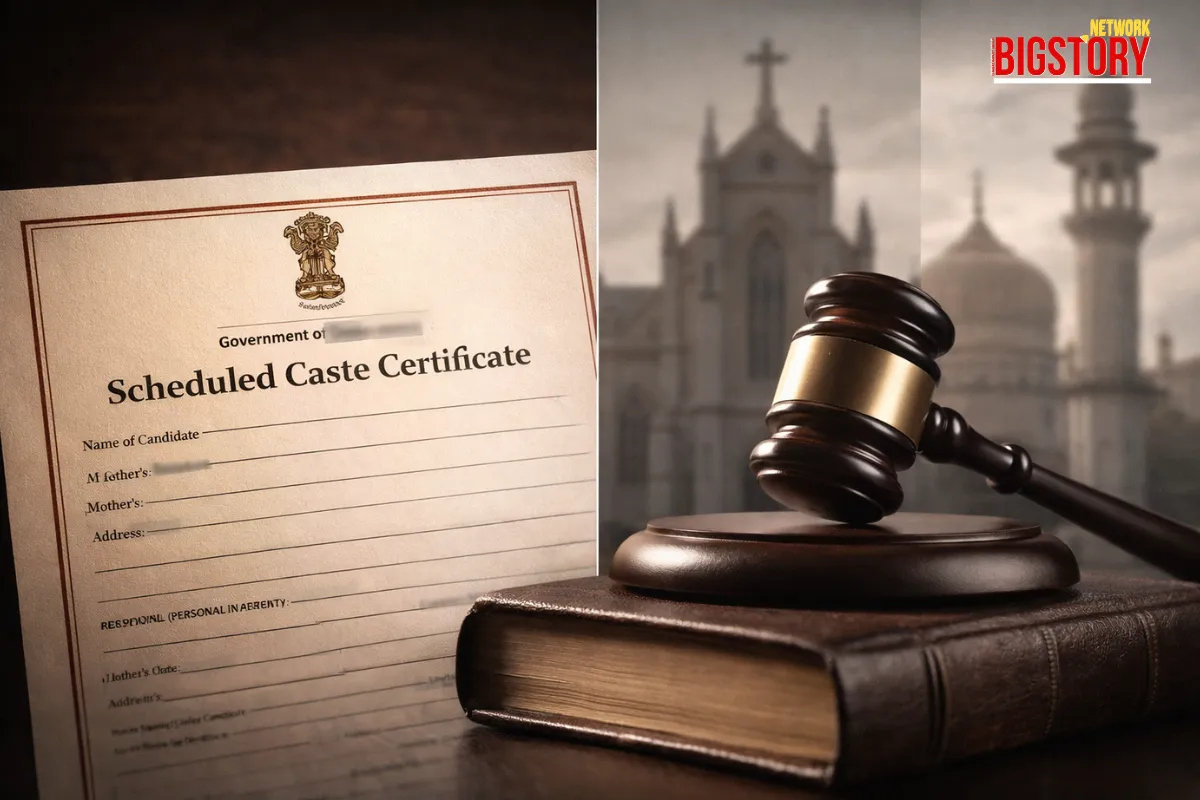
What happened: The Supreme Court confirmed that only individuals professing Hinduism, Sikhism, or Buddhism are eligible for Scheduled Caste (SC) status.
Why it happened: In a case involving a Christian pastor who alleged caste-based assault, the Court ruled that conversion to Christianity results in an "immediate and complete loss" of SC identity and protections.
The strategic play: The Court invoked the 1950 Constitution Order, stating its religious restriction is "absolute" and that a person cannot simultaneously practice another faith and claim SC benefits.
India's stake: This ruling reinforces the religious criteria for reservations, dealing a major setback to Dalit Christians and Muslims seeking SC status and the protection of the Anti-Atrocities Act.
The deciding question: Will the ongoing K.G. Balakrishnan Commission provide enough empirical evidence of post-conversion discrimination to convince Parliament to amend the 1950 Order, or is the religious bar now permanent?
In a sweeping constitutional clarification delivered on Tuesday, the Supreme Court of India ruled that individuals who profess a religion other than Hinduism, Sikhism, or Buddhism cannot be recognized as members of a Scheduled Caste (SC). By declaring the religious restriction in the 1950 Constitution Order to be an "absolute bar," the apex court has effectively closed the door on Dalit converts to Christianity or Islam seeking reservations or protection under the SC/ST (Prevention of Atrocities) Act.
The landmark ruling firmly entrenches the legal precedent that caste—and the constitutional protections designed to mitigate its historic injustices—is inextricably tied to specific religious identities under Indian law.
The Supreme Court Bench (Justices P.K. Mishra & N.V. Anjaria) The judicial authority that handed down Tuesday's verdict. The bench interpreted Clause 3 of the 1950 Order strictly, stating: "No statutory benefit, protection or reservation or entitlement under the Constitution... can be claimed by or extended to any person who by operation of Clause 3 is not deemed to be a member of the Scheduled Caste. This bar is absolute."
Constitution (Scheduled Castes) Order, 1950 This foundational Presidential Order originally restricted SC status strictly to Hindus. It was historically amended in 1956 to include Sikhs, and again in 1990 to include Buddhists. However, despite decades of political lobbying, it continues to legally exclude Christians and Muslims.
Chinthada Anand The appellant in the case. The Court noted that Anand had been actively practicing Christianity and serving as a pastor conducting Sunday prayers for over a decade. These "concurrent facts" were used as definitive evidence that he had abandoned his original religious identity and, by extension, his SC status.
Mainstream coverage is heavily focused on the technicality of the "absolute bar" and the dismissal of the pastor's assault case. However, the true "Missed Angle" is how this ruling creates a bizarre, stalled evolution of social identity in India.
By relying strictly on the 1950 "letter of the law," the Court has sidelined decades of sociological research—including the Sachar and Ranganath Misra reports—which strongly suggest that caste-based stigma and untouchability frequently persist long after a person converts to Christianity or Islam. By reinforcing the "absolute bar," the Supreme Court has frozen the legal definition of a "Dalit" as an exclusively religious category rather than a socioeconomic reality.
This creates a glaring legal paradox: a citizen can be considered "socially and educationally backward" enough to qualify for Other Backward Classes (OBC) status regardless of their religion, but they can only be considered "untouchable" enough for SC status if they belong to three specific faiths.
If social prejudice survives religious conversion in the real world, why does the law insist that it doesn't?
News & Wire Coverage:
 Exclusive Content


Sign up for the Daily newsletter to get your biggest stories, handpicked for you each day.



 Trending Now! in last 24hrs


