BIGSTORY Network


India March 12, 2026, 4:13 p.m.

The Insider Exploitation: How India's Gas Agencies Are Fueling a ₹4,500 LPG Black Market

While the Middle East war chokes off supply, corrupt local distributors are exploiting government rationing by hoarding subsidized cylinders and bleeding ordinary citizens and small businesses dry.

by Author Brajesh Mishra
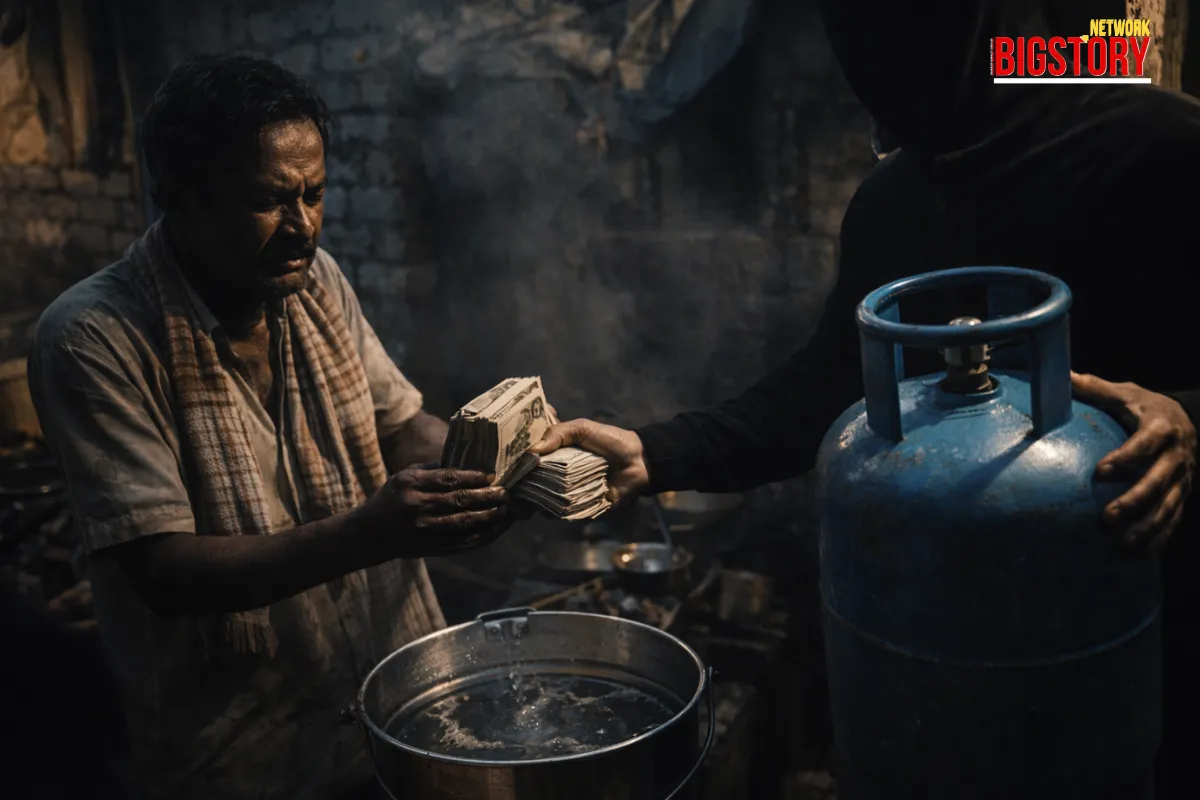
Hero Image

⏱️ 30-Second Brief

Expand to Read

What happened: Commercial LPG cylinders are being sold on the black market for up to ₹4,500—more than double their official price—across major Indian cities. Why it happened: The Middle East war severely restricted India's gas imports, leading the government to ban commercial supplies and enforce a 25-day waiting period for domestic refills. The strategic play: Corrupt gas agency owners are exploiting the panic by hoarding official stock and selling subsidized cylinders out the back door to desperate consumers and restaurants. India's stake: The exorbitant black market rates are crushing household budgets and threatening to permanently shut down thousands of small eateries and street food vendors who cannot afford the ₹4,500 price tag. The deciding question: Can state police forces and the Petroleum Ministry effectively crack down on the insider corruption at authorized gas agencies before the artificial scarcity sparks urban riots?

The deepening energy crisis has triggered an immediate and devastating domestic fallout, birthing a predatory lpg gas black market where cylinders are selling for up to 4500 rupees across India in 2026. On Thursday, reports confirmed that desperate citizens and restaurant owners are being forced to pay more than double the official commercial rate just to keep their kitchens running, exposing a massive network of insider exploitation.

As the government's strict gas rationing leaves a desperate supply vacuum in major metropolitan areas, authorized distributors are capitalizing on the panic. This illegal parallel economy is systematically destroying the MSME hospitality sector and squeezing middle-class household budgets that are already buckling under the weight of macroeconomic inflation.

How We Got Here

  • The Trigger: On March 9, the Centre invoked the Essential Commodities Act to legally prioritize domestic gas over commercial supplies following the effective blockade of the Strait of Hormuz.
  • The Background: To prevent household hoarding amid the crisis, the government imposed a mandatory 25-day wait period between domestic cylinder bookings on March 11, inadvertently driving desperate consumers toward illegal distributors.
  • The Escalation: By mid-week, restaurants and small eateries in Bengaluru, Mumbai, Thane, and Delhi reported buying 19kg commercial cylinders in the black market for anywhere between ₹4,000 and ₹6,000 to avoid permanent shutdown.
  • The Stakes: On March 12, Delhi Police were forced to deploy Station House Officers (SHOs) and PCR vans directly outside gas agencies to prevent illegal refilling and curb the rampant backdoor sales of highly subsidized cylinders.

The Key Players

Delhi Police The law enforcement agency has been thrust onto the frontlines of the energy crisis. By deploying motorcycle patrol units and PCR vans to gas agencies across the capital, they are attempting to maintain basic law and order while physically cracking down on the illicit ₹4,500 LPG black market.

Manpreet Singh, Honorary Treasurer, NRAI Representing the National Restaurant Association of India, Singh has highlighted the existential threat facing commercial establishments. He noted that the total absence of regular LPG supplies is forcing eateries to either pay extortionate black market rates or shift immediately to expensive alternatives like piped natural gas and induction cooking.

Gas Agency Owners & Staff The authorized local distributors operating at the absolute ground level of the crisis. Numerous reports accuse agency staff of explicitly exploiting the 25-day domestic limit and the commercial gas freeze by diverting highly subsidized ₹918 domestic cylinders directly into the black market for staggering illegal profits.

The BIGSTORY Reframe — The Insider Exploitation

Mainstream coverage remains fixated on the visuals of long, anxious queues outside gas agencies and the sudden surge in sales of electric induction cooktops. While headlines appropriately point to the US-Iran war and the Strait of Hormuz blockade as the macroeconomic root of the shortage, they are missing the systemic, homegrown corruption that is weaponizing the crisis against the Indian public.

The black market isn't being run by shadowy, unknown middlemen—it is being orchestrated from within the system. Official gas agency owners and their delivery staff are the entities artificially hoarding the stock. They are utilizing the government's strict 25-day refill restriction as an administrative smokescreen to divert subsidized ₹918 domestic cylinders, flipping them out the back door for up to ₹4,000 to desperate families and ₹4,500 to panic-stricken street vendors. This is a manufactured, secondary crisis of pure insider exploitation.

What This Means for India

  • Economic Extraction: When a street vendor or a household is forced to pay ₹4,500 for a cylinder to survive the week, that capital is directly extracted from essential food and education budgets, sparking an immediate socio-economic crisis.
  • MSME Eradication: Thousands of small eateries, Dhabas, and cloud kitchens operate on razor-thin margins; paying a 130 percent premium on cooking fuel will force mass bankruptcies across the urban hospitality sector.
  • Law Enforcement Pivot: Local police forces must immediately shift their operational mandate from merely managing crowds at agency gates to actively conducting raids on illegal refill godowns and distributor backrooms.

The Implications

  • Short Term: Frustration at local gas agencies will likely boil over into localized urban unrest if the artificial scarcity is not immediately addressed by visible police crackdowns on corrupt distributors.
  • Medium Term: The Ministry of Petroleum will face immense pressure to aggressively enforce the Essential Commodities Act against its own distributor network, including the mass cancellation of operating licenses for agencies caught hoarding.
  • India-Specific Consequence: The crisis reveals a devastating vulnerability in India's subsidized distribution networks: whenever global supply shocks occur, the very institutions trusted to deliver essential goods to the poor will instantly pivot to exploit them.

If authorized government gas distributors are the ones running the ₹4,500 black market, how can the Centre expect the Essential Commodities Act to protect the citizens it is meant to serve?

Sources

News & Wire Coverage:

Official Statements & Data:


Brajesh Mishra
Brajesh Mishra Associate Editor

Brajesh Mishra is an Associate Editor at BIGSTORY NETWORK, specializing in daily news from India with a keen focus on AI, technology, and the automobile sector. He brings sharp editorial judgment and a passion for delivering accurate, engaging, and timely stories to a diverse audience.

BIGSTORY Trending News! Trending Now! in last 24hrs

The Diplomatic Tightrope: How India Secured an Iranian Exemption to Bypass the Hormuz Blockade
India
The Diplomatic Tightrope: How India Secured an Iranian Exemption to Bypass the Hormuz Blockade
The Z+ Grid Collapse: Farooq Abdullah Survives Point-Blank Assassination Attempt in Jammu
India
The Z+ Grid Collapse: Farooq Abdullah Survives Point-Blank Assassination Attempt in Jammu
The Insider Exploitation: How India's Gas Agencies Are Fueling a ₹4,500 LPG Black Market
India
The Insider Exploitation: How India's Gas Agencies Are Fueling a ₹4,500 LPG Black Market
The Anti-Corruption Upgrade: Why the ₹8.69 Lakh Crore Jal Jeevan Mission Extension Changes Everything
India
The Anti-Corruption Upgrade: Why the ₹8.69 Lakh Crore Jal Jeevan Mission Extension Changes Everything