IP to IPO Awards 2026 in New Delhi brought policymakers, academia, investors and industry together to push research, IP and innovation towards commercialisation.
 Brajesh Mishra

The IP to IPO Awards 2026 in New Delhi brought together policymakers, academics, investors, entrepreneurs and industry leaders to focus on a key challenge for India’s innovation ecosystem: turning research and intellectual property into commercial technologies, startups and enterprises. The event also marked the Delhi launch of the book IP to IPO: Decolonizing Academic Startup Revolution.
New Delhi, August 13, 2026: India’s innovation story may no longer be about whether the country can generate ideas. The harder question is what happens to those ideas after they are patented.
That question took centre stage at the IP to IPO Awards 2026 and the Delhi launch of IP to IPO: Decolonizing Academic Startup Revolution – Building Innovation Ecosystems for Viksit Bharat 2047 at the Constitution Club of India on Thursday.
The event brought together representatives from government, Parliament, academia, industry, startups, investment and the legal ecosystem around a proposition that is increasingly important to India’s innovation ambitions: a patent is not the end product of research. Commercialisation is.
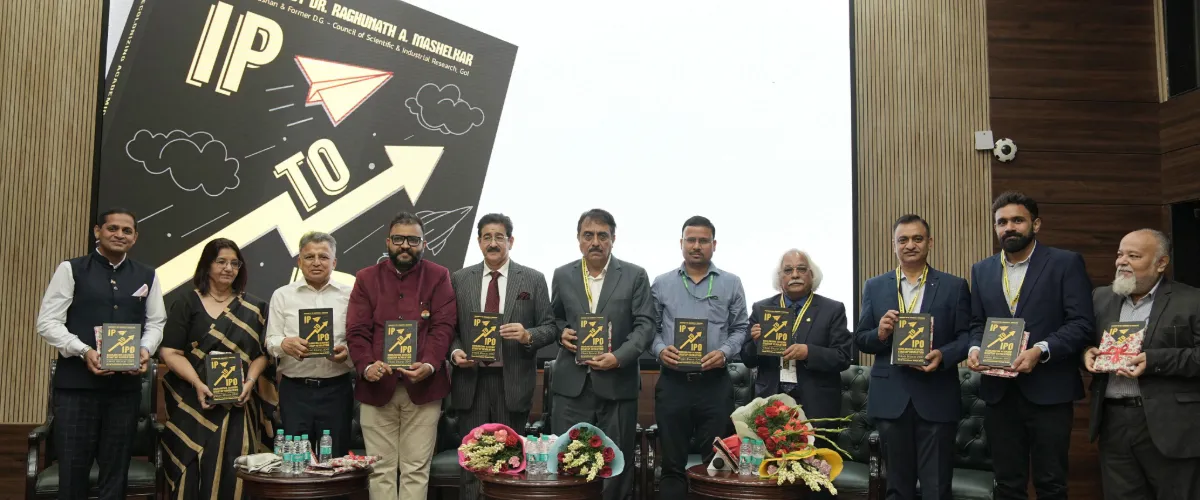
The programme featured Lok Sabha Speaker Om Birla, Commerce and Industry Minister Piyush Goyal, MPs Ravi Kishan and Shrikant Shinde, Controller General of Patents, Designs & Trade Marks Unnat Pandit, Atal Innovation Mission Mission Director Deepak Bagla, Indian Angel Network co-founder Padmaja Ruparel, Amity University Vice Chancellor P. B. Sharma, and other representatives from the innovation, investment and startup ecosystem.
But the significance of the gathering lay less in the list of names and more in the problem it sought to address.
India’s universities and research institutions produce research and intellectual property, yet the journey from laboratory or campus to market remains a difficult one. The IP to IPO Movement proposes a framework built around a simple progression:
Idea → IP → Innovation → Enterprise → Viksit Bharat 2047.
At the centre of the initiative is Umesh Rathod, author of the book and founder of Lean Campus Startups. Rathod argued that India’s next phase of development cannot rely only on knowledge creation. Knowledge has to move through intellectual property, innovation and enterprise before it can create broader economic value.
“India should not only be the world’s market; India must become a global source of innovation, intellectual property and enterprise.”
That argument also shifts the way academic success is measured. Instead of stopping at research papers and patent filings, the framework calls for greater attention to licensing, startups, commercialised technologies, revenue and societal impact.
This is where the book’s larger proposition enters the picture. IP to IPO seeks to address the distance between research output and commercial outcomes by arguing for universities and research institutions that function not only as centres of education and research, but also as engines for IP creation, technology transfer and startup formation.
The awards component of the event recognised individuals and institutions for contributions spanning innovation, intellectual property, entrepreneurship, research, technology commercialisation and institution building. The gathering also featured discussions around academic entrepreneurship, institutional IPR policies, technology transfer and industry-academia collaboration.
The larger challenge, however, extends beyond one movement or one book.
For India to translate its growing research and innovation capacity into economic strength, the pipeline cannot end at “patent granted.” It has to continue toward “technology adopted,” “startup built,” “product scaled” and ultimately “value created.”
That is the central proposition behind the IP to IPO movement—and perhaps the more consequential measure of India’s innovation ambitions.
Patent filing may mark the creation of intellectual property. The real test begins after that.
The event closed with the movement’s defining message: “Idea से IP, IP से Innovation, Innovation से Enterprise—and Enterprise से Viksit Bharat!”
 Exclusive Content


Sign up for the Daily newsletter to get your biggest stories, handpicked for you each day.



 Trending Now! in last 24hrs