BIGSTORY Network


India Feb. 12, 2026, 3:07 p.m.

The "Grip" on Modi: Why Rahul Gandhi Claims the India-US Deal is a Wholesale Surrender

Nationwide Bharat Bandh disrupts banking and transport as Rahul Gandhi accuses PM Modi of surrendering India’s data and food sovereignty to the US.

by Author Brajesh Mishra
Hero Image

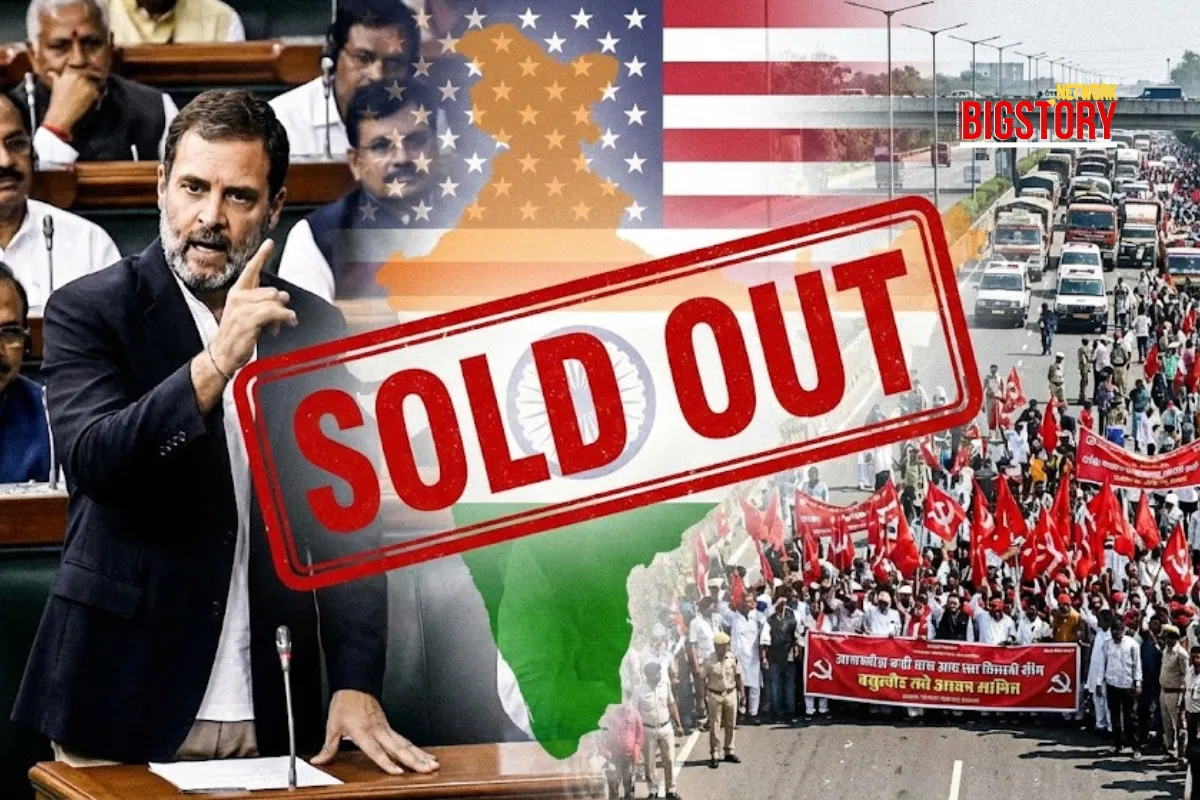
India is witnessing a massive display of industrial and agrarian unrest today as the Bharat Bandh takes hold. From the coal mines of Chhattisgarh to the apple orchards of Himachal Pradesh, millions have walked off the job. In Parliament, the political temperature reached a breaking point as Leader of Opposition Rahul Gandhi accused the government of being in a "chokehold" or "grip" of foreign powers.

This matters because the strike represents a rare "Kisan-Mazdoor" (Farmer-Worker) unity against a new wave of economic reforms; by framing the India-US trade deal as a "wholesale surrender" of data and food security, the Opposition is attempting to turn local labor grievances into a broader battle for national sovereignty.

The BIGSTORY Angle (The Reframe)

While mainstream media focuses on commuter delays, the real BIGSTORY is the "Data as Petrol" conflict. In his speech, Rahul Gandhi reframed the India-US trade deal as a theft of India's "biggest data pool." He argued that by allowing free data flow to the US without localization, the government has given away the "fuel" for India's AI future.

The reframe is this: The strike isn't just about the VB-G RAM G Act replacing MGNREGA; it is about the weaponization of data and energy. Protesters fear that the Electricity Bill 2025 and its mandatory Smart Meters are backdoors for foreign tech giants to privatize the power grid and harvest household data. This isn't just a wage strike; it's a war over who owns the 21st-century infrastructure of India.

The Context (Rapid Fire)

  • The Trigger: The Feb 12 Bharat Bandh called by unions including AITUC, CITU, and INTUC, alongside the SKM farmers' umbrella body.
  • The Backstory: Tensions have been building since the Feb 1 Budget, which unions claim ignored the Old Pension Scheme (OPS) while accelerating privatization.
  • The Escalation: The government's defense of the India-US Trade Deal as a "golden era" for exports has been met with a privilege notice against Rahul Gandhi for allegedly "misleading the House."

The Chessboard (Key Players)

  • Rahul Gandhi: The Critic. Alleged that the PM has caved to US pressure, handing over data and energy security.
  • Piyush Goyal (Commerce Minister): The Architect. Defends the trade deal, stating sensitive sectors like dairy and grains are protected while Indian products get zero-duty US access.
  • Kiren Rijiju: The Enforcer. Accused the Opposition of "illegal" conduct in the Speaker’s chamber and threatened privilege motions.

The Implications (Your Wallet & World)

  • Short Term: Banking & Transport Disruption. Public sector banks and state transport in Kerala, Odisha, and Punjab are significantly hit. If you have cheque clearances or manual deposits, expect a 24-48 hour delay.
  • Long Term: The replacement of MGNREGA with the VB-G RAM G Act (guaranteeing 125 days but requiring state cost-sharing) could fundamentally alter rural consumption patterns and labor migration if states struggle with the 40% funding share.

The Steel Man (The Counter-Argument)

The government’s strongest argument is that protectionism is a recipe for stagnation. Commerce Minister Piyush Goyal argues that the India-US framework actually secures zero-duty access for Indian textiles and engineering goods, which are currently struggling. Proponents argue that the Labour Codes are necessary to make India a "Global Manufacturing Hub," and that Smart Meters are the only way to reduce the ₹3 lakh crore in distribution losses that currently cripple the energy sector.

The Closing Question

Is the Bharat Bandh a necessary "emergency brake" on a corporate-driven agenda, or is it an outdated tactic that holds India's modernization hostage? Share your take in the comments.

FAQs

  • Q: Why is there a Bharat Bandh on February 12, 2026?
  • A: According to Livemint, the strike is against the four new Labour Codes, the privatization of the power sector via the Electricity Bill 2025, and the India-US trade deal.
  • Q: What did Rahul Gandhi say about PM Modi and the US deal?
  • A: The Times of India reports that Gandhi accused the PM of being in a "US chokehold," alleging he has surrendered India's data, food, and energy security.
  • Q: Are banks and schools closed for the strike today?
  • A: Banking services at PSU banks are partially affected. Schools are closed in states like Kerala and Odisha, but private banks and services in major metros like Delhi and Mumbai are largely operational.

Sources: Livemint, The Times of India, Hindustan Times

Brajesh Mishra
Brajesh Mishra Associate Editor

Brajesh Mishra is an Associate Editor at BIGSTORY NETWORK, specializing in daily news from India with a keen focus on AI, technology, and the automobile sector. He brings sharp editorial judgment and a passion for delivering accurate, engaging, and timely stories to a diverse audience.

BIGSTORY Trending News! Trending Now! in last 24hrs

Red Fort to CBSE Exams: What You Need to Know About Delhi's New Terror Alert
India
Red Fort to CBSE Exams: What You Need to Know About Delhi's New Terror Alert
The 74 Lakh Missing Voters: How AI Just Reshaped the 2026 Tamil Nadu Election
India
The 74 Lakh Missing Voters: How AI Just Reshaped the 2026 Tamil Nadu Election
Shame to Our Country": How the AI Summit Protest Just Fractured the INDIA Bloc
India
Shame to Our Country": How the AI Summit Protest Just Fractured the INDIA Bloc
The "Already Naked" Jibe: How PM Modi Turned the AI Summit Protest Against Congress
India
The "Already Naked" Jibe: How PM Modi Turned the AI Summit Protest Against Congress