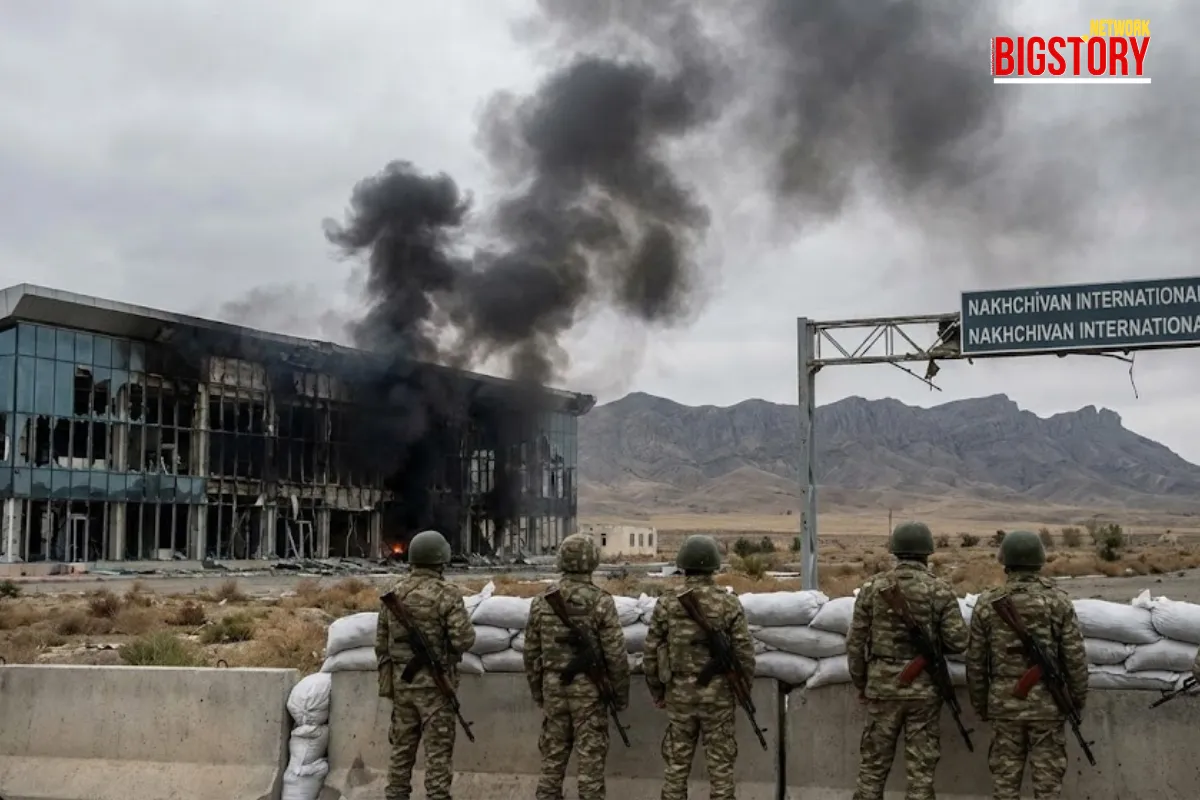
The 2026 Middle East War has officially breached the South Caucasus. On Thursday, four unmanned aerial vehicles breached Azerbaijani airspace from the south, striking the terminal of Nakhchivan International Airport and a nearby school. The attack injured four civilians and triggered an immediate, furious response from Baku. President Ilham Aliyev swiftly placed the Azerbaijani armed forces on "mobilization readiness level one," ominously warning that the nation's "Iron Fist" is prepared to crush the skulls of anyone testing its sovereignty.
This matters because the geopolitical fault lines of the region have just snapped. Despite Azerbaijan declaring strict neutrality at the onset of "Operation Epic Fury," Baku and Tehran have a deeply paranoid, historically fraught relationship. Iran views Azerbaijan as a staging ground for Israeli intelligence, while Baku eyes Iran's massive ethnic Azerbaijani minority (roughly 25% of Iran's population) as a vulnerable demographic. By striking Nakhchivan—an exclave physically separated from mainland Azerbaijan—the conflict threatens to drag Turkey, Baku's closest ally, directly into the war against Tehran.
The "BigStory" Angle (The "False Flag" Defense & AI OSINT)
Mainstream media is framing this as a deliberate Iranian escalation to punish an Israeli ally. They are missing the intense intelligence war surrounding the "False Flag" Defense.
Tehran is desperately trying to walk back the attack. Iranian Deputy Foreign Minister Kazem Gharibabadi explicitly denied targeting Azerbaijan, pushing a narrative that the drones were an Israeli-engineered false flag operation launched from within the Caucasus to force Baku to open a northern front against Iran. The strategic question is terrifying: Is Israel using the chaos of the broader war to activate the "Baku Corridor" for a ground-based decapitation strike on Northern Iran?
Furthermore, watch the AI OSINT (Open-Source Intelligence) battlefield. Independent analysts and intelligence agencies are feeding social media footage of the drone strikes through AI acoustic and visual modeling software. By analyzing the exact pitch of the engine noise and the silhouette of the falling munitions, AI tools are attempting to definitively prove whether the weapons were Iranian-made Shaheds or Israeli-made Harop "kamikaze" drones, an analysis that could decide whether Turkey goes to war.
The Context (Rapid Fire)
- The Trigger: Four drones entered the airspace of the Nakhchivan exclave; while Azerbaijani air defenses intercepted one, three struck civilian infrastructure, shattering the region's fragile neutrality.
- The Backstory: Tensions had already peaked in June 2025 during the Nuclear Crisis when Iran accused Azerbaijan of providing operational bases for Mossad. Just yesterday, President Aliyev attempted a diplomatic olive branch by visiting the Iranian Embassy in Baku to offer condolences for the Supreme Leader's death.
- The Escalation: The stakes involve global energy. Azerbaijan supplies up to 40% of Israel’s oil via the BTC pipeline. Any Iranian attempt to sever that supply line would cripple Israel's wartime logistics and devastate European energy markets.
Key Players (The Chessboard)
- Ilham Aliyev (The Commander): President of Azerbaijan, who has activated the military and is leveraging his nation's recent military victories to project strength, warning of severe retaliation.
- Kazem Gharibabadi (The Diplomat): Iran's Deputy Foreign Minister, who is desperately trying to de-escalate the northern border by blaming adversaries, while maintaining that Iran will strike any foreign military bases used against it.
- Zaur Shiriyev (The Analyst): A scholar at the Carnegie Endowment, who points out that striking a critical international airport makes it virtually impossible for Baku to dismiss the event as a mere "accidental" spillover.
The Implications (Your Wallet & World)
- Short Term (Airspace & Logistics): If you are a traveler or expat in Baku, maintain high vigilance and avoid areas near the Iranian Embassy and military installations. Commercial aviation in the Caspian region is facing immediate, severe disruptions. Expect total airspace closures and GPS jamming as electronic warfare (EW) activity surges along the 700-km border.
- Long Term (The Turkish Red Line): Ankara is watching closely. Under the 2021 Shusha Declaration, Turkey and Azerbaijan share a mutual defense pact. If Aliyev determines that Iran deliberately launched the drones, Turkey is treaty-bound to intervene militarily, effectively triggering a catastrophic, multi-regional superpower conflict.
The Closing Question
Iran claims the drone strike was an Israeli false flag designed to drag Azerbaijan and Turkey into the war, while Baku prepares its "Iron Fist" for retaliation. Will President Aliyev risk a full-scale war with Tehran over the Nakhchivan strikes, or will diplomacy prevail? Tell us in the comments.

FAQs
- Q: Is Azerbaijan entering the war against Iran in 2026?
- A: As of March 5, 2026, Azerbaijan has not officially declared war, but President Ilham Aliyev has placed the military on "mobilization readiness level one" following drone strikes on its territory, bringing the nation to the brink of conflict.
- Q: Why did Iran attack Nakhchivan Airport in Azerbaijan?
- A: While the drones originated from the south, Iran officially denies launching the attack, claiming it is an Israeli "false flag." However, analysts note Iran has long accused Azerbaijan of harboring Israeli intelligence assets and supplying Israel with oil.
- Q: What is "mobilization readiness level one" in Azerbaijan?
- A: It is the highest state of military alert short of a formal declaration of war, meaning the armed forces are fully activated, reservists may be called up, and units are deployed to combat positions along the border.
- Q: Will Turkey support Azerbaijan if Iran attacks?
- A: Yes. Under the 2021 Shusha Declaration, Turkey and Azerbaijan have a mutual defense pact. A deliberate, sustained Iranian attack on Azerbaijani sovereignty would legally require Ankara to provide military support.
Sources: