
Weaponizing the ongoing Middle East energy crisis to force a permanent structural shift in India’s kitchens, the Centre has mandated that urban households move to piped gas within 90 days or lose their cylinder supply forever.
 Brajesh Mishra
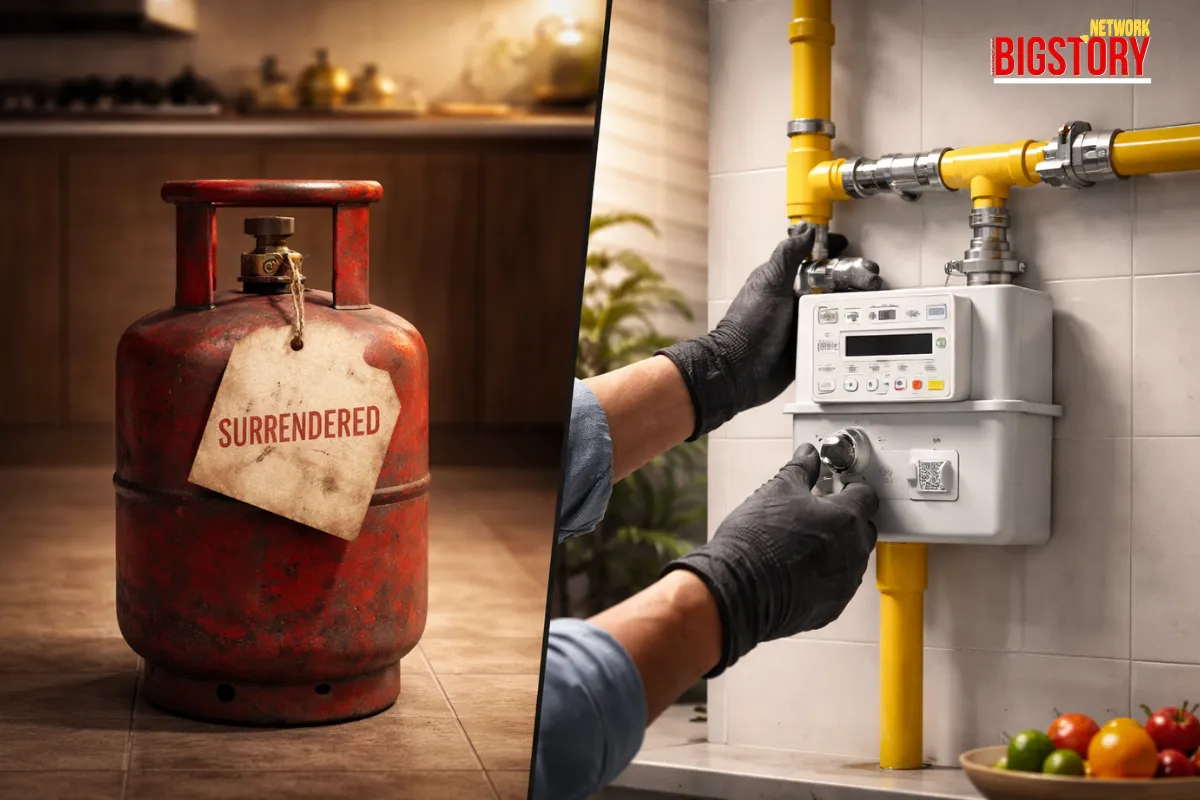
What happened: The Centre has notified the Natural Gas Distribution Order, 2026, making it mandatory for urban households to switch to Piped Natural Gas (PNG) where available.
Why it happened: With the Strait of Hormuz blockaded due to the US-Israel-Iran war, India is reallocating its scarce, imported LPG cylinders to rural areas and forcing urban users onto domestic pipeline networks.
The strategic play: If your home is in a PNG-ready area, your LPG supply will legally cease after three months of notification. Dual connections (LPG + PNG) are now prohibited and must be surrendered immediately.
India's stake: This "PNG First" policy aims to rapidly decouple India's major cities from volatile Middle Eastern oil politics, ensuring energy security for 12.6 crore households by 2034.
The deciding question: Will urban housing societies cooperate with the 48-hour installation timelines, or will the three-month cutoff trigger a new wave of urban energy anxiety?
The Indian government has officially weaponized the escalating Middle East energy crisis to force a permanent, structural shift in the nation’s kitchens. On Tuesday night, the Ministry of Petroleum and Natural Gas invoked the sweeping powers of the Essential Commodities Act, 1955, to notify a landmark order that effectively ends the era of "dual fuel" for urban India.
The directive is blunt: if you live in an area covered by a functional gas pipeline, you must move to Piped Natural Gas (PNG) within 90 days, or your traditional LPG cylinder supply will be permanently cut off.
This drastic measure is not just about modernization; it is an act of geopolitical triage, designed to instantly recover millions of LPG cylinders from "gas-ready" cities and reallocate them to rural regions as the blockade of the Strait of Hormuz chokes India's vital energy imports.
The newly notified Natural Gas and Petroleum Products Distribution (Through Laying, Building, Operation and Expansion of Pipelines and Other Facilities) Order, 2026 treats the rollout of urban gas pipelines with the same urgency as wartime defense logistics.
Speaking on the rapid rollout, Oil Secretary Neeraj Mittal stated, "A crisis has been turned into an opportunity... the order addresses longstanding challenges in infrastructure development and regulatory uncertainty."
Ministry of Petroleum and Natural Gas (MoPNG) The driving force behind the mandate. With PM Modi having recently called the West Asia oil crisis 'worrisome' in the Lok Sabha, the Ministry is utilizing the Essential Commodities Act to bypass decades of urban red tape and force immediate compliance from both consumers and local governments.
City Gas Distribution (CGD) Entities Companies like IGL, MGL, and GAIL Gas are now empowered—and heavily pressured—to execute an impossible logistical mandate. They are expected to add an estimated 15 lakh new PNG connections in the next two weeks alone to meet the government's emergency targets.
PNGRB (Petroleum and Natural Gas Regulatory Board) The designated nodal agency monitoring the implementation. They will track approvals and compliance across the country to ensure the transition doesn't stall in bureaucratic limbo.
Mainstream media is currently focusing on the "threat" aspect of the mandate—that cylinders will be cut off—and the logistical nightmare this poses for older apartment buildings in dense urban areas like Mumbai and Kolkata.
However, the true "Missed Angle" is the deliberate destruction of India's "LPG Backup" culture. For decades, urban middle-class Indians have kept a single, heavy red LPG cylinder hidden in their kitchens as a backup to their modern PNG meter, fearing a pipeline failure.
This new order effectively makes that practice illegal. By mandating the immediate surrender of LPG connections for PNG-enabled addresses, the government is performing a massive, nationwide "resource recovery." These millions of recovered cylinders aren't just empty metal; they represent an immediate injection of energy security for rural India, where the cost and availability of a cylinder have become a flashpoint for political unrest.
If the pipeline reaches your door, your cylinder is gone. The era of energy abundance in urban India is officially over; the era of energy efficiency has been mandated by law.
 Exclusive Content


Sign up for the Daily newsletter to get your biggest stories, handpicked for you each day.


 Trending Now! in last 24hrs


