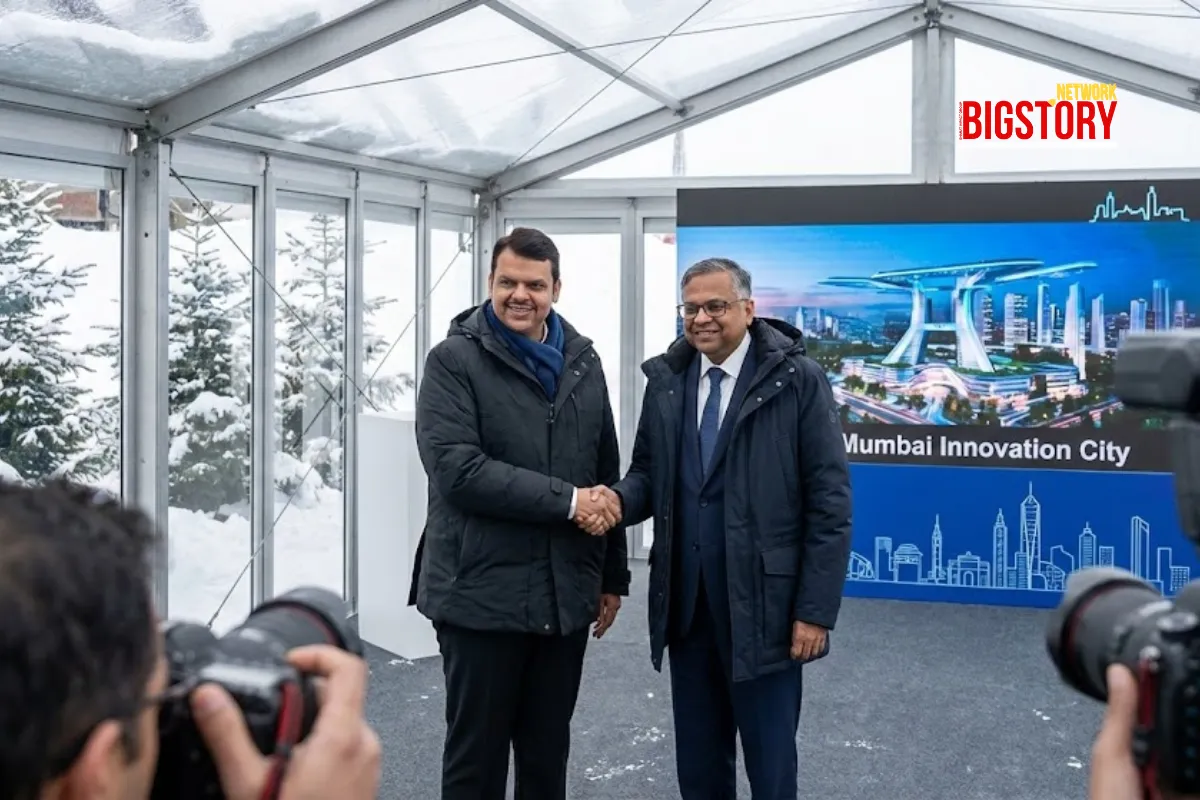
In a move that redefines India's commercial geography, Maharashtra Chief Minister Devendra Fadnavis announced today, January 22, 2026, at the World Economic Forum in Davos that Tata Sons will invest $11 billion to build a dedicated "Innovation City" near the upcoming Navi Mumbai International Airport. This project serves as the anchor for a staggering $96 billion (approx. ₹8.7 lakh crore) investment basket secured by the state on Day 1 of the summit.
The announcement signals a decisive branding shift for Mumbai. Long established as the country’s financial capital, the city is now making its most aggressive bid to claim the "Deep Tech" mantle. The new Innovation City is designed as a plug-and-play ecosystem for AI, data centers, and semiconductor R&D, positioning Navi Mumbai as a direct rival to established tech hubs like Bangalore and Hyderabad.
The Context (How We Got Here)
- The Trigger: The impending completion of the Navi Mumbai International Airport (developed by the Adani Group) has unlocked a new logistical corridor. The state government is leveraging this transit hub to create a high-value "Third Mumbai" economic zone.
- The Background: Tata Group has been aggressively pivoting toward deep tech, with recent semiconductor bets in Gujarat and electronics in Assam. This Mumbai project consolidates their R&D backbone close to their headquarters.
- The Escalation: In late 2025, Maharashtra proposed the "AI and Innovation Ecosystem" concept. Today's formal announcement confirms the scale and location, targeting a $1 trillion state economy roadmap.
The Key Players (Who & So What)
- Devendra Fadnavis (CM, Maharashtra): The government driver. He framed this not just as an infrastructure project but as a shift in identity, aiming to make Mumbai a hub where "anyone in the world can access a plug-and-play innovation system."
- N. Chandrasekaran (Chairman, Tata Sons): The strategist. His "Future Ready" strategy (Digital, AI, Supply Chain) finds a physical home in this project. The choice of Navi Mumbai suggests Tata sees the future of tech requiring robust physical logistics (airport) alongside digital pipes.
- MMRDA (Mumbai Metropolitan Region Development Authority): The executor. Having signed 10 MoUs worth $96 billion, their challenge now shifts from "signing" to "building" the infrastructure required to support nearly 10 lakh new jobs.
The BIGSTORY Reframe (The "Coopetition" Corridor)
While the headline is "Tata Invests," the subtext is the unique neighborly rivalry shaping Navi Mumbai.
- Adani & Tata, Side by Side: The new airport is an Adani asset. The massive Innovation City next door is a Tata project. Two of India's largest, often rival, conglomerates are now anchoring the same critical economic zone.
- From Finance to Physics: For decades, Mumbai meant "Dalal Street" (Finance). This investment marks the birth of the "Silicon Coast." It is not just about IT services (coding); it is about "Deep Tech" and "Data Sovereignty." By placing data centers next to an international airport, Mumbai is copying the "Aerotropolis" model used by global hubs like Dubai and Singapore.
The Implications (Why This Matters)
- Real Estate Earthquake: The announcement validates the "Third Mumbai" thesis. Expect an immediate spike in land prices in the Raigad-Panvel-Ulwe belt. This is no longer speculative; with Tata breaking ground in 6-8 months, the appreciation curve is set.
- The Talent Shift: Until now, Mumbai lost its tech talent to Bangalore or the US. An $11 billion ecosystem creates a "reverse migration" magnet, offering high-end AI and semiconductor jobs within the MMR region for the first time.
- Infrastructure Stress Test: Can Navi Mumbai handle this? A $96 billion influx brings nearly a million workers. Without immediate upgrades to the Trans-Harbour Link (MTHL) connectivity and local metro grids, this dream city could face the same urban choking as the old Mumbai.
The Closing Question (Now, Think About This)
Mumbai has always been the heart of India's money; with this city, is it finally trying to become its brain?
FAQs
- Where will the Tata Innovation City be located? The project is planned for Navi Mumbai, strategically located near the upcoming Navi Mumbai International Airport (NMIA) in the Raigad district, leveraging the new logistical corridor.
- When will construction for the Tata Innovation City begin? According to the announcement at Davos, the project is expected to break ground within 6 to 8 months, aligning with the operational timeline of the new airport.
- What is the total investment secured by Maharashtra at Davos 2026? The state government, led by CM Devendra Fadnavis, secured investment commitments totaling approximately $96 billion (₹8.7 lakh crore) on the first day, with the Tata deal being the flagship.
- What sectors will the Innovation City focus on? The hub is designed as a "plug-and-play" ecosystem focusing on Deep Tech, Artificial Intelligence (AI), Data Centers, and Semiconductor R&D, marking a shift from Mumbai's traditional finance focus.
- How many jobs will these investments create? The total basket of MoUs signed at Davos is estimated to generate approximately 9.6 lakh direct and indirect jobs in the Mumbai Metropolitan Region and surrounding areas.
Sources
News Coverage
Context & Analysis

 Brajesh Mishra
 Exclusive Content