
The Opposition demanded debate. The BJP demanded attendance. Both missed the real question: why Parliament spent March 9 fighting over procedure while a Gulf conflict kills Indians, hikes LPG prices, and puts 1 crore diaspora workers at risk.
 Brajesh Mishra
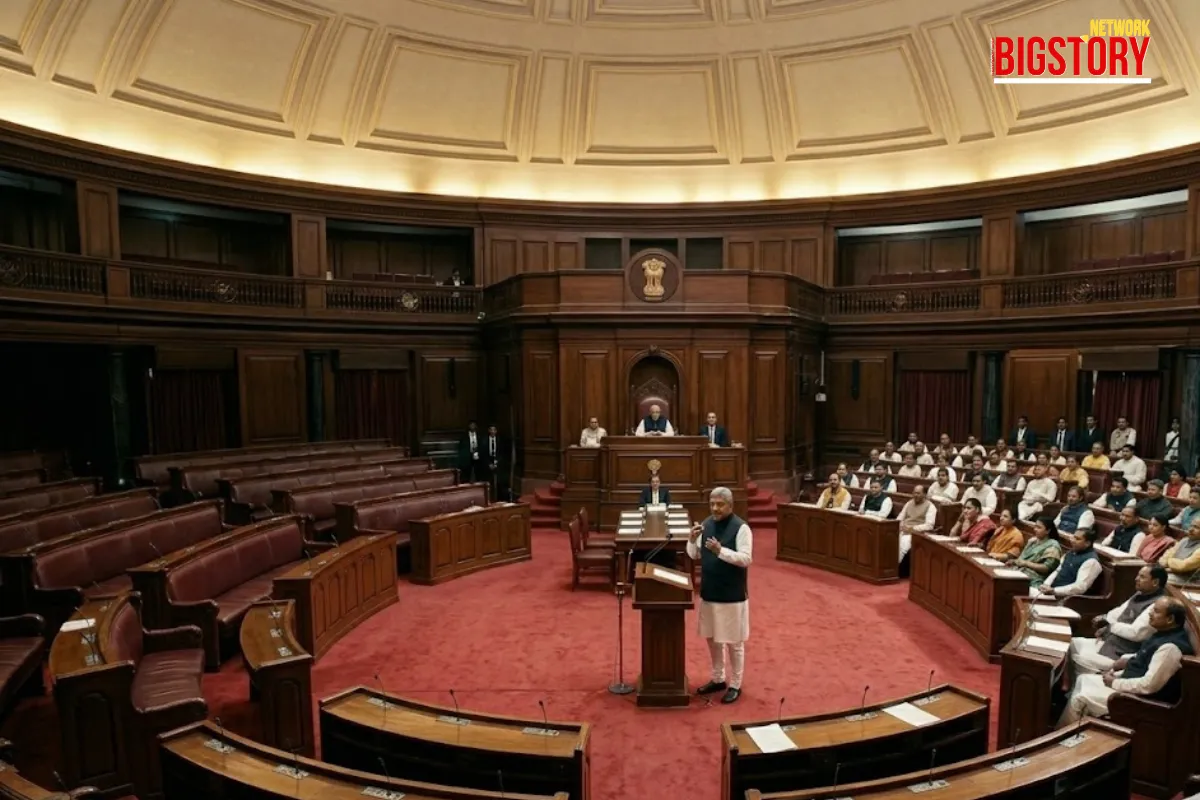
The opposition walkout on Jaishankar's West Asia parliament statement erupted on March 9 when Congress President Mallikarjun Kharge led the entire INDIA bloc out of both the Rajya Sabha and Lok Sabha, moments after External Affairs Minister S. Jaishankar rose to deliver a suo motu briefing on the Gulf conflict. BJP's Leader of the House JP Nadda immediately condemned the exit as "anarchy" and "hooliganism," accusing the Opposition of abandoning Parliament at the country's most critical foreign policy moment. The walkout was not spontaneous. The Opposition had already tabled a request — denied by the Chair — for a short-duration Rule 176 debate on West Asia before Jaishankar's statement proceeded. Their argument: a minister's suo motu statement is a one-way broadcast. No MP may ask questions. No clarification is permitted. With 67,000 Indians already evacuated, two Indian mariners confirmed dead in a Gulf of Oman shipping attack, and LPG prices already up Rs 60, the Opposition argued that Parliament deserved more than a scripted monologue.
On February 28, 2026, joint US-Israeli strikes on Iran killed Supreme Leader Ayatollah Ali Khamenei — the single most destabilising event in the region in decades. India issued a statement urging restraint and the Cabinet Committee on Security convened under PM Modi within 48 hours to assess the fallout for energy supply, Indian community safety, and diplomatic standing with Tehran. Between March 1 and 7, the MEA activated a crisis-response mechanism — special flights, 24/7 embassy helplines across UAE, Saudi Arabia, Oman, Bahrain, Qatar, and Kuwait — and facilitated safe passage for over 52,000 Indians from the Gulf region. Jaishankar personally spoke with Iranian Foreign Minister Araghchi for the second time, describing the bilateral channel as "obviously difficult." By March 9, when Parliament's Budget Session Phase 2 opened, the government's own count stood at nearly 67,000 Indians safely across international borders. On that same morning, the oil tanker Skylight — carrying Indian crew members — was attacked in the Gulf of Oman. Two Indian mariners are dead. One is missing. Jaishankar walked into Parliament to deliver a statement. The Opposition walked out demanding a debate. BJP walked to the cameras to call it treason-adjacent. The two dead mariners received no floor time from any party.
S. Jaishankar, External Affairs Minister, Government of India — Jaishankar authored the government's entire West Asia response: the Tehran calls, the evacuation coordination, the bilateral outreach to Gulf governments. His Parliament statement today was the government's first formal accounting to the legislature of what India has done since February 28. He confirmed the 67,000 evacuation figure, stated that India "favours peace, dialogue, and diplomacy," and described the West Asia situation as "a deep cause for concern." His decision to deliver a statement rather than invite debate reflected the government's preference to control the narrative — and gave the Opposition its procedural grievance on a platter. JP Nadda, Leader of the House, Rajya Sabha; Union Minister; BJP President — Nadda moved fast. Within minutes of the walkout, he was at the microphone calling the Opposition's conduct a betrayal of the Indian people at a moment of national crisis. His statement served a dual political purpose: it deflected scrutiny from the government's refusal to allow debate, and it reframed the story as Opposition irresponsibility rather than government accountability. Calling it "anarchy" and "hooliganism" ensured the television cycle ran with the confrontation angle, not the substance. Mallikarjun Kharge, Congress President; Leader of Opposition, Rajya Sabha — Kharge made the procedural move that triggered the walkout: he formally requested a short-duration discussion on "emerging challenges for energy security and the fast-changing geopolitical situation in West Asia affecting India's energy security." The Chair denied it. The walkout followed. Whether Kharge's gambit helps or hurts depends entirely on whether any Indian voter connects the walkout to the Rs 60 LPG hike already hitting 300 million cooking gas households.
Every outlet today is running a BJP-vs-Opposition procedural fight. Nadda said "anarchy." Jairam Ramesh justified the walkout. The Chair denied the debate request. This is the political theatre both sides scripted — and both sides won their preferred headline. But the fight over format consumed the entire available floor time, and the real accountability questions got no airtime whatsoever. Two Indian mariners are dead. The merchant tanker Skylight was attacked in the Gulf of Oman, and a third crew member is missing. This fact appeared in Jaishankar's statement and received zero follow-up — because the Opposition had left the building and the BJP was busy filming its condemnation. Meanwhile, the Rs 60 LPG price hike landed on Indian households this week as a direct downstream consequence of the West Asia conflict. India imports roughly 55% of its crude from the Gulf. That dependency does not pause for parliamentary procedure. The government's 7–8 week energy buffer — 250 million barrels held in strategic reserves at Mangalore, Padur, and Visakhapatnam — is a holding position, not a solution. Parliament spent March 9 arguing about who should speak, not about what those barrels actually buy India if the conflict deepens.
The immediate economic exposure is concrete: $200 billion in annual India-Gulf trade is directly at risk, LPG prices have already risen Rs 60, and any further supply disruption pushes that number higher. The states most exposed to Gulf remittance disruption — Kerala, Uttar Pradesh, Bihar, Rajasthan — have not received a single government communication about contingency planning. Nearly 1 crore Indians remain in the region. The 67,000 evacuated represent less than 1% of that diaspora. The MEA faces the harder question next: what is the protocol if the conflict reaches the UAE or Saudi Arabia? The current evacuation framework was designed for smaller-scale emergencies — not for the simultaneous extraction of millions from multiple countries at once. Parliament is the correct place to demand that plan. No MP presented one today. Watch the next 7–30 days for: India's third contact with Iranian leadership (the second call was described as "obviously difficult" — the third will define whether India retains any diplomatic leverage in Tehran); any government announcement on fuel pricing in response to the LPG hike pressure; and whether the Speaker grants Opposition a dedicated West Asia debate before the Budget Session closes April 2.
In the next 0–7 days, the political fallout from today's walkout will be fought on television, not in Parliament. BJP will run the "Opposition abandoned India" line through the weekend news cycle. The Opposition will counter with LPG prices and the dead mariners — but only if their communications teams are paying attention to what Jaishankar actually said in that statement. Over the next 1–3 months, the pressure point is energy pricing. If the West Asia conflict persists at current intensity, India's strategic reserves buy eight weeks — after which the government faces a stark choice between subsidising a fuel shock or passing it to consumers. The Finance Ministry and the Petroleum Ministry are the institutions to watch, not Parliament. The India-specific consequence that neither party is talking about: the families of the two dead Indian mariners from the Skylight attack are waiting for government confirmation, repatriation support, and compensation. The MEA has a process. The families need it activated. Parliament had the floor time to demand it today and used none of it. If India cannot use Parliament to ask the government why two of its citizens died in a Gulf shipping lane — and what it plans to do about the 1 crore more still there — what exactly is the Budget Session for?
 Exclusive Content


Sign up for the Daily newsletter to get your biggest stories, handpicked for you each day.

 Trending Now! in last 24hrs


