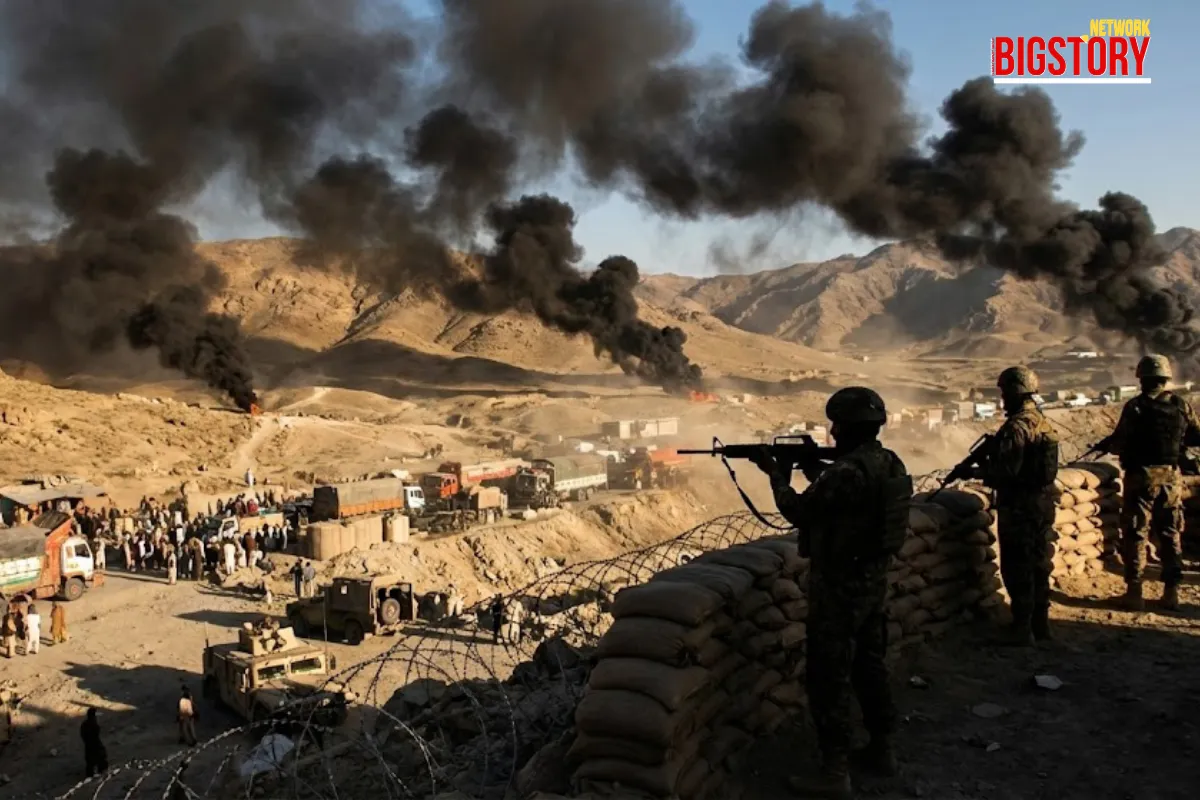
The decades-old geopolitical chessboard of South Asia has just been violently upended. On Friday, February 27, Pakistan's Defence Minister Khawaja Asif took to social media to declare that Islamabad’s patience had officially "reached its limit," plunging the neighboring nations into a state of "open war." Under the banner of Operation Ghazab-Lil-Haqq, Pakistani fighter jets crossed into Afghan airspace, striking high-value military targets in Kabul, Kandahar, and Paktia.
This matters because this is no longer a localized border skirmish; it is a full-scale conventional engagement. The airstrikes were a direct, furious response to a large-scale Taliban offensive that allegedly captured nearly two dozen Pakistani outposts along the disputed Durand Line. By Saturday morning, the situation escalated further, with Afghan forces claiming they had shot down a Pakistani fighter jet over Jalalabad and captured the pilot alive—a flashpoint that threatens to drag the entire region into a prolonged and devastating conflict.
The "BigStory" Angle (The "Strategic Depth" Paradox & Drone Warfare)
Mainstream analysts are viewing this purely as retaliation for Tehrik-i-Taliban Pakistan (TTP) border attacks. They are missing the catastrophic failure of the "Strategic Depth" Doctrine.
For decades, Pakistan's military and intelligence apparatus nurtured allied factions in Afghanistan to secure "strategic depth" against its eastern rivals. Today, that exact policy has inverted. Afghanistan has now achieved "strategic reach" into Pakistan. By utilizing the TTP as a proxy force multiplier, Kabul is able to bleed Pakistani security forces in urban centers, while the conventional Taliban military engages the Pakistani army directly along the 1,640-mile border.
Furthermore, watch the Drone Warfare evolution. On February 27, the Afghan Defence Ministry claimed, for the first time, that "drone units of the Afghan Air Force" successfully struck targets inside Pakistan. If true, this signals a massive technological leap for the Taliban, proving they have integrated advanced unmanned aerial capabilities into their retaliatory strike matrix.
The Context (Rapid Fire)
- The Trigger: On February 21–22, Pakistan conducted "intelligence-based" airstrikes in Nangarhar and Paktika to eliminate TTP hideouts, resulting in at least 13 civilian deaths, according to UNAMA.
- The Backstory: In response, on February 26, the Taliban launched a "large-scale offensive," overwhelming Pakistani border defenses, destroying equipment, and killing dozens of soldiers.
- The Escalation: Pakistan responded with Operation Ghazab-Lil-Haqq, claiming the total destruction of 104 Afghan military posts and initiating direct aerial bombardment of Taliban brigade headquarters in Kabul.
Key Players (The Chessboard)
- Khawaja Asif (The Escalator): Pakistan's Defence Minister, who publicly formalized the conflict by declaring "open war," signaling a shift from covert operations to total military commitment.
- Zabihullah Mujahid (The Defiant): The Afghan Government Spokesman, who characterized the Taliban's massive offensive as a necessary and measured response to repeated Pakistani "rebellions" and violations of Afghan sovereignty.
- Attaullah Tarar (The Messenger): Pakistan’s Information Minister, currently providing real-time operational updates, claiming staggering Taliban casualty figures to bolster domestic morale amid the crisis.
The Implications (Your Wallet & World)
- Short Term (Civilian Evacuations): If you reside in the border provinces of Khyber Pakhtunkhwa (KP) or Balochistan, heed local evacuation orders to designated safe zones immediately. Major border crossings, including Torkham and Chaman, are strictly closed to all commercial and civilian traffic.
- Long Term (Regional Panic): The declaration of "open war" has triggered alarm across neighboring capitals. If the captured pilot situation in Jalalabad is not resolved through rapid diplomatic backchannels, expect immediate, severe disruptions to regional trade routes and airspace closures affecting international flights over South Asia.
The Closing Question
Pakistan spent decades attempting to secure a friendly government in Kabul, only to end up in an open war with them. Can military force solve a border crisis that decades of diplomacy and proxy alliances created? Tell us in the comments.

FAQs
- Q: Why did Pakistan declare "open war" on Afghanistan in February 2026?
- A: Pakistan's Defence Minister declared open war following a massive, coordinated cross-border offensive by Taliban forces on February 26, which captured multiple Pakistani border posts and killed dozens of soldiers in retaliation for earlier Pakistani airstrikes.
- Q: Was a Pakistani fighter jet shot down in Jalalabad?
- A: On February 28, 2026, Afghan military and police claimed to have shot down a Pakistani fighter jet over Jalalabad and captured the pilot alive during the ongoing aerial bombardment, though the situation remains highly volatile.
- Q: What is Operation Ghazab-Lil-Haqq?
- A: Operation Ghazab-Lil-Haqq is the large-scale military counter-offensive launched by Pakistan on February 27, involving direct air and ground strikes on Afghan military targets, including targets in Kabul, Kandahar, and Paktia.
- Q: How many civilians have died in the 2026 Afghanistan-Pakistan war?
- A: While precise numbers are difficult to verify amid the fog of war, the UN mission in Afghanistan (UNAMA) confirmed at least 13 civilian casualties resulting from Pakistan's initial airstrikes on February 21-22 in Nangarhar and Paktika provinces.
Sources: