
Milky Mist dairy, Indian dairy sector, value-added dairy products, cooperative model, dairy business India, paneer business, Amul vs Milky Mist, FMCG strategy India, T Satish Kumar, dairy startup India, premium dairy brands, dairy FMCG, Blinkit dairy products, quick commerce dairy, dairy industry analysis India
 Minaketan Mishra

T. Satish Kumar proved private dairy companies can scale nationally in India—just not by competing with cooperatives on fresh milk. In 1997, he entered a market structurally designed for cooperatives. Rather than fight, he bifurcated it. While cooperatives dominated commodity fresh milk (3-5% margins), Milky Mist owned premium paneer, cheese, ghee (20-45% margins). Same raw milk. Different game. One mega-factory in Tamil Nadu. Scales 22 states nationally without hyper-local logistics. By FY26: ₹3,145 Cr revenue, 31.3% CAGR, 155.6% PAT growth in 2 years. The lesson: great advantage isn't beating incumbents—it's playing a game their incentive structure prevents them from playing.
In an industry built entirely for cooperatives, one man proved the opposite was possible.
Milky Mist Dairy Food is the fastest-growing packaged food company in India among companies with revenue exceeding Rs 1,500 crore, recording a revenue CAGR of 31.26% between FY24 and FY26. But here's what makes this extraordinary: the company delivered a CAGR of 31.3% in revenue, 40.5% in EBITDA, and 155.6% in PAT during the FY24-FY26 period with a FY26 EBITDA margin of 13.7%.
The anomaly isn't just the numbers. It's that Milky Mist Dairy Food Limited was formed in 1997 by T. Sathish Kumar, an entrepreneur who entered a market fundamentally designed to exclude his business model. He didn't disrupt the sector. He bifurcated it. He looked at the game cooperatives dominate and chose to play an entirely different one.
This is the story of how structural traps become escape routes—and what every business student should learn from it.
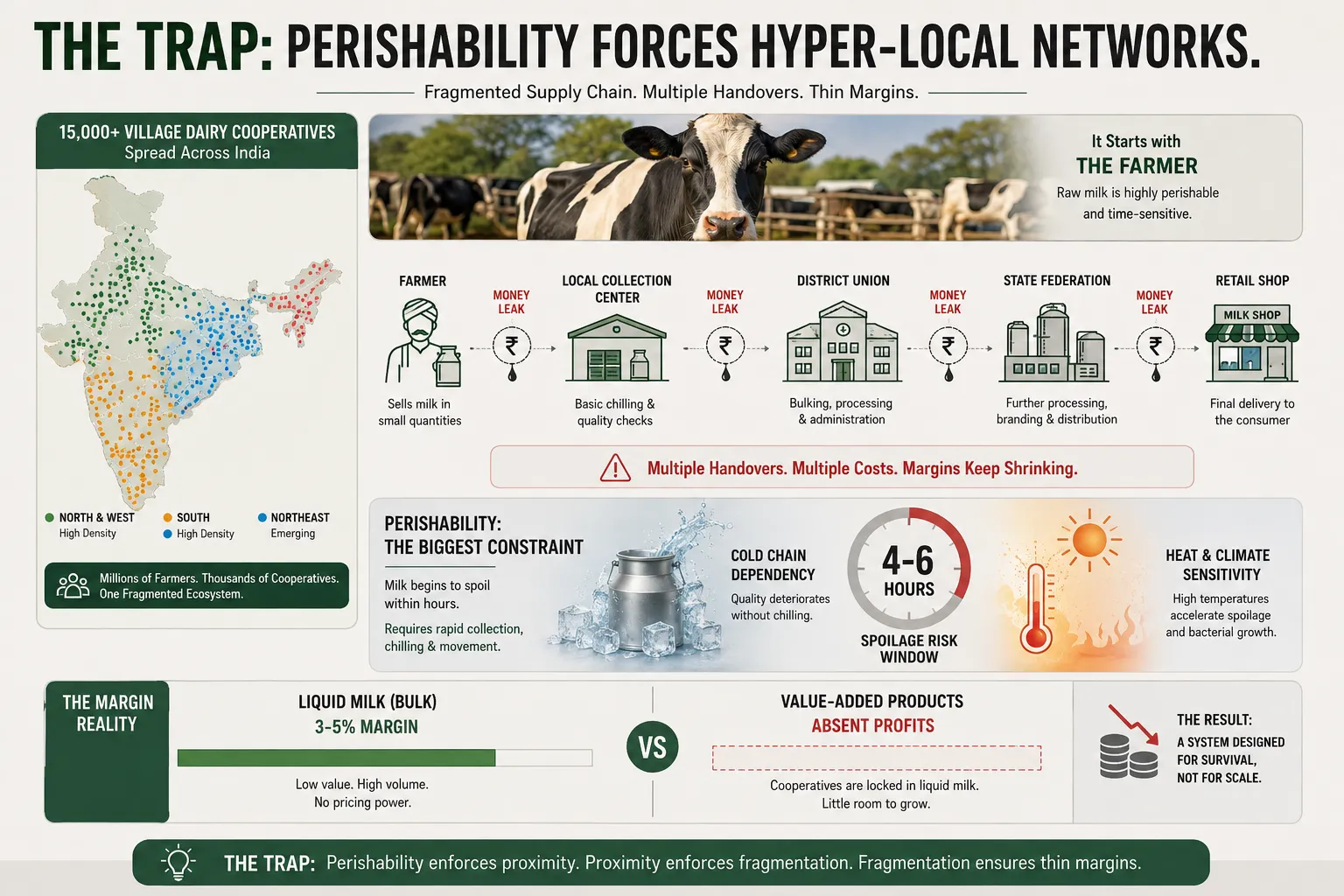
India's dairy sector is a success story that obscures a brutal truth: private companies cannot compete on fresh liquid milk. This isn't a market preference. It's physics and economics colliding.
About 37 million litres per day of liquid milk are sold and this milk is provided by the cooperatives. Organised cooperatives cover almost 15,000 villages and have almost 6 lakh members. This network isn't accidental. It's a structural necessity.
Here's why: milk spoils in 4–6 hours without refrigeration to 4°C. That perishability creates a geography trap. A dairy company can't centralize production and ship nationally. It must operate hyper-local cold chains—procurement from scattered farms, daily cold delivery to scattered retail. The infrastructure is massive, and the margins are razor-thin.
For public processors, VAPs often yield margins 2–3 times higher than plain milk. But liquid milk margins? Milky Mist's net margin of 3.3% (adjusted for MAT) is in-line with peers 3.3% to 5%. On liquid milk. On fresh milk alone, the economics are brutal.
Cooperatives survive this because they aren't profit-maximizing entities. AMUL takes a farmers-first approach: it supports farmers by returning 85% of every rupee earned on a product back to them. This rate is higher than the global average of 33%. They can afford thin margins because surplus is redistributed to members, not extracted as shareholder profit.
Private companies cannot do this. They need shareholder returns. On 3–5% margins, on a logistics-intensive business, that's mathematically impossible.
This is the trap. Cooperatives own it not because they're better operators—they own it because the business model forces a cooperative structure.
Key Learning for Students: When a market structure appears permanent, ask whether it's culture or constraint. If it's constraint—if physics, regulations, or unit economics force a particular structure—then the market itself isn't trapped. The model within that market is. And that model can be escaped.
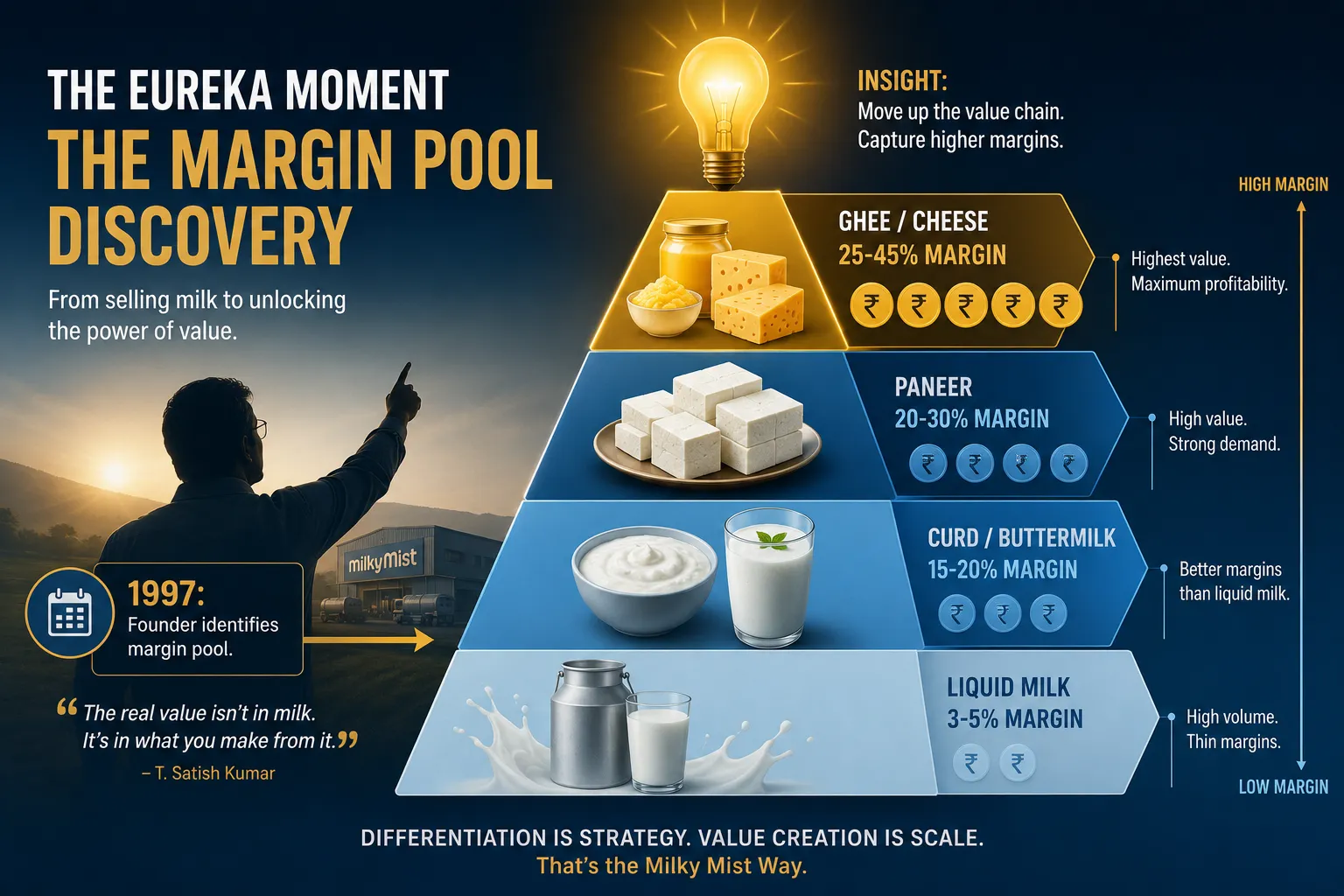
T. Satish Kumar entered dairy in the late 1990s with a straightforward question: If cooperatives own fresh milk, where is the margin?
He discovered it had moved upstream. Into products.
Milky Mist's model can ultimately be understood as a value-creation chain: Procure milk directly from farmers → manufacture value-added products → control cold-chain logistics → build branded retail visibility → command premium pricing → introduce more categories through the same distribution infrastructure.
The numbers are stark:
Same raw material. Same starting point. But different end point, and therefore different profit pool.
This is margin arbitrage at its simplest. Not innovation. Not technology disruption. Just asking: Where does the money actually live in this value chain?
The insight wasn't just numerical. It was categorical. It is exclusively focused on value-added products within the dairy market, which are considered premium. It focuses on value added dairy products, which aligns more closely with fast-moving consumer goods ("FMCG") companies than traditional dairy businesses in terms of gross margins, distribution model and premium pricing.
Milky Mist wasn't a dairy company. It was an FMCG company that happened to use dairy as its raw material.
Key Learning for Students: When incumbents own one segment (cooperatives own fresh milk), don't fight them. Find the adjacent segment they can't compete in by design, and own that instead. Cooperatives optimize for farmer welfare and member redistribution. They can't build premium FMCG brands efficiently. That's not their DNA. It's Milky Mist's entire operating model.
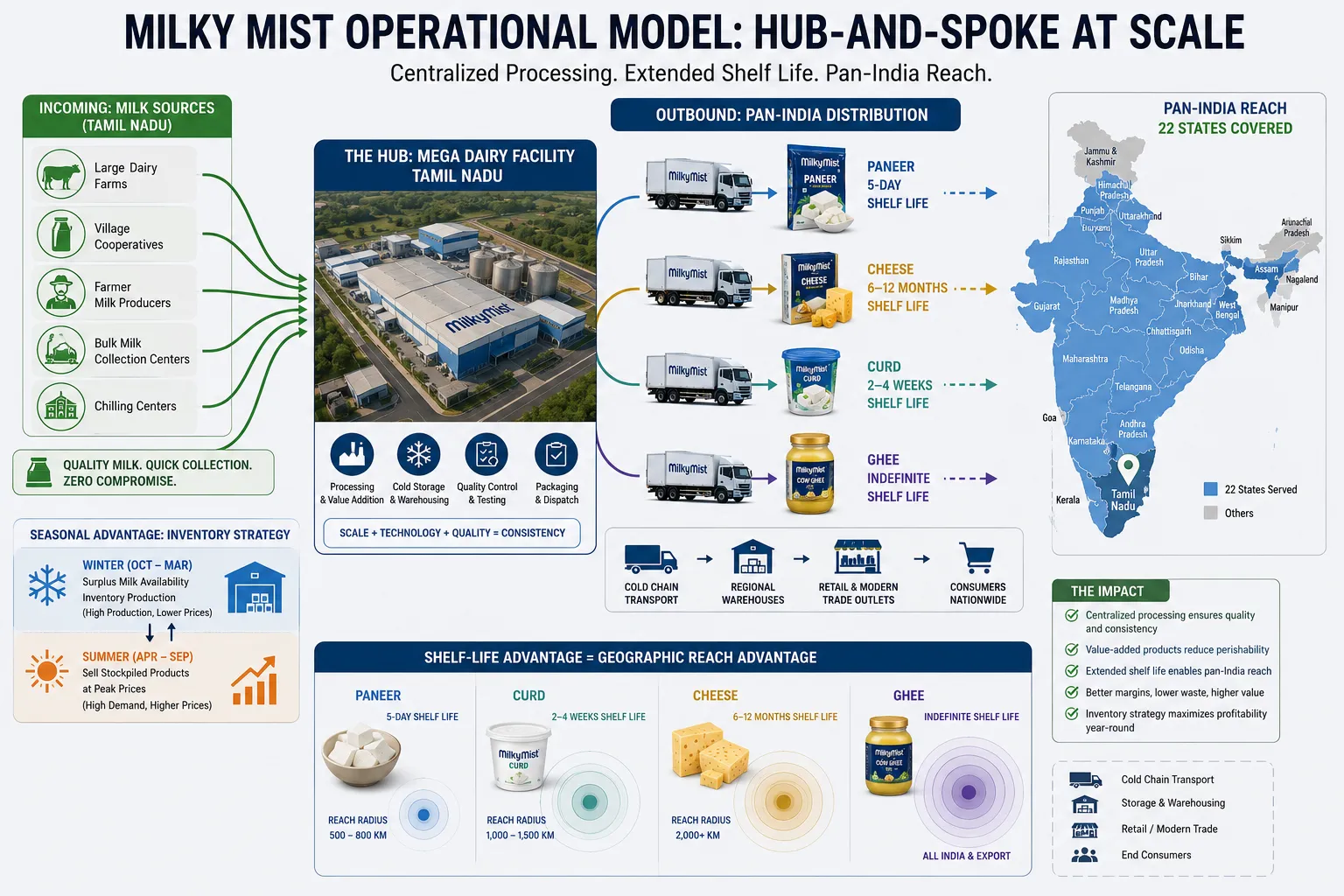
Fresh milk is perishable. Therefore, the cooperative model is hyper-local. A dairy union in Gujarat can't sell milk in Tamil Nadu. Spoilage and cost make it impossible.
Paneer is shelf-stable for 5 days in retail conditions. Cheese lasts 6–12 months. Ghee lasts indefinitely. Curd lasts weeks.
This shelf-life decoupling is the entire business model.
Milky Mist Dairy Food Limited is a Tamil Nadu–headquartered packaged food company, expanded revenue from operations at a 31.26% CAGR from Fiscal 2024 to Fiscal 2026 (Source: 1Lattice Report). The Company is the fastest growing packaged food company in India among firms with revenue scale above ₹1,500 Crore, expanding revenue from operations at a 31.26% CAGR from Fiscal 2024 to Fiscal 2026.
One facility in Tamil Nadu. Serves 22 states. The company derives a significant majority of its revenue from South India, comprising Kerala, Tamil Nadu, Karnataka, Andhra Pradesh and Telangana, which collectively contributed 69.23% of revenue from operations in Fiscal 2026. Although the company is pursuing a pan-India expansion strategy, the model is designed to scale nationally precisely because the products don't spoil.
But the model has a second genius layer: inventory arbitrage.
Milk supply varies seasonally. In winter, supply peaks. Farmers have fat cattle on abundant fodder. Prices collapse. In summer, supply drops. Prices spike.
A traditional dairy is trapped by this. You can't force consumers to drink more milk in winter.
Milky Mist uses winter surplus to manufacture paneer, curd, ghee—products that last. You stockpile them at low input cost. In summer, when milk is scarce and prices rise, you sell the inventory at higher wholesale prices because demand is up and supply is down.
This is classic inventory economics. But it's invisible to cooperatives because they optimize for daily milk flow, not product accumulation.
Here's where the model becomes unbeatable:
A liter of milk costs ₹30–40 to source and process. Retail price: ₹32–42. Margin: 5–8%.
One kilogram of paneer requires ~1.3 liters of milk. Input cost: ~₹50. Retail price: ₹150–180. Margin: 25–30%.
Same raw material. 5x better profit per unit. Now scale volume—procurement increases, per-unit operational cost drops—and the math becomes self-reinforcing.
Paneer contributes 29.4 per cent of revenue, while paneer, cheese and curd together account for 59 per cent. The portfolio is diversified, but premium VAP drives the business.
Cooperatives could build VAP brands. In theory. But they don't, because their mandate is farmer welfare first. Building premium brands requires:
None of these fit the cooperative DNA. They optimize for volume, member payouts, and stable supply. Milky Mist optimizes for margin, inventory turnover, and brand moat.
Key Learning for Students: When you can't beat incumbents at their game, flip the game. Here: margins exist in perishables if you eliminate perishability. Incumbents can't follow you because the structural constraints of their business model (member welfare, local focus) prevent them. That's your moat, not your constraint.
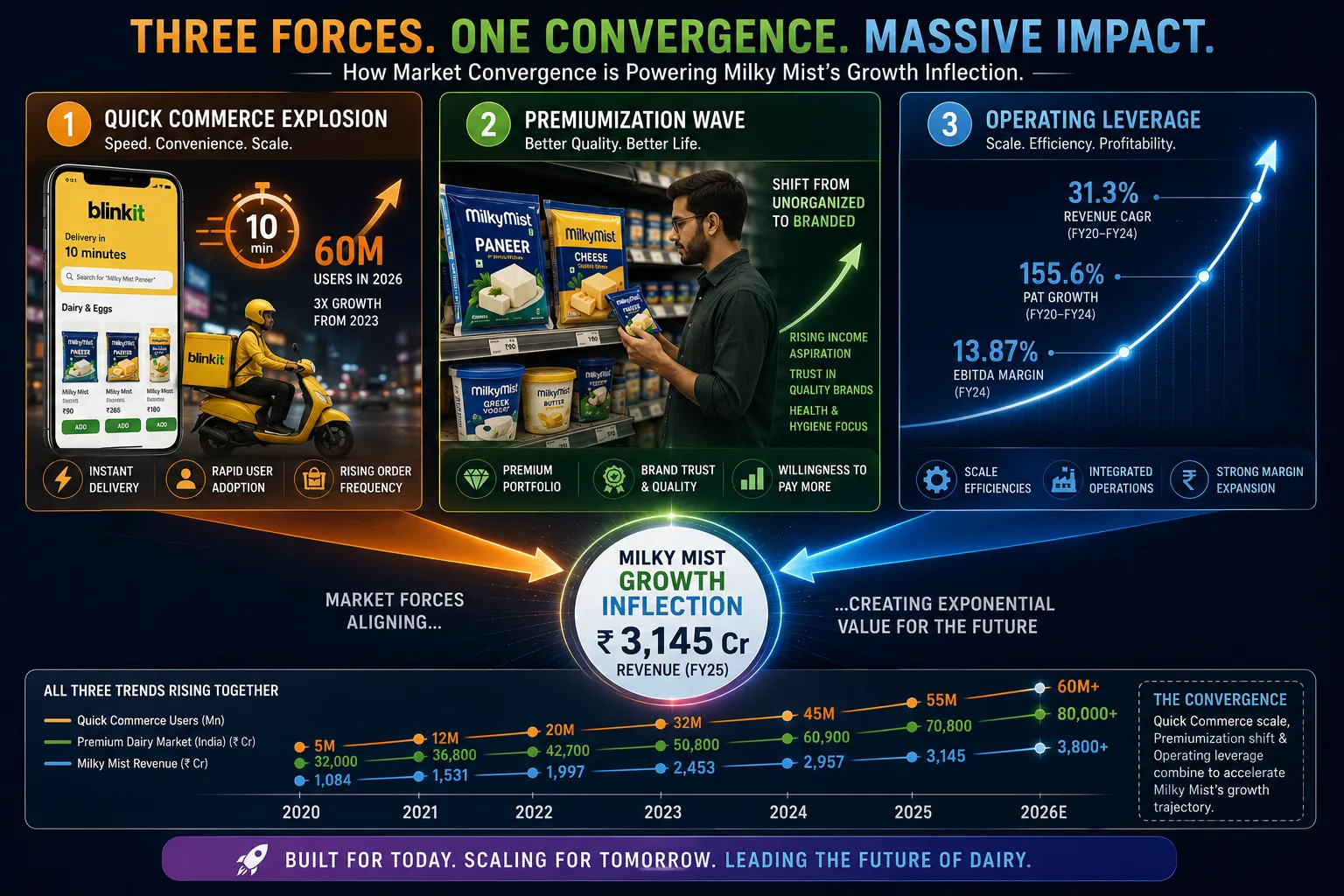
Nothing Milky Mist had built mattered until the market changed.
In 2024, the spotlight was on quick commerce. The wind was behind its sails as the sector saw rapid growth propelled by widespread consumer adoption in metros and capital flooding to support innovation. India's quick commerce market projects a 17% growth rate in 2025, the fastest globally. Its quick commerce sector will create 2.4 million blue-collar jobs by 2027.
For dairy, this is transformative. Dairy products online are among the highest selling products on Blinkit and other quick commerce platforms India. Milk, curd, butter, cheese, paneer, and yogurt are frequently ordered through daily essentials delivery apps because freshness is important.
But here's the asymmetry: liquid milk is harder to deliver via quick commerce. It's bulky, heavy, and truly perishable. Paneer, cheese, curd—Milky Mist's core products—fit quick commerce perfectly. They're shelf-stable, lightweight, high-value (can justify delivery cost), and ordered frequently.
Bernstein Research estimates that India's quick commerce user base crossed 60 million monthly active users in early 2026, with average order frequency rising from 3.2 orders per month in 2024 to 5.8 orders per month by late 2025.
Quick commerce didn't just create a new channel. It changed consumption patterns. Consumers who once bought paneer weekly now buy it 2–3 times per week. Higher frequency. Higher volume.
In parallel, urban India is shifting away from unorganized dairy toward branded, hygienic, packaged products.
Return on Equity (ROE): Expanded dramatically from 15.11% in FY25 to 32.12% in FY26. EBITDA Margins: Steady expansion from 11.8% in FY24 to 13.87% in FY26, driven by favorable product mix and operational scale.
This is the signature of a company operating in a growing market segment while benefiting from operating leverage. Milky Mist's infrastructure is built to scale. Each incremental unit of paneer costs less to produce because fixed costs (the mega-factory, logistics hub, cold chain) are amortized over more volume.
The numbers tell the story. Profit After Tax (PAT) Growth: Scaled >6x in two years, jumping from ₹19.44 crore in FY24 to ₹127.01 crore in FY26.
PAT growing faster than revenue. This is the signature of a company hitting inflection—where the business model is finally getting the market conditions it was built for.
Milky Mist's FY2025 revenue from operations of Rs. 2,349.50 crore can broadly be understood as: Revenue from operations increased at a 29.82% CAGR between FY2023 and FY2025, from Rs. 1,394.18 crore to Rs. 2,349.50 crore.
The inflection is real. Quick commerce + premiumization + operating leverage = exponential profit growth.
Key Learning for Students: Great businesses need two things: a good model and the right market timing. Milky Mist's model existed in 2000. It didn't scale until 2020+, when quick commerce and organized retail matured. The lesson: build for the inflection, but don't expect overnight results. Satish Kumar invested for 15+ years before the tailwinds arrived. That's founder patience.
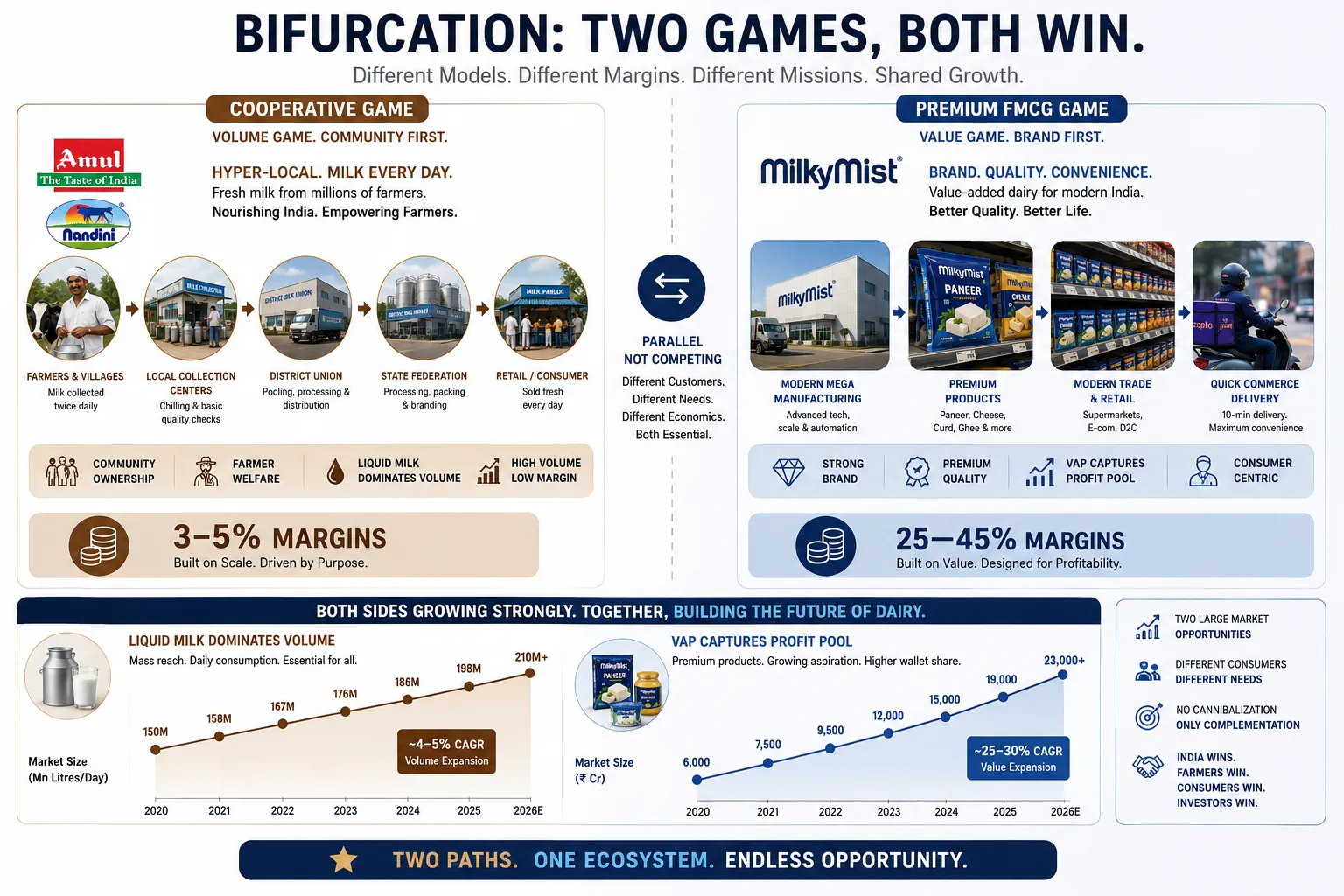
The most common framework for competitive strategy is disruption: find an incumbent, introduce new technology or lower costs, capture share.
Milky Mist didn't do that. It didn't disrupt cooperatives. It bifurcated the market.
Cooperatives own liquid milk: commodity, thin margins, hyper-local, low-branded. Milky Mist owns premium VAP: branded, high-margin, national, FMCG. They coexist because they serve different segments.
Milky Mist's 31.3% revenue CAGR is much faster than Dodla's 14.89%, Bikaji's 13.37%, and Nestle India's 8.79%. Its 13.87% EBITDA margin is also well above Dodla's 7.48% and Parag's 8.12%.
The inflection: as organized retail grows from 20% to 40% of India's dairy market, VAP becomes the growth engine. Cooperatives remain dominant in liquid milk volume. But Milky Mist captures the profit pool in categories cooperatives can't (or won't) compete in.
It commands leadership positions across several premium categories: the largest private packaged paneer brand in the organised market (~19.0% market share), the largest private packaged cheese brand in South India with 12% market share.
This share isn't from disrupting cooperatives. Cooperatives don't make branded paneer. They make milk and commodity butter. Milky Mist is competing with fragmented, unorganized paneer producers—small dairies, regional brands, neighborhood paneer makers.
The moat: brand, distribution reach, capital for cold-chain, and supply consistency. Things that small producers can't build.
Could Amul launch a competing paneer brand? Technically, yes. Realistically, no.
Amul's DNA is built around farmer-member economics. Margins on VAP are meaningless if they require expensive brand-building, national logistics, and premium positioning. Amul's member farmers want volume, not luxury pricing.
Building a national premium brand is orthogonal to cooperative economics. So they don't do it. And that's fine—they own the larger market (liquid milk) where cooperatives have unbeatable advantages.
Key Learning for Students: Incumbent moats aren't just about scale or cost. Often they're about organizational DNA and incentive structure. Cooperatives can't build FMCG brands efficiently because their members benefit from volume payouts, not margin expansion. This isn't a weakness in the cooperative model. It's a design feature. But it's your competitive advantage—a game the incumbents can't play even if they tried.
When Satish Kumar entered dairy, he didn't see an unsolvable problem. He saw a solvable structure.
Fresh milk margins are thin because perishability forces hyper-local logistics. Cooperatives are necessary because private companies can't survive on 3% margins and hyper-local cost.
Most founders see this and exit. Satish Kumar asked: What if I don't compete on fresh milk?
Your Move: Pick a "trapped" sector—real estate (regulation), healthcare (insurance), agriculture (commodity prices). Map the trap ruthlessly. Is it regulation? Physics? Unit economics? Or organizational structure? When you understand the why, the escape route becomes obvious.
The market (India's dairy) is structurally cooperative. The business model isn't.
Milky Mist proved you can operate in a cooperative-dominated market without being a cooperative, by competing in a different segment.
Most founders conflate market structure with possibility. They see "cooperatives own dairy" and think "private companies can't win in dairy." False. Private companies can't win in liquid milk. They can absolutely win in premium VAP.
Your Move: Map the market structure (who dominates, how, why). Then identify segments the structure doesn't favor. That's your segment. That's where you build.
Before you innovate, ask: Where is the profit pool today? Who's ignoring it? Why?
Paneer makers earn 25–30% margins. Liquid milk sellers earn 3–5%. Same input. Different output. Difference of 20 percentage points.
Milky Mist built the entire company on that observation. Not on technology. Not on efficiency. Just on margin geography.
Your Move: Create a spreadsheet. Map profit margins across the value chain. Find the gap where profit exists but is being ignored. Build a company there.
Perishability locks cooperatives into hyper-local geography. Shelf-stability unlocks national reach.
Look for product characteristics—perishability, weight, legal compliance, seasonality—that limit competitors. Can you flip them? That's your moat.
For dairy: move from perishable to shelf-stable, unlock national scale.
For fresh food: add preservatives/packaging, same unlock.
For software: move from on-premise to cloud, unlock reach.
Your Move: What product characteristics limit your competitor's geography or operating model? Can you change the characteristic? That's your business model.
Quick commerce didn't exist in 2000. If Satish Kumar had needed to wait for quick commerce, he'd have failed.
But he didn't need it. He needed a growth inflection. Quick commerce is just one. Premiumization works. Modern retail works. Direct-to-consumer works.
The point: build the right model and stay patient for the market to catch up. The two together create acceleration.
Your Move: Ask yourself: what market change (regulation, technology, consumer shift) will make my model work? When might it happen? Build in expectation of that change. When it arrives, you'll have years of operating runway ahead of everyone else.
The deepest insight: Amul and Nandini aren't your competitors. Fragmented, unorganized paneer makers are.
This frees you from the trap of fighting incumbents. You're not trying to out-cooperate the cooperatives. You're building a consumer goods company that happens to use milk.
Incumbents' advantages (farmer networks, local distribution, member relationships) are irrelevant in your segment.
Your Move: When you enter a market with dominant incumbents, don't fight them on their turf. Find a segment where their advantages don't apply. Build for that segment. Let them stay in theirs.
Milky Mist's founder didn't invent a new market. He identified that a single market had two games inside it:
Satish Kumar chose to own Game 2. Let cooperatives keep Game 1. Both businesses can scale without cannibalizing each other.
This pattern—bifurcation instead of disruption—repeats in India's most interesting business problems.
Real estate: cooperatives own affordably-priced apartments; private developers own luxury. Both scale.
Agriculture: commodity crops stay unorganized; branded seeds/fertilizers go premium. Both coexist.
Education: government schools own mass education; private schools own premium. Both exist.
The pattern is: when a market appears trapped, look for the bifurcation line—the segmentation where incumbents can't compete and profit lives elsewhere. Build on the other side of that line. Let the incumbents keep their game.
The Milky Mist case teaches three foundational principles:
First: Structural traps look permanent until you realize they're not. Cooperatives didn't trap private companies from dairy. They trapped private companies from fresh milk. Different thing entirely. When a market seems impossible, ask what market you could actually compete in.
Second: The margin pool always moves. In mature industries, profit doesn't live where revenue lives. It lives upstream or downstream, in value-added services, in premium segments, in adjacent categories. Find the margin. Build the company. Volume and market share will follow.
Third: Great competitive advantage is rarely about beating incumbents. It's about playing a game they can't. Cooperatives could make branded paneer. But their organizational structure makes it irrational. Your moat isn't fighting them better. It's doing something their incentives prevent them from doing.
Milky Mist's founder proved all three over 28 years. He didn't disrupt India's dairy sector. He bifurcated it. He saw the game cooperatives couldn't win and spent three decades building the company to own it.
That's the playbook for India's most interesting businesses.
Background & Founding: T. Sathish Kumar founded Milky Mist Dairy Food Limited, headquartered in Erode, Tamil Nadu, India. Beginning operations in the late 1990s, Kumar identified the margin opportunity in value-added dairy products while the sector remained locked in commodity fresh milk.
Vision: Kumar's strategy was deliberate: avoid competing with cooperatives on their home turf (fresh milk) and instead build infrastructure to own premium packaged dairy—paneer, cheese, curd, ghee, and ice cream.
Scaling: The company generated Rs. 2,349.50 crore of revenue from operations in FY2025, compared with Rs. 1,394.18 crore in FY2023, validating a 28-year vision.
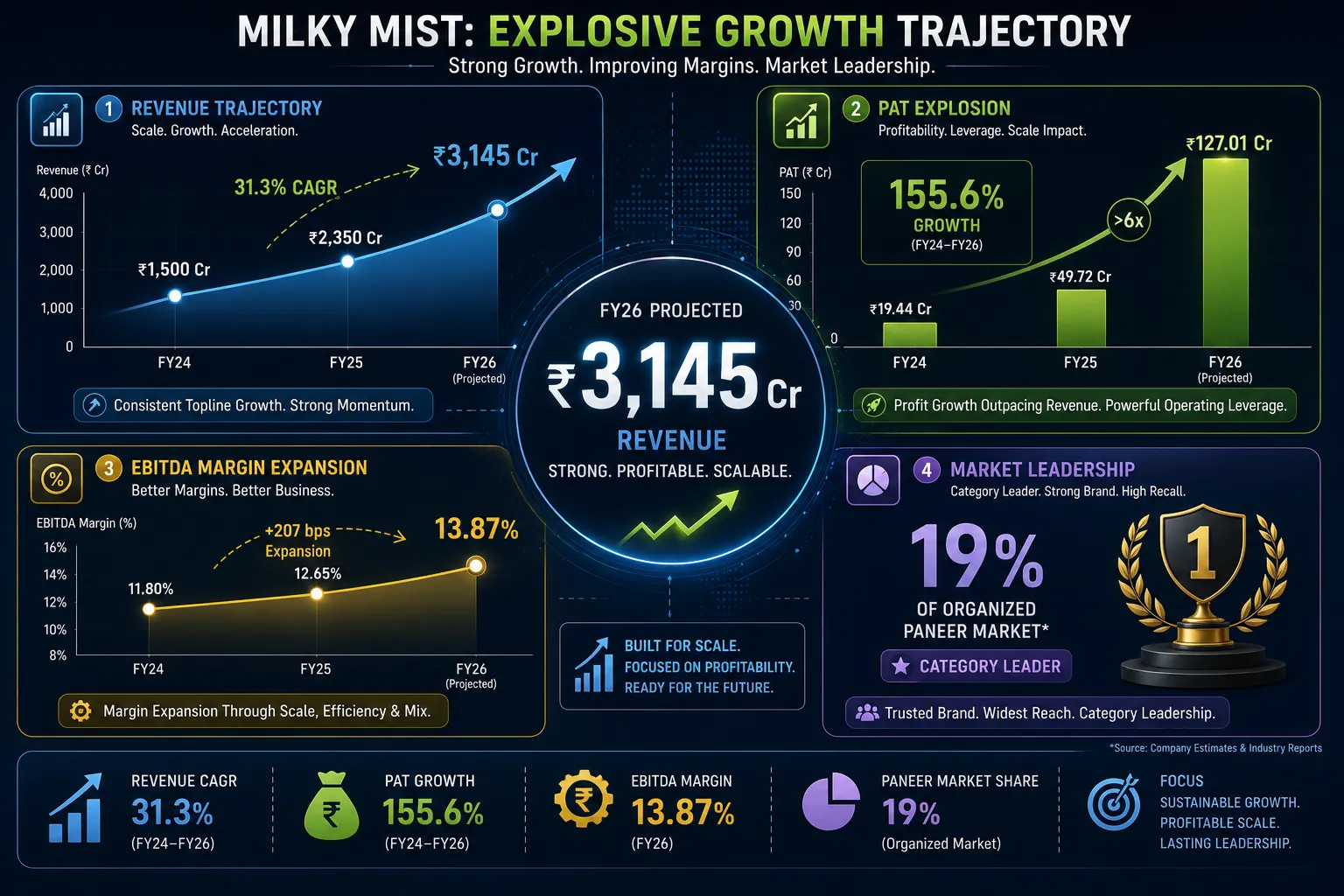
Revenue Growth: FY24 (~₹1,500 Cr) → FY25 (~₹2,350 Cr) → FY26 (~₹3,145 Cr). CAGR: 31.3%
EBITDA Margin Expansion: FY24 (11.8%) → FY25 (12.5%) → FY26 (13.87%). Net improvement: +207 basis points.
Profit After Tax (PAT) Explosion: FY24 (~₹19.44 Cr) → FY25 (~₹54.5 Cr) → FY26 (~₹127.01 Cr). Growth: >6x in 2 years. PAT growing faster than revenue signals operating leverage and inflection.
Return on Equity (ROE): FY25 (15.11%) → FY26 (32.12%). Expansion: +1,701 basis points. Indicates capital efficiency and profitability acceleration.
Paneer Market Share: ~19% of India's organized packaged paneer market. Leadership position in premium category where cooperatives have minimal presence.
Milky Mist's inflection is real. The company isn't just growing; it's compounding. Fixed costs (mega-factory, cold chains, brand) are being amortized over exponentially growing volumes.
The question isn't whether Milky Mist will continue growing. Market tailwinds (quick commerce, premiumization, organized retail growth) are structural. The question is whether the company can maintain margins as it scales nationally.
Regional concentration remains a risk. The company derives a significant majority of its revenue from South India, comprising Kerala, Tamil Nadu, Karnataka, Andhra Pradesh and Telangana, which collectively contributed 69.23% of revenue from operations in Fiscal 2026. Expanding into North and East India requires new infrastructure, new brand-building, and new supply chain relationships.
But the model is proven. The playbook is clear. The market is aligned.
In a sector built for cooperatives, a private founder didn't fight. He found a different game. 28 years later, he built a ₹3,100 crore company that doesn't compete with cooperatives—it complements them.
That's not disruption. That's bifurcation. That's the pattern to remember.
 Exclusive Content


Sign up for the Daily newsletter to get your biggest stories, handpicked for you each day.



 Trending Now! in last 24hrs


